Facebook
 Google
 GitHub
 Linkedin
Hi there!
How would you go about finding the short circuit (s.c.) current \(I_{ab} \) and the open circuit (o.c.) voltage \(V_{ab} \) in order to calculate the equivalent resistance as seen from the terminal ab?
\( R_{ab} = \frac{V_{o.c.}} {I_{s.c.}} = \frac{V_{ab}} {I_{ab}} \)
I have been trying to use the node voltage method for the s.c. case with node c as the principal node and node d as reference. This does not give the correct result.
Is it correct to assume then that the voltage at point c is always 20 V?
Is it correct to assume that the voltage at point a is always 12 V?
Would it be better to assume that there are 2 principal nodes c and d and the reference node e when using the node voltage method?
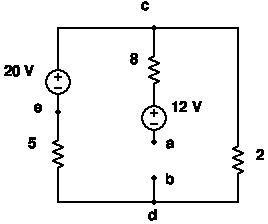
How would you go about finding the short circuit (s.c.) current \(I_{ab} \) and the open circuit (o.c.) voltage \(V_{ab} \) in order to calculate the equivalent resistance as seen from the terminal ab?
\( R_{ab} = \frac{V_{o.c.}} {I_{s.c.}} = \frac{V_{ab}} {I_{ab}} \)
I have been trying to use the node voltage method for the s.c. case with node c as the principal node and node d as reference. This does not give the correct result.
Is it correct to assume then that the voltage at point c is always 20 V?
Is it correct to assume that the voltage at point a is always 12 V?
Would it be better to assume that there are 2 principal nodes c and d and the reference node e when using the node voltage method?