how to charge 12v battery with 10v charger

Thread Starter

Hedi Hadi

Joined Aug 16, 2017
2
hi, i'm working with diy 30.000mah battery bank 12v, i want to charge it with 10v charger, i used a diode to keep it going into the charger but instead charging it the charger sucked all the battery power, can i use capacitor to get higher than 12v? or only boost converter helps me?

thanks for helping :)
 

DickCappels

Joined Aug 21, 2008
10,661
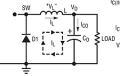
I think that it would be possible to charge a low ESR capacitor across the 10V source then switch the capacitor so that it is in series with the 10V source to make 20V for a moment, the 20V is then applied to what would resemble the output of a buck converter (the cathode of the diode in the circuit fragment below).

upload_2017-8-17_21-26-46.png
The load would be the battery. You would still have to add all the control circuitry.

A boost circuit would probably be a lot less complicated.
 

MrAl

Joined Jun 17, 2014
13,667
Hi,

Yeah i agree a boost converter is probably the best bet here especially because the charge current will be significant for a 30AHr battery. Capacitor "voltage doublers" are usually used at lower power like to run ic chips. You'd need some pretty good caps to do a voltage doubler with just caps and can put out some 2 amps or more for charging. Switching is not easy either.

Another possibility if you are charging from the line voltage (you just said 10v charger) is to use a transformer and build your own charger which can actually be simpler than doing a boost converter.
You can however purchase low cost boost converters on web sites like Amazon. These are ready made and adjustable.

The drawback to any boost converter is that any voltage increase at the output results in a current increase at the input, which may or may not work nicely. This makes building your own charger an interesting prospect too.
 

BobTPH

Joined Jun 5, 2013
11,463
The only difference between charging a capacitor and switching it and using a buck converter, is that the buck converter uses an inductor to limit the current to the capacitor which is lossless, whereas, without an inductor it would be limited by the power supply and capacitor series resistances which would dissipate energy.

Bob
 

Tonyr1084

Joined Sep 24, 2015
9,744
You didn't say, so I'll ask: Is your 10 V AC or DC? If it's AC then you can rectify the voltage and charge a battery. If you've already tried to charge the battery and found you drained it - I'm wondering if you DID use an AC power source.

If you ARE using 10 VAC then rectifying it with a single diode should give you 14.14 volts minus the forward voltage drop of the diode (typically 0.7 volts) giving you 13.44 volts. That's not really good enough to charge a 12 volt battery, typically you want to push it to 14 volts for a short period of time but then maintain the float voltage at 13.6 to 13.8 volts.

People are telling you to be wise and use a buck converter. Well, why not just use a 13.8 volt power source? OR better yet, if you're charging a specialty battery (not a lead acid (LA) battery) just get the right charger and avoid the headache of an exploded battery because it wasn't charged properly. That's another thing you didn't tell us - what type of battery you're charging. Of course we just assume it's a LA battery. But what if you're charging a Lithium Ion battery?
 
Top