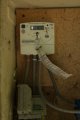
First, the transmitter certainly does not transmit constantly, and so that 1 watt is only occasional. Then, see that there is a battery, 3.6 volts. That supplies the power burst fr transmitting.
Next, be aware that, at least in the USA, the power consumed by meters is regulated, and next, given that it is indeed taken from the input side, it is the minimum possible.
What gives me a big concern is the apparent ability to switch the delivered power off. That function can not possibly be hacker-proof, although it is probably fairly secure.
It may be possible to have the utility organization obtain the correct specifications for that model meter. But you will need to ask very politely.
Can they? Sure doesn't seem to be that much space in mine to have a 200A switch? In fact, it is the same size as the original mechanical meter. I don't think they can fit a 200A switch into it but I could be wrong... What I have learned from this thread is that I no longer have to phone the power company to report outages? Seems the meter now does it for me? I do call them when the 3 phase high lines 100' in front of my house make nasty with the numerous trees and start arcing and giving that lovely 60 cycle plasma hum and immensely bright light before it trips their line fuses. They don't think much of my suggestion that they use buried service though our small heavily treed community.
"Perform Remote Disconnect/Connect " is mentioned in the next to last item on sheet two of the specification presented in the second post.
It does not seem reasonable that the switching is inside that package, so just what it means is not clear.
This is not the first time that I have witnessed a lie on the internet.
OR it might be that a control signal for switching of an electric water heater or A/C system is available. That has been an option with my local utility for many years. But it was always a separate package next to the electric meter.
"Perform Remote Disconnect/Connect " is mentioned in the next to last item on sheet two of the specification presented in the second post.
It does not seem reasonable that the switching is inside that package, so just what it means is not clear.
Just went out and eyeballed mine. It says Smart Meter, 240V, 1W and has an LCD readout always on. Same form size as before but the dome is plastic instead of glass and the plastic a bit yellowing making the LCD display hard to read. Here in the states, I've never seen a "pay as you go" meter. Maybe they put 3 200A triacs in the meter? It sure doesn't have room for a manual switch and arc chutes. Face plate of the device is very similar with the LCD readout where the numbered wheels were which kinda hides what is behind it. From what I remember all that was behind the meter when pulled are the stabs so it's all contained in the part under the dome and just the stabs behind it. Not a whole lot of room... Used to be they would manually remove the meter from the base and put a sealed cover plate over the stab sockets plus pull the overhead fuse on the transformer in case someone tried to "short" the power back on without killing themselves.
Consider that the disconnect contacts will not normally need to operate very many times on most residential meters, they can be much more compact than on contactors. and the common does not need to ever be broken, so in the UK that would be only one contact, but in the USA, two contacts. and it can be a small motor operating a spring toggle snap, so it could be rather compact.
Consider that the disconnect contacts will not normally need to operate very many times on most residential meters, they can be much more compact than on contactors. and the common does not need to ever be broken, so in the UK that would be only one contact, but in the USA, two contacts. and it can be a small motor operating a spring toggle snap, so it could be rather compact.
I had wondered if there were any need for it to be an "isolator" - i.e. ensure the safety of the disconnected circuits when disconnected, in which case it would require a double-pole switch with 3mm contact gaps.
Certainly not triacs, as @SamR wondered, as 200A triacs would generate 200W of heat!
I don't have one to look at, as I have refused to have one fitted!
[Edit] answering my own question after a little thought. . .It needn't be an "isolator" because the user has no control over whether it is on or off, so should presume it is live at all times. It is immediately followed by a double pole isolater.
I would never ever trust the internal switch as a service isolation device, BECAUSE it is not under local control. That is the whole reason for lockout/tagout efforts.
And all of the wires passing through the meter is because usually the electric meter, in residential installations,is the demarcation point between customer responsibility and utility responsibility. At least in my locality it is presented that way.
That is funny because I own the enclosure that the meter is mounted in, but the utility owns the meter.
The 3W on the meter nameplate is for the number of "wires" which the meter can measure. Metering is for a single-phase 3 wire circuit. (2, 120V phases, 1 Neutral)
On average, your typical AMI Smart Meter will use 3-4 VA. We don't use Watts as the power factor changes when the unit is receiving, transmitting, performing calculations and typical metering operations. The battery is used for keeping the clock in sync with the utility time clock for TOU (Time of Use) billing. The manufacturers use super-capacitors in the design, so if there happens to be an outage, the meter has the mustard to send the "last gasp" to the utility to trigger the outage management notifications/alarms. Another job of the capacitor(s) is to maintain the data in the meter register(s)/metrology if and when they lose power.
There is a way to measure exactly how much power your meter uses, but it is rather disruptive. First, you must obtain one of those "Kill A Watt" instruments, and then fabricate both a female connector assembly and a male connector assembly to mate with the Kill A Watt device. Next, disconnect your electric meter from both the line and the load wiring in the meter box. Then connect the outlet side of the Kill A watt to the inlet side of the electric meter, and connect the inlet side of the Kill a watt device to the mains, one side and neutral. Let it run for a few hours and record the readings before disconnecting it and re-connecting your meter as it was. Now you will have all the power consumption information, and experience connecting your electric meter, Handy to know, really. And every bitof this is honest, not stealing power. Possibly not legal, but not dishonest.
There is a need to be very careful because the voltages and power involved are capable of causing death or worse.
Another possibility is to get a sensitive current transformer, then take the incoming neutral and the outgoing neutral from the meter and put them through it in opposite directions. The output is the current used by the meter. If both cables are on the same side of the meter this might just be feasible.
You can assume that the voltage will be the mains voltage.
Multiplying voltage by current will give you VA nor Power.
It might be an overestimation of power if the meter is supplied by a capacitive dropper, but if it is supplied by a transformer it will be pretty close.
Either one of the above suggestions will get you in serious trouble with your electricity provider. They frown on breaking the tamper seal on your meter.
In the US, you'll be "protected" by a hundred or two hundred amp fuse. One slip and you could vaporize your favorite screwdriver. That's the least of your worries as the flash will blind you and spray you with molten metal. Death from electrocution may be welcome at that point.
Either one of the above suggestions will get you in serious trouble with your electricity provider. They frown on breaking the tamper seal on your meter.
It would be feasible to get a split-core current transformer around the input and output neutrals without disturbing anything except the spiders. They are the two wires in the middle with blue tags, and the currents already are going in opposite directions.

 Facebook
 Google
 GitHub
 Linkedin