how i get it?..

atferrari

Joined Jan 6, 2004
5,011
My questions:

Where do you study and what metric system do you use at home? When you need to express temperature, what scale do you use?

Are you sure you do not recognize the symbol "º"?

Did you know that if you enter those symbols, Google could tell you more than what you would like to read in your whole life?

Are you kidding?
 

Thread Starter

skyskysky

Joined Nov 29, 2014
12
My questions:

Where do you study and what metric system do you use at home? When you need to express temperature, what scale do you use?

Are you sure you do not recognize the symbol "º"?

Did you know that if you enter those symbols, Google could tell you more than what you would like to read in your whole life?

Are you kidding?


no..just i want to understand..
 

GopherT

Joined Nov 23, 2012
8,009
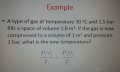
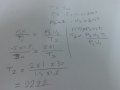
this ans my ans it correct..
The equation you have on the right is perfectly correct.
However! Gas equations are worked in degrees Kelvin, not Celsius. Add 273.15 to convert Celsius to kelvin.

When you complete your calculations, subtract 273.15 from your answer to convert back to degrees-Celsius.
 

Thread Starter

skyskysky

Joined Nov 29, 2014
12
The equation you have on the right is perfectly correct.
However! Gas equations are worked in degrees Kelvin, not Celsius. Add 273.15 to convert Celsius to kelvin.

When you complete your calculations, subtract 273.15 from your answer to convert back to degrees-Celsius.

amm..so 30 c + 273.15 = 303.15 then calculate it by useing that law..and then
the ans will be for T2 is 224.5 ..!!
 

GopherT

Joined Nov 23, 2012
8,009
Also, it is bad question because it makes one think that the compression causes the new temperature and pressure.
Compression normally causes a gas to heat up. Therefore, after compression, heat would have to be removed from the system to achieve the desired pressure to lower the temperature.
 

Thread Starter

skyskysky

Joined Nov 29, 2014
12
Also, it is bad question because it makes one think that the compression causes the new temperature and pressure.
Compression normally causes a gas to heat up. Therefore, after compression, heat would have to be removed from the system to achieve the desired pressure to lower the temperature.
ok..
 

GopherT

Joined Nov 23, 2012
8,009
amm...so it will be T2 is 224.5 + 273.15..is it ur mean ?
No,
Think about this...
- You are compressing the gas from 1.8 volume down to 1.0 volume (compression factor of 0.5555)
- If the temperature were to remain constant, you would expect the pressure to nearly double
- according to the Problem, The pressure only goes up from 1.5 to 2.0 (1.33333 )
- this means that the temperature must drop (it must drop a lot).


If we were at a constant temp, volume ratio change would be the reciprocal of the pressure ratio change. Multiplying them together would give us 1.00000
Instead, 0.5555 x 1.3333 gives us 0.740xxxx
That means the energy of the gas must be reduced so it does not make as much pressure as we expected at our new volume. Like reducing pressure of a balloon by putting it in the freezer makes it smaller!

Since multiplying out pressure change factor by our volume change factor is less than onE, that means, our final temperature must be COLDER than out starting temp (303.15) to have that little pressure. In fact, our final temperature should be initial temp 303.15 x 0.760x = 225.5.


Final temperature must be 224.5 - 273.15 = -48.65

No gas went in or out of the system,
 
Top