How does this current source work?

Thread Starter

matthej

Joined Oct 10, 2020
68
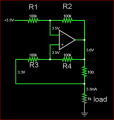
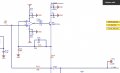
There is a design that has a current source to provide downstream. It is made up of an op-amp, 2n222 transistor and some resistors.
It is producing a current of up to 3.3mA. The drop across the 100 resistor is 3.3V.
I can't figure out how this is working. The input to the op-amp is from a DAC which ranges between 0 and 3.3V. The V_LaserA voltage is at +5V
Any help would be appreciated!current_source.jpg
 
Last edited:

crutschow

Joined Mar 14, 2008
38,322
Since you aren't showing the complete circuit, how can we analyze it?

But basically feedback keeps the voltage at the transistor emitter equal to 2 times the voltage at the op amp (+) input.
 
Last edited:

Thread Starter

matthej

Joined Oct 10, 2020
68
Since you aren't showing the complete circuit, how can we analyze it?

But basically feedback keeps the voltage at the transistor emitter equal to 2 times the voltage at the op amp (+) input.
Sorry didn't think the rest of the circuit mattered much. The current source goes to a device that is looking for current between 0 and 3.3mA. The other piece of the circuit goes to a diff amp which goes to an ADC for a telemetry measurement.
I am measuring a drop across the 100 ohm resistor of 3.3V when the input to the op amp is at 3.3V
Does that make sense?
 

tonyStewart

Joined May 8, 2012
231
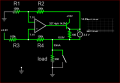
Re-drawn to simplify, it is the unity gain differential amplifier, where we see the input pairs match at the left and also the Op Amp (differential null) inputs. But this part is not a current source.
1699229192849.png
 

MisterBill2

Joined Jan 23, 2018
27,186
The opamp is delivering enough base drive to the transistor to raise the inverting input voltage up to match the voltage at the non-inverting input. That circuit was shown in the `1976 National Semiconductor linear circuits book. It is classic and simple. The big caution is in avoiding having the acitive circuit voltages greater than the opamp supply voltages.
 

crutschow

Joined Mar 14, 2008
38,322
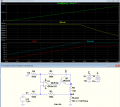
Below is the LTspice sim of the basic Howland constant-current circuit you have, for a constant 3.3V input and a varying load resistance.
The differential circuit maintains the voltage across the 100Ω resistor R5 equal to the input voltage, to generate the constant output current.
Since the input is differential, either input (or both) can be used to generate the constant current.

Note how the output voltage (red trace) increases to keep the load current constant at 33mA (yellow trace) as the load resistance increases (green trace) until the output saturates (at about 330Ω load resistance) at the maximum op amp output voltage (blue trace).

1699296863760.png
 
Last edited:

tonyStewart

Joined May 8, 2012
231
This doesn't look like what I drew above. The +3.3V should be on the + input of the op-amp
Thanks, Murphy's Law. If anything can be reversed, it will be.

1699310897482.png


As long as R1/R2= R3/R4 , the 100 Ohm being 0.1% introduces 0.1% error
You can modify any R, V and interactively understand why it works as a differential amplifier must produce the same voltage across the 100 ohm as the far left 3.3 to achieve a null error on the input. But the voltage reaches maximum with a load of 330 Ohms then current drops. But below it stays constant.

Transistor Pd= 375 mW max

https://tinyurl.com/yrgdftk9
 
Last edited:

Thread Starter

matthej

Joined Oct 10, 2020
68
Thanks, Murphy's Law. If anything can be reversed, it will be.

View attachment 306932


As long as R1/R2= R3/R4 , the 100 Ohm being 0.1% introduces 0.1% error
You can modify any R, V and interactively understand why it works as a differential amplifier must produce the same voltage across the 100 ohm as the far left 3.3 to achieve a null error on the input. But the voltage reaches maximum with a load of 330 Ohms then current drops. But below it stays constant.

Transistor Pd= 375 mW max

https://tinyurl.com/yrgdftk9
Thanks this is helpful . I am still trying to come up with the equations to get it such that Iload = Vin(3.3V)/Rsource(100 ohms).

I have a few equations, but can't get it reduced further. Can anyone help?
 

Thread Starter

matthej

Joined Oct 10, 2020
68
Post your equations.
Referencing the circuit that tonyStewart shows above:

I am assuming V+=V-. calling this V : Also assuming minimal drop from base to emitter (is this ok(

i1=i2 => Vout -V/R2 = V/R1, which yields: V=(R1/R1+R2)Vout

i3=i4 => V-Vin/R3 = Vl-V/R4, which yields: V=(R4Vin+R3Vl)/(R3+R4)

I100 = Il + I4 => Vout-Vl/100 = Vl/Rl + Vl-V/R4


Now I am stuck and not sure where I go from here?
 
Top