How do I choose these components ?

Thread Starter

Hextejas

Joined Sep 29, 2017
187
I have been trying to breadboard this circuit, the one shown in the tutorial.
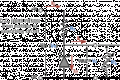
diode24.gif
I am trying to get the circuit to work so I can predict the various voltages and currents. So far I have smoked a few resistors as well as scorched my fingers.
These are the components that I vave:
1) Vin = 18.3v ( 2 9v batteries in series )
2) Diode = BZX55Cn. n = 2v4 - 75
3) Rs = 1k and 330 ohm, very thick and they don't smoke. I don't know how to tell the wattage. Rd = a wide range of 1/2 watt resistors. These smoke and get very hot.
4) Rl Same resistors as above.

Trying to do the exercise here is where I am stuck.
http://www.electronics-tutorials.ws/diode/diode_7.html
Using an 18 ohm 1/2 watt resistor as Rs, coupled with a BZX55C18, and things get hot.
A huge part of the problem is that I have no clue as to how to read a diode data sheet so that I could pick a proper diode.
I used the above diode as the 18 was close to the source voltage.
Thanks
 

Dodgydave

Joined Jun 22, 2012
11,395
The choice of Rs is, Vin - Vzener/Iz+ Iload,

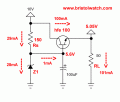
So if your supply is 18V and your zener is 2.4V, then Rs is dropping 15.6V and needs to supply your output load current, so if you're wanting to draw 500mA, then 15.6V / 500mA = 31 ohms resistor @ 7.8W ( 15.6v X 500mA).

Preferred value is 30 ohms @ 10W.

Ideally for more current loads use a pass Npn transistor.


zr1.gif
 
Last edited:

MrChips

Joined Oct 2, 2009
34,628
You are attempting to create 2.4V from 18V source. Using a resistor and a zener diode is going to be very inefficient. Most the energy will be wasted as heat in the resistor or diode.

Use a buck converter instead.
 

DickCappels

Joined Aug 21, 2008
10,661
Some things to reduce the smoke and maybe get it working:
• Use one 9v battery instead of two.

• Do not use RL -it might be taking too much current and is not required for the experiment.

• Use the highest value for RS that gets you a pleasing reading with your voltmeter. 330 is good, but 1k might be ok. Do not go lower than 330 for now.

• Make sure you have the zener connected correctly. The end without the band goes to ground (the negative battery terminal).

upload_2017-10-7_17-46-50.png

What is the part number of your zener?

Further reading: https://www.allaboutcircuits.com/textbook/semiconductors/chpt-3/zener-diodes/
 

phranzdan

Joined Aug 4, 2017
40
I have been trying to breadboard this circuit, the one shown in the tutorial.
View attachment 136740
I am trying to get the circuit to work so I can predict the various voltages and currents. So far I have smoked a few resistors as well as scorched my fingers.
These are the components that I vave:
1) Vin = 18.3v ( 2 9v batteries in series )
2) Diode = BZX55Cn. n = 2v4 - 75
3) Rs = 1k and 330 ohm, very thick and they don't smoke. I don't know how to tell the wattage. Rd = a wide range of 1/2 watt resistors. These smoke and get very hot.
4) Rl Same resistors as above.

Trying to do the exercise here is where I am stuck.
http://www.electronics-tutorials.ws/diode/diode_7.html
Using an 18 ohm 1/2 watt resistor as Rs, coupled with a BZX55C18, and things get hot.
A huge part of the problem is that I have no clue as to how to read a diode data sheet so that I could pick a proper diode.
I used the above diode as the 18 was close to the source voltage.
Thanks
Hi: The first thing you need to do is determine what RL is. There is no way to make an intelligent design without knowing the output requirements. Note that the simple circuit you show is really limited in the amount of current it can deliver. Usually, 50 ma is about the max. You can use zener diodes in the DO1 package, for more current, but it is much better to use a simple pass regulator. Let me know what RL is and I will be able to suggest some values.
 
Last edited by a moderator:

Thread Starter

Hextejas

Joined Sep 29, 2017
187
I am trying to replicate the Zener diode Example 1, for a variety of training reasons.
Here is the Example and it shows the various voltage, loads and the math.
They have 12v in whereas I had a choice of 9 or 18.
They state The maximum power rating PZ of the zener diode is 2W....Where did they get that number ?
===========================================
Given either 9v or 18v in, and a 1k load resistor and 5ma current.
What diode and series resistor would I use. Please show how you determine them.
Question. When I am asked to measure the current flowing thru the diode do I merely put the probes on each end of the diode ? I recall that when I was trying to measure current on a circuit board, I had to remove a component and put the meter is series with it. Breadboarding has me fooled.
And the same question re the load resistor.
This is perhaps my 10th time using a breadboard and I am having a hard time figuring out where to measure what. Wired are easy to see
Zener Diode Example No1
A 5.0V stabilised power supply is required to be produced from a 12V DC power supply input source. The maximum power rating PZ of the zener diode is 2W. Using the zener regulator circuit above calculate:

a). The maximum current flowing through the zener diode.


b). The minimum value of the series resistor, RS


c). The load current IL if a load resistor of 1kΩ is connected across the zener diode.


d). The zener current IZ at full load.


Thread Starter

Hextejas

Joined Sep 29, 2017
187
Hi: The first thing you need to do is determine what RL is. There is no way to make an intelligent design without knowing the output requirements. Note that the simple circuit you show is really limited in the amount of current it can deliver. Usually, 50 ma is about the max. You can use zener diodes in the DO1 package, for more current, but it is much better to use a simple pass regulator. Let me know what RL is and I will be able to suggest some values.
Thank you Phran.
The Rl is 5v with Rl being 5ma.
 

Thread Starter

Hextejas

Joined Sep 29, 2017
187
Some things to reduce the smoke and maybe get it working:
• Use one 9v battery instead of two.

• Do not use RL -it might be taking too much current and is not required for the experiment.

• Use the highest value for RS that gets you a pleasing reading with your voltmeter. 330 is good, but 1k might be ok. Do not go lower than 330 for now.

• Make sure you have the zener connected correctly. The end without the band goes to ground (the negative battery terminal).

View attachment 136758

What is the part number of your zener?

Further reading: https://www.allaboutcircuits.com/textbook/semiconductors/chpt-3/zener-diodes/
The diode is BZX55C18
 

Thread Starter

Hextejas

Joined Sep 29, 2017
187
The choice of Rs is, Vin - Vzener/Iz+ Iload,

So if your supply is 18V and your zener is 2.4V, then Rs is dropping 15.6V and needs to supply your output load current, so if you're wanting to draw 500mA, then 15.6V / 500mA = 31 ohms resistor @ 7.8W ( 15.6v X 500mA).

Preferred value is 30 ohms @ 10W.

Ideally for more current loads use a pass Npn transistor.


View attachment 136757
Thank you Dodgy
I will try some components based upon your helpful suggestions and formulae.
Also when opening to men is your statement " your Zener is 2.4V ". Mine was actually 18v.
Not knowing anything about zeners other than what they were supposed to do, I was picking the voltage of the zener based upon it being greater than Vin. Are you saying that the V of the Zener is the amount of the voltage drop ??? !!!
 

Thread Starter

Hextejas

Joined Sep 29, 2017
187
Some things to reduce the smoke and maybe get it working:
• Use one 9v battery instead of two.

• Do not use RL -it might be taking too much current and is not required for the experiment.

• Use the highest value for RS that gets you a pleasing reading with your voltmeter. 330 is good, but 1k might be ok. Do not go lower than 330 for now.

• Make sure you have the zener connected correctly. The end without the band goes to ground (the negative battery terminal).

View attachment 136758

What is the part number of your zener?

Further reading: https://www.allaboutcircuits.com/textbook/semiconductors/chpt-3/zener-diodes/
Thank you Dick.
That link is opening my eyes some as I am starting to pay more attention to reverse bias and Zener voltages.
Back to the breadboard.
 

phranzdan

Joined Aug 4, 2017
40
Thank you Phran.
The Rl is 5v with Rl being 5ma.
I take it to mean that the output is 5v with a current of 5ma. usually, we make the current in the zener diode some multiple of the load current. Let the current in the zener be 20ma so that the total current will be 25ma. Your supply originally was nominally 18 volts. To provide a drop of 13 volts at 25ma the resistor would need to be 520 ohms. The power dissipated in the resistor is E x I or 13x .025 = .325 watts. The power in the zener is E x I or .025 x 5 = .125 watts. Although a 1/2 watt resistor would work, I would use a 1 watt. I saw a suggestion by someone to use a single 9 volt in which case all of the calculations would need to be done over. In this case the resistor would need to drop 4 volts with the same current resulting in a value of 160 ohms. The power would be .025 x 4 or .1 watt. In this case a 1/2 or 1/4 watt would work. The dissipation in the zener diode would remain the same. If all done correctly you should not have any overheating problems.
 

dl324

Joined Mar 30, 2015
18,219
Given either 9v or 18v in, and a 1k load resistor and 5ma current.
What diode and series resistor would I use. Please show how you determine them.
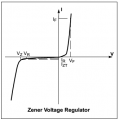
When you're using a zener as a voltage regulator, you want the current in the zener to be at least 10 times the maximum load current. The reason for this is that you want the zener to regulate voltage as well as possible and that means maintaining a high current (which puts it at the steep part of the current vs voltage graph) and changes the least between no load and full load.
upload_2017-10-7_19-33-52.png

The problem you're working on is using a 5mA load and 400mA in the zener.

At 400mA, a 5V zener would be dissipating P = I * V = 400mA * 5V = 2W
Question. When I am asked to measure the current flowing thru the diode do I merely put the probes on each end of the diode ?
No, that would require you to have the I-V curve for that particular zener; which won't exist unless you created it. You measure the voltage drop across the series resistor and use Ohm's Law to calculate current.
\( \small I = \frac{V}{R} \)
I recall that when I was trying to measure current on a circuit board, I had to remove a component and put the meter is series with it.
Doing this can affect your measurements because any current meter will have resistance and that will change the voltages in the circuit.
 
Last edited:

Thread Starter

Hextejas

Joined Sep 29, 2017
187
Some things to reduce the smoke and maybe get it working:
• Use one 9v battery instead of two.

• Do not use RL -it might be taking too much current and is not required for the experiment.

• Use the highest value for RS that gets you a pleasing reading with your voltmeter. 330 is good, but 1k might be ok. Do not go lower than 330 for now.

• Make sure you have the zener connected correctly. The end without the band goes to ground (the negative battery terminal).

View attachment 136758

What is the part number of your zener?

Further reading: https://www.allaboutcircuits.com/textbook/semiconductors/chpt-3/zener-diodes/
Thank you Dick, I did have the diode backwards/. Color me embarrassed. After I switched it around it started to work and I was ecstatic.
Measuring every which where. So, I started swapping out resistors, and the diode to see what would be the impact and now I cant get the booger to work again !!!
Arggggggg.
What's weird is that I tore the board down and went back to the working setup. Now I can get an accurate load voltage but with 000 current. I've checked it over and over and I dont know where to start looking. So, enough for today and back at it tomorrow.

Oh yeah another question.
I finally got a meter that has a diode setting on it and it shows a voltage in the range of .7v ~ .8v.
I also thought that I would be able to measure a resistance but it shows 0. Is that correct ?

thanks again for this small step for me.
 
Last edited:

DickCappels

Joined Aug 21, 2008
10,661
The forward voltage in the diode test mode is typical of a small signal silicon diode at a millliamp or so.

It is normal to not get a usable reading when trying to measure the reistance of a diode, that is why there is a diode test function. I just checked a couple of my meters and the on some scales the test currents involved are less than I would expect the leakage current to be across a small diode. Consider 10 Meg Ohms with 200 mv full scale in the resistance measurement mode is 20 nanoamps <= that is a very small current.
 

Thread Starter

Hextejas

Joined Sep 29, 2017
187
Arggggggg,
My meter had a blown ma current fuse and i struggled for 2 days trying to figure it out.
I have some on order and they are not cheap.
Oh well, at least now I can proceed with the next steps which will be predicting the readings using a variety of diodes, voltages, and resistors.
Wasted a lot of time.
 
Top