How Can I Solve This Question More Efficiently? -- phasor

Thread Starter

Phycho_cat

Joined Aug 23, 2024
26
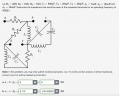
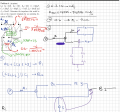
Hello everyone! I spent almost an hour trying to solve this problem, and I managed to get the answer. However, I find it unacceptable that it took me so long to solve what isn't a very complicated question. I was wondering if anyone has any tips or tricks for tackling these kinds of questions more efficiently. For my final, I’ll need to answer seven questions in two and a half hours, and only the final answers are graded, so I really need to step up my game. Thanks!
 

Attachments

WBahn

Joined Mar 31, 2012
32,704
My first recommendation is to not waste time finding the impedances of things that don't matter. You calculated the impedance of every capacitor and inductor in the circuit even though none of them are on any path from A to B.

Redraw the circuit with the terminals of interest on opposite sides and then draw the rest of the circuit. Omit anything that obviously isn't on a viable path. Things that aren't obvious but that also aren't on viable paths will likely become obvious. Eliminate them. Then find the impedance of what's left. In this case, you should have been able to identify that R1 was the only component connecting A to B and been able to answer 9 kΩ at an angle of 0° within just a few seconds.

Other recommendations:
* Go for the low hanging fruit -- look through the entire exam and identify problems that you can solve quickly and confidently. Claim the points for those and move on.
* Combine series/parallel combinations of like components were possible before computing impedances.
* Get very comfortable with doing polar/rectangular conversions quickly.
* Track your units.

For instance, you have (C2+L2)||C1. What you means is that C2 is in parallel with L2, and that is a fine and common way to indicate that. But, especially under the time pressure of an exam, you are likely to, at some point, put (250E-12 + 19E-3) and just add them together. This is particularly likely if the magnitudes of the two values are in the same ballpark, such as 1000 µF and 10 mH. But if you write down (250E-12 F + 19E-3 H), it will be a big red flag that these can't be added together any more than 3 ft can be added to 4 lb.
 

Thread Starter

Phycho_cat

Joined Aug 23, 2024
26
My first recommendation is to not waste time finding the impedances of things that don't matter. You calculated the impedance of every capacitor and inductor in the circuit even though none of them are on any path from A to B.

Redraw the circuit with the terminals of interest on opposite sides and then draw the rest of the circuit. Omit anything that obviously isn't on a viable path. Things that aren't obvious but that also aren't on viable paths will likely become obvious. Eliminate them. Then find the impedance of what's left. In this case, you should have been able to identify that R1 was the only component connecting A to B and been able to answer 9 kΩ at an angle of 0° within just a few seconds.

Other recommendations:
* Go for the low hanging fruit -- look through the entire exam and identify problems that you can solve quickly and confidently. Claim the points for those and move on.
* Combine series/parallel combinations of like components were possible before computing impedances.
* Get very comfortable with doing polar/rectangular conversions quickly.
* Track your units.

For instance, you have (C2+L2)||C1. What you means is that C2 is in parallel with L2, and that is a fine and common way to indicate that. But, especially under the time pressure of an exam, you are likely to, at some point, put (250E-12 + 19E-3) and just add them together. This is particularly likely if the magnitudes of the two values are in the same ballpark, such as 1000 µF and 10 mH. But if you write down (250E-12 F + 19E-3 H), it will be a big red flag that these can't be added together any more than 3 ft can be added to 4 lb.
Thanks for your detailed reply and helpful tips. I usually try to get rid of those unnecessary values, but this question has two parts. I was able to answer the first part, finding the impedance for port A-B, in just a few seconds. However, the next part was a real struggle for me, finding the impedance for port A-C. I had to simplify the circuit, and doing this took me almost an hour! I was thinking that playing around with some circuits on a breadboard to build intuition might be helpful for these kinds of questions, especially for understanding the total impedance at different ports in a circuit.
 

WBahn

Joined Mar 31, 2012
32,704
Ah, when I open the screenshot it only shows Part A, but looking at the thumbnail I can see that there is another part. I can't read it (don't know why my preview cuts if off), but you say that that's looking for the impedance from A-C.

I can't tell from your work if you are familiar with complex impedance in the complex frequency domain. This is where

\(
Z_R \; = \; R \\
Z_L \; = \; sL \\
Z_C \; = \; \frac{1}{sC}
\)

If so, work the problem symbolically to find the complex impedance and then, at the end, set s=jw to find the impedance at at the requested frequency.
 

The Electrician

Joined Oct 9, 2007
2,986
Hello everyone! I spent almost an hour trying to solve this problem, and I managed to get the answer. However, I find it unacceptable that it took me so long to solve what isn't a very complicated question. I was wondering if anyone has any tips or tricks for tackling these kinds of questions more efficiently. For my final, I’ll need to answer seven questions in two and a half hours, and only the final answers are graded, so I really need to step up my game. Thanks!
Are you still interested in more efficient solutions? How do you do the arithmetic?
 

Thread Starter

Phycho_cat

Joined Aug 23, 2024
26
Are you still interested in more efficient solutions? How do you do the arithmetic?
Yes, absolutely! I think now actually it makes more sense to me. My new approach is to start by asking myself (let’s say we want Zth for port b-d) how can I get from b to d and how can I go from d to b, to consider all the possible paths, and if an element is not included in these paths, I basically have to get rid of it and then find the Zth based on whatever we have left.


My TA told me we can also use MNA for these types of questions, but I think that's going to take longer.
 
I consider "efficiency" to mean no manual calculation of numerical impedance values--the computer does it all.

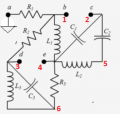
Use linear algebra to do nodal analysis. Choose one node to be the reference node (ground); node "a" in this case. From the remaining 6 nodes form an admittance matrix. Next use a property of admittance matrices: the values on the diagonal of the inverse of the admttance matrix of a passive network are the impedances to ground of the corresponding nodes.
The 2,2 element of the inverse of this admittance matrix is the a-c impedance.

Net.png

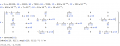
Here is the 6x6 admittance matrix with "a" grounded.
eff.png
 
Last edited:
Yes, absolutely! I think now actually it makes more sense to me. My new approach is to start by asking myself (let’s say we want Zth for port b-d) how can I get from b to d and how can I go from d to b, to consider all the possible paths, and if an element is not included in these paths, I basically have to get rid of it and then find the Zth based on whatever we have left.


My TA told me we can also use MNA for these types of questions, but I think that's going to take longer.
You might find this interesting: https://en.wikipedia.org/wiki/Resistance_distance

Also this: https://www.physicsforums.com/threa...trical-circuits-networks.939813/#post-5951075
 
Last edited:

Thread Starter

Phycho_cat

Joined Aug 23, 2024
26
I consider "efficiency" to mean no manual calculation of numerical impedance values--the computer does it all.

Use linear algebra to do nodal analysis. Choose one node to be the reference node (ground); node "a" in this case. From the remaining 6 nodes form an admittance matrix. Next use a property of admittance matrices: the values on the diagonal of the inverse of the admttance matrix of a passive network are the impedances to ground of the corresponding nodes.
The 2,2 element of the inverse of this admittance matrix is the a-c impedance.

View attachment 341021

Here is the 6x6 admittance matrix with "a" grounded.
View attachment 341018
Thank you so much for your reply! I can’t even express how much I appreciate you taking the time to help a stranger student like me! It really means a lot. I tried saving all my values for resistors, inductors, and everything as variables, then solving the equations, and it’s incredible how just being organized and having a simple strategy can make such a huge difference. I truly can’t thank you enough, as this is going to be such a big help for my final. I tend to freeze up when I’m stressed and struggle to get the final answer, which is the only part that's graded, so your advice will make a world of difference. Thanks again.
 
Top