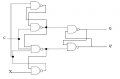
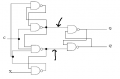
There is an X ff and the question is about finding the characteristic table of its. What kind of a ff is this? I can't define the present states and next states. How can I find?
There is an X ff and the question is about finding the characteristic table of its. What kind of a ff is this? I can't define the present states and next states. How can I find? View attachment 124259
First, determine your stable states. In this case you have sixteen possible combinations of input and output. But some of them might not be stable (in which case you probably don't have a viable flip flop) so you need to confirm that each state, if entered, will stay there.
Then, from each state, change one of the inputs and track the changes as they propagate through the circuit. From this analysis, determine which stable state the circuit will go to. One common trick to do this is to assume a really long delay for each gate. Another is to break one or more of the feedback paths and insert a D flip flop that you use to decide when a feedback signal is allowed to affect the circuit operation. If the final state ends up depending on which delay path is longer than another or which order you clock the DFFs, then you have a critical race condition.
From these results build up a truth table showing all of the possible changes of your two inputs, which includes rising and falling edges. See which ones can be combined. Review the result and decide what kind of flip flop it is. If it's one that has never existed, give it a name.

 Facebook
 Google
 GitHub
 Linkedin