How can I convert a positive signal into a negative?

Thread Starter

Loirens

Joined Jul 8, 2023
8
Hello. I have a car's module that controls the interior courtesy lights so when you open the door lights gradually turn on and when you close it, they gradually fade to off. The point is the module is designed to work with a constantly grounded circuit so the bulb receives always ground and when opening the door receives positive from the module. Easy.
Now my car is circuit is designed opposite, so the system is constantly feed by positive, and what varies is the ground.

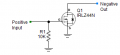
The question is how can I make that positive signal from the module negative? I cannot use a relay because when it dims the low voltage causes the relay to flicker and I don't get the desired effect. I though maybe a transistor could do the job.

I'll wait to hear you. Thanks.
 

LowQCab

Joined Nov 6, 2012
5,101
It would be just as complicated to completely replace your "Module" with a completely new Circuit,
as it would be to convert the Module's Output-Polarity.

So, why not just make your own new "Module" ?

What is your experience level with building Circuits ?
.
.
.
 

k1ng 1337

Joined Sep 11, 2020
1,038
We need more information to solve the problem. A schematic or diagram is best because the terms you are using don't seem to follow convention.
 

BobTPH

Joined Jun 5, 2013
11,466
I don’t suppose you know whether the dimming is achieved by analog means or by PWM, do you? If PWM, an added MOSFET could do it.
 

Thread Starter

Loirens

Joined Jul 8, 2023
8
It would be just as complicated to completely replace your "Module" with a completely new Circuit,
as it would be to convert the Module's Output-Polarity.

So, why not just make your own new "Module" ?

What is your experience level with building Circuits ?
.
.
.
No, I cannot replace that module because it has many other features that have to do with the radio, parking sensors...
What I know about electronics is very basic.
 

Thread Starter

Loirens

Joined Jul 8, 2023
8
How hard will it be to reverse the connections of the light? That could allow you to reverse the function.
It would take some job. I'll have to thoroughly study that, but I thought that reversing the signal would be easier by just adding a transistor or something else.
 

Thread Starter

Loirens

Joined Jul 8, 2023
8
We need more information to solve the problem. A schematic or diagram is best because the terms you are using don't seem to follow convention.
I don’t suppose you know whether the dimming is achieved by analog means or by PWM, do you? If PWM, an added MOSFET could do it.
I'm sorry but I have absolutely no idea. All I can tell you the module is a BCM (body control module) that controls interior lighting and some other features and all the schematics I have are the connectors pin out from the module. There's no manual for the internal circuitry.
 

LowQCab

Joined Nov 6, 2012
5,101
You should have stated that You were dealing with a BCM.
In that case, the short-answer would be no.

You might be able to "splice-into" the harness and add an auxiliary Circuit,
but I would warn You against messing-around with such an expensive Computer.
.
.
.
 

MisterBill2

Joined Jan 23, 2018
27,187
Depending on the type of light that would be dimmed, some options can exist. There also exist bayonnet base bulbs with two buttons in the bottom and no connection to the base. Then it would only take a socket insert change.
 

Thread Starter

Loirens

Joined Jul 8, 2023
8
Seems like that is all you need. What I don't understand is the application and why there are two modules?
View attachment 309715
Sorry, it's late but I don't have much time.
There are two modules because the car I'm working on originally doesn't have the fade to off lighting and I'm trying to add some other features to it as well, like parking sensors, and all that relies on a bus communication network provided by this BCM.

I want to thank you for this easy solution. When I have more time I'm gonna test it out and then I'll tell you.


Thanks and happy new year.
 
Top