Household heaters...

Thread Starter

Externet

Joined Nov 29, 2005
2,624
Hi.
Typical 1200W 120VAC heaters; I find a couple of types:
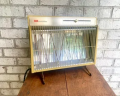
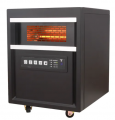
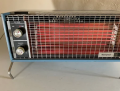
-The ones that the heating element works glowing red hot;
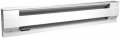
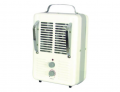
-The ones their heating element do not get red hot.
What differs ? Is it the wattage rating of the heating element ?

If the wattage rating of the not red hot is higher; can that same (not red hot) heating element be fed by say 240VAC instead and when gets red hot (without failing) consumes 2400W ?
 

DickCappels

Joined Aug 21, 2008
10,661
Don’t exceed the appliances ratings as given by the manufacturer. I prefer to trust them over my intuition, suggest that you adopt the same stratrategy.
 

sparky 1

Joined Nov 3, 2018
1,218
A plug-in Watt meter is a reasonable way to measure a heater element's electrical power.
This method should agree with your electric bill except during peak hours you pay more per Watt-Hour
The color of the element is an indicator of the visible spectra however much of the infra-red is not visible to the human eye.
The cost of a heating element is often related to it's life expectancy at the recommended Wattage and frequency/duty cycle applied.
Logically, that raises the question: Is it cost effective to modify a heater or put on a sweater ?
 
Last edited:

dovo

Joined Dec 12, 2019
72
If the wattage rating of the not red hot is higher; can that same (not red hot) heating element be fed by say 240VAC instead and when gets red hot (without failing) consumes 2400W? Power is proportional to the square of the voltage.
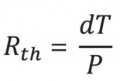
Assuming constant electrical resistance a 120 VAC, 1200 W heating element will dissipate 4800 W when powered by 240 VAC. The "not red hot" heater transfers its heat to the environment primary by convection. Let's say the heater surface temperature is 35°C above ambient air when powered on 120 VAC and 140°C above ambient when powered on 240 VAC. In a 20°C room the surface temperature is 160°C. Do you think it will fail?

Power = voltage squared divided by resistance:
P = (V^2)/R

1716481076074.png
 

MrChips

Joined Oct 2, 2009
34,627
Hi.
Typical 1200W 120VAC heaters; I find a couple of types:
-The ones that the heating element works glowing red hot;
-The ones their heating element do not get red hot.
What differs ? Is it the wattage rating of the heating element ?

If the wattage rating of the not red hot is higher; can that same (not red hot) heating element be fed by say 240VAC instead and when gets red hot (without failing) consumes 2400W ?
No. A 120VAC heater is designed to operate on 120VAC, not 240VAC.

Household heaters that glow red hot have a built-in fan to move the hot air out and prevent the heater element from burning up. Other household heaters heat up a tank of oil and relies on a rising flow of air by convection.
 

crutschow

Joined Mar 14, 2008
38,316
Operating on 240V instead of 120 will increase the power by a factor of four (not two), since power is proportional to the square of the voltage, and burn out the element.

Note that the efficiency of a heater is always 100%, independent of the type of element that heats up, since all the energy (even from the fan) goes into heating the air.
 

Thread Starter

Externet

Joined Nov 29, 2005
2,624
Thanks. Yes, goofed with the Watts being squared instead of doubled.

Rephrasing... The heating elements that do not get red hot; What if the voltage is raised until they do.:confused:
The thing am asking is not the power dissipated; it is about the power rating.
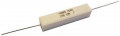
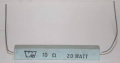
As a 10Ω 10Watt resistor, and a 10Ω 20Watt resistor. Both get equally hot at the same voltage applied, but one is capable of getting hotter.

1716490862221.png1716490905036.png
 

dovo

Joined Dec 12, 2019
72
Thanks. Yes, goofed with the Watts being squared instead of doubled.

Rephrasing... The heating elements that do not get red hot; What if the voltage is raised until they do.:confused:
The thing am asking is not the power dissipated; it is about the power rating.
As a 10Ω 10Watt resistor, and a 10Ω 20Watt resistor. Both get equally hot at the same voltage applied, but one is capable of getting hotter.

View attachment 322992View attachment 322993
I doubt that the heating element in a home non-forced air space heater is rated for a temperature much above it's actual 120 VAC temperature and above 150 deg. C well above it's design temperature. An applicable safety standard may be UL 1278.

https://www.shopulstandards.com/ProductDetail.aspx?UniqueKey=27566

"
1 Scope
1.1 These requirements cover movable and wall- or ceiling-hung electric room-heating equipment rated 600 volts or less to be employed in ordinary locations in accordance with the National Electrical Code, ANSI/NFPA 70.


1.2 These requirements do not cover fixed heaters, location-dedicated heaters, baseboard heaters, duct heaters, central-heating furnaces, fan-coil units, panel- or cable-type radiant-heating equipment, electric boilers, or any other electric heating equipment or appliances that are covered in or as a part of separate, individual requirements."
 

JohnSan

Joined Sep 15, 2018
121
The type that glow are 'radiators' of heat.

The type that don't are convector heaters.

The convectors shift a lot of air which keeps the temperature of the element down, so no glow.
Some are fan assisted or have a large aperture to aid convection and heat a room space.

The glowing type generally have a reflector at the rear and typically radiate the heat forward to provide you with a warm fuzzy feeling when you sit in front of them.

:cool:
 

Ian0

Joined Aug 7, 2020
13,097
Thanks. Yes, goofed with the Watts being squared instead of doubled.

Rephrasing... The heating elements that do not get red hot; What if the voltage is raised until they do.:confused:
The thing am asking is not the power dissipated; it is about the power rating.
As a 10Ω 10Watt resistor, and a 10Ω 20Watt resistor. Both get equally hot at the same voltage applied, but one is capable of getting hotter.

View attachment 322992View attachment 322993
Both don't get equally hot at the same voltage applied. Both DO dissipate the same power, but the larger one has more surface area so it can radiate or convect the same power with a lower temperature gradient across the surface-to-air interface.
 
Top