Hot air temp control circuit

Thread Starter

etonam

Joined Jun 21, 2016
20
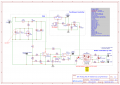
Hi there. I'll appreciate if u could help me with this circuit. It's been used in a video by Long Technical (
) The 1st stage U1.1 is a noninverting amplifier. Its output is fed into the inverting input of the 2nd stage U1.2 which is a square wave oscillator. And I'm having trouble understanding this oscillator. The RC positive feedback taps into a voltage divider connected to Vcc. The 10k-pot to vary temperature is in this voltage divider. Also tell me about the thermocouple sensor on the noninverting input of U1.1 Measured cold, it's a short. Does its resistance change as the hot air is turned on? Thanks, Etonam.
 

Attachments

Hi there. I'll appreciate if u could help me with this circuit. It's been used in a video by Long Technical (
) The 1st stage U1.1 is a noninverting amplifier. Its output is fed into the inverting input of the 2nd stage U1.2 which is a square wave oscillator. And I'm having trouble understanding this oscillator. The RC positive feedback taps into a voltage divider connected to Vcc. The 10k-pot to vary temperature is in this voltage divider. Also tell me about the thermocouple sensor on the noninverting input of U1.1 Measured cold, it's a short. Does its resistance change as the hot air is turned on? Thanks, Etonam.
U1.1 (LM358) is a non-inverting amplifier that boosts the signal from the thermocouple, and its output drives U1.2, which is wired as a Schmitt-trigger style comparator/oscillator, with the RC network (R8, R10, C1) and the 10 k temp pot set the oscillation threshold, effectively controlling heater duty cycle. And with a thermocouple, we are actually measuring the voltage generated at the thermocouple junction, which will be proportional to the temperature.
 

Thread Starter

etonam

Joined Jun 21, 2016
20
Thanks for the answer. The oscillation frequency should be fo = 1/2piR9C1. am I right? Could you direct me to litterature where I can learn in detail about this type of oscillator in U1.2? Once again, thanks for your time. Etonam.
 
Top