Homemade aluminium foil capacitor - why doesn't it hold a charge ?

Yup.

I decided to do some science and took two pieces of aluminum foil separated by a sheet of laser printer paper, with an 8" x 10.7" area of foil overlap, and got 11.7 nF capacitance. Swapping a sheet of GLAD Cling-Wrap for the paper, I got 9.2 nF.

Rather strange results, as I would have expected the Cling-Wrap to yield a lot more capacitance, not less.

Go figure. :confused:o_O
FWIW that's about what I'd expect for anhydrous paper considering its dielectric constant (i.e. relative permittivity) is greater than that of PVC and significantly greater than that of polyethylene (which being the constituent of most modern 'cling wrap' products).

For all that I agree with @Aleph(0) -- (Clean) Processed latex as found in toy balloons (and less mentionable productso_O) sports a dielectric constant ≈ 6 times that of paper and ≈ 11 times that of modern 'cling wrap':)

Very best regards
HP
 

OBW0549

Joined Mar 2, 2015
3,565
FWIW that's about what I'd expect for anhydrous paper considering its dielectric constant (i.e. relative permittivity) is greater than that of PVC and significantly greater than that of polyethylene (which being the constituent of most modern 'cling wrap' products).

For all that I agree with @Aleph(0) -- (Clean) Processed latex as found in toy balloons (and less mentionable productso_O) sports a dielectric constant ≈ 6 times that of paper and ≈ 11 times that of modern 'cling wrap':)
Interesting stuff! I didn't know any of that...
 

djsfantasi

Joined Apr 11, 2010
9,237
FWIW that's about what I'd expect for anhydrous paper considering its dielectric constant (i.e. relative permittivity) is greater than that of PVC and significantly greater than that of polyethylene (which being the constituent of most modern 'cling wrap' products).

For all that I agree with @Aleph(0) -- (Clean) Processed latex as found in toy balloons (and less mentionable productso_O) sports a dielectric constant ≈ 6 times that of paper and ≈ 11 times that of modern 'cling wrap':)

Very best regards
HP
In art supply stores, one might find jars of liquid latex. Painting it on or applying with a squeegee might produce better results.
 

Aleph(0)

Joined Mar 14, 2015
597
latex as found in toy balloons (and less mentionable productso_O)
HP I'm not dotting Is and crossing Ts cuz I know you were just giving examples of latex products for ppl unfamiliar with it but I need to disclaim that latex contraceptive products are a bad choice for diy caps cuz so called _lube_ isn't oil it's usually just aqueous sugar solution and also those products have _raised features_ that make them unsuitable for capacitor dielectric cuz of nonuniform density! So HP like I said I know you and probably everyone else who posted on here knows all that but like you say it's good to be kind to esl and newbie readers:)

So anyhow what I suggest is to take section of latex from balloon or exam glove or other dry form with uniform thickness and remove all the non stick powder then assemble cap with latex stretched to point of being transparent for highest capacitance:)!

Interesting stuff! I didn't know any of that...
OBW0549 here's link to PDF that I say no DIY capacitor manufacturer should be without:D! So I notice some figures don't totally jibe with HP's but that's ok cuz they strengthen her point:cool:!
 

Aleph(0)

Joined Mar 14, 2015
597
In art supply stores, one might find jars of liquid latex. Painting it on or applying with a squeegee might produce better results.
Djsfantasi Tnx! That's a lot easier than trying to figure out how to keep latex section under tension in assembled capacitor:)!

Strantor to achieve greatest capacitance the dielectric has to be as thin as allowed by max voltage requirement. So anyhow I'm saying 400um should be just fine for low voltage DIY cap!:cool:
 

shortbus

Joined Sep 30, 2009
10,049
HP I'm not dotting Is and crossing Ts cuz I know you were just giving examples of latex products for ppl unfamiliar with it but I need to disclaim that latex contraceptive products are a bad choice for diy caps cuz so called _lube_ isn't oil it's usually just aqueous sugar solution and also those products have _raised features_ that make them unsuitable for capacitor dielectric cuz of nonuniform density! So HP like I said I know you and probably everyone else who posted on here knows all that but like you say it's good to be kind to esl and newbie readers
Who but Aleph or HP would give a explanation of the "lubricant's of contraceptive devices". So we now know you prefer ribs? Only joking with you my friend.

You do know balloons have a residual water based lubricant on them don't you? It's used in the process of making them, to allow the latex to come of off the molding form.
 

ian field

Joined Oct 27, 2012
6,536
Hi there,

I'm interested by capacitors and super capacitors and so i decided to make my own.
This is the textbook, school science project variety of capacitor, with A5 sheets of aluminium foil
separated by photocopy paper (as the dielectric).

This has been interesting. I've been able to get my capacitor to slowly release it's
charge over a period of 70 seconds (after the battery is disconnected)
before the display on my multi-meter registers zero volts.

Commercially manufactured capacitors can hold a charge practically indefinitely.
What i would like to know is:
Why does my homemade capacitor not hold a charge:
(It starts to discharge the very moment i disconnect the battery).

Both (aluminium) sheets are surrounded on both sides by paper.
It's not clear to me how, or why, my capacitor is discharging.

Thank you to anyone who can offer some suggestions or solutions

Sally :)
When I first got a microwave - the weird things I tried nuking included a book. I was astonished by the amount of steam..........

Paper capacitors usually had wax or oil or something to exclude moisture.

Cling film is much thinner and probably has better dielectric coefficient - but it can be a real struggle to handle.
 
You do know balloons have a residual water based lubricant on them don't you? It's used in the process of making them, to allow the latex to come of off the molding form.
While I can't - ahem... don't dare speak for @Aleph(0):eek::eek::eek: -- Embarrassingly, I was unaware of that!:oops: But then your kind response underscores a vital point! -- Always, always, always vacuum-treat dielectric materials (including bona fide dielectric oils) prior to incorporation! -- FWIW (Re: solid dielectrics) said treatment may safely be deemed 'complete' at such time as absolute pressure in the VC (vacuum chamber) containing said materials remains below 100 umhg (i.e. micrometers Hg - AKA 'Microns') for a period of at least four hours sans pumping...

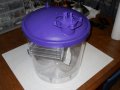
FWIW -- Repurposed unused polycarbonate suction canisters represent an excellent source of ulta-inexpensive VCs!:) Note that 'reusability' is readily achieved via replacement of the adhesive lid bead with a nonadheasive seal (e.g. cured silicone, neoprene, a large 'o-ring', etc)!:)

By way of elucidation:

Image of a typical 16 liter canister (Spec: DeRoyal Omni-Jug) --- Post continued below image...

Suction1.JPG


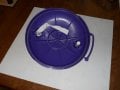
Underside of lid -- Please note the 'factory' (adhesive) seal bead immediately inside the 'rim' --- Post continued below image...


Suction2.JPG

Important! -- While I've not experienced same (despite appearance of downright 'scary' stress 'checking'/cracking:eek:), implosion of the canister is always possible! - Hence I advise caution! - Meaning use of appropriate PPE and common sense!

Best regards and good luck!
HP:)
 
Last edited:

Aleph(0)

Joined Mar 14, 2015
597
Who but Aleph or HP would give a explanation of the "lubricant's of contraceptive devices".
Shortbus I had to set record straight on choice of source of latex for dielectric:)! So anyhow I blame my sometimes coarse sensibilities on growing up in same city that's HP's home town:D

So being serious I'm sry if I offended you:(

So we now know you prefer ribs?
Shortbus since smart alecky question deserves smart alecky answer I say ribs are ok at Famous Dave's for ppl who like BBQ (which I don'to_O):p

Always, always, always vacuum-treat dielectric materials
HP I agree but material should be rinsed with alcohol b4 vac processing and totally saturated with proper dielectric oil afterwards to prevent degradation by oxidation! Also O3 will totally disintegrate it right on the spot! So really there are better materials for building capacitors for serious use but latex is good for just experimenting:)!
 

Thread Starter

Sally S

Joined Jun 29, 2017
18
Waxed paper would be a better dielectric, since it won't absorb moisture from the air like photocopy paper does. Damp paper will have lower resistance than dry paper.
Hi Alec,

thanks for the suggestion.

I'm a little bit puzzled by this whole water thing.
I checked a listing of dielectric constants for various substances, including water.
Water has a value of 80 ! Which clearly dwarfs the values for common insulators,
like wood ~ 2.0, various plastics 2.0 to 3.0. So, it's not clear to me how, water
vapour in the air, might sabotage my capacitor,...
Wouldn't a damp, or humid day, increase the capacitance ?

Sally :)
 

OBW0549

Joined Mar 2, 2015
3,565
So, it's not clear to me how, water
vapour in the air, might sabotage my capacitor,... Wouldn't a damp, or humid day, increase the capacitance ?
It might increase the capacitance somewhat but it will drastically decrease the dielectric's leakage resistance, leading to shorter self-discharge time. Many insulating substances become at least slightly conductive when wet.
 

Thread Starter

Sally S

Joined Jun 29, 2017
18
@Alec_t nailed it. Paper is very much affected by moisture. In the lab, I set up, I was capable of measuring currents to about 2E-12 Amps (2 pA) and applied voltages to +-100 Volts DC in an environmental chamber that had temperature control from -80 C to 200 C. Humidity was not instrumented, but could be reduced using a dry Nitrogen purge.

One day, I was bored, I actually measured the resistance of a piece of paper. Humidity definitely affects it.

You should try Kapton as your dielectric. http://www.ebay.com/itm/2-Square-Fe...hash=item4b1a24f8d5:m:mZ-2wFwCd9WntVjfPgMzzCg
Hi KISS,
I found a document online 'DEC-Kapton Summary of properties.pdf'.
Unless i've misunderstood the document, the dialectic constant for kapton is 3.4.
(which is comparable with paper)
But i guess Kapton doesn't absorb water the way paper can.
Thanks for your suggestion.

Sally :)
 

Thread Starter

Sally S

Joined Jun 29, 2017
18
It might increase the capacitance somewhat but it will drastically decrease the dielectric's leakage resistance, leading to shorter self-discharge time. Many insulating substances become at least slightly conductive when wet.
Thank you OB :)

So it might increase the capacitance initially.... but later on... it is a different story.

some nice phrases for me to look up here:
"leakage resistance"
"self-discharge time"

Sally :)
 

Thread Starter

Sally S

Joined Jun 29, 2017
18

Thread Starter

Sally S

Joined Jun 29, 2017
18
HP I'm not dotting Is and crossing Ts cuz I know you were just giving examples of latex products for ppl unfamiliar with it but I need to disclaim that latex contraceptive products are a bad choice for diy caps cuz so called _lube_ isn't oil it's usually just aqueous sugar solution and also those products have _raised features_ that make them unsuitable for capacitor dielectric cuz of nonuniform density! So HP like I said I know you and probably everyone else who posted on here knows all that but like you say it's good to be kind to esl and newbie readers:)

So anyhow what I suggest is to take section of latex from balloon or exam glove or other dry form with uniform thickness and remove all the non stick powder then assemble cap with latex stretched to point of being transparent for highest capacitance:)!


OBW0549 here's link to PDF that I say no DIY capacitor manufacturer should be without:D! So I notice some figures don't totally jibe with HP's but that's ok cuz they strengthen her point:cool:!
Hi Aleph,
Thank you, the pdf file has been invaluable.
And so has the latex discussion!

Sally :)
 
Top