Hobby rocket guidance by servos

Thread Starter

Kevil

Joined Jun 28, 2020
224
I am working on an amateur rocket with a range up to 10 (100) km whose 4 wings will be controlled by servomotors. The rocket will be guided by the Microchip ATSAMD21J18, FreeRTOS, Harmony, MPLAB X IDE. I will read the position and acceleration data from the Bosh BMI160 sensor at a 100Hz interval. The servos will be controlled by TCC (Timer/Counter for Control Applications) with a 24 bit resolution and 48 MHz MCU clock i.e. the TOP of the counter will be set to 960 000 (48E6/50) to get the 50Hz servo control period. The servos can be steered from the zero position -90° PWM 1ms, center default position PWM 1.5 ms to full deflection +90° PWM 2 ms (CCx Compare/Capture 96000).

Resolution for 1° is 96000/180degrees = 533.33 counts i.e. the 1 counts is 1/533.33° = 6.75"

Do you think that this resolution is adequate for PID rocket steering to fly straight up without rotating?
 

Ya’akov

Joined Jan 27, 2019
10,235
What you want to do—active control of a rocket—is not a trivial task. A lot of people have spent a lot of time working on this problem. I suggest you find a high power rocket forum where flight electronics are an active topic.

There is literally no way for someone without domain specific knowledge to evaluate your plan. Your question is unanswerable a priori–it requires empirically derived knowledge which comes from a lot of trying and a little success.

Also, without making any accusations, the risk that this is intended as a weapon delivery system is a real one and I for one would not contribute to that. If you can convincingly show that it isn’t for such an application, that’s good—but there are regulations in every country concerning high power model rocketry because it can be a threat to aircraft.

You don’t have to be in the US to be covered by regulations—in fact, you might even be much more heavily constrained to the point of not even being allowed.
 

LowQCab

Joined Nov 6, 2012
5,101
"" fly straight up without rotating? ""

ALL inherently-stable Rockets rotate,
even if it's only ~10 revolutions per minute.
There's a bunch of really good reasons for rotation.
.
.
.
 

Thread Starter

Kevil

Joined Jun 28, 2020
224
@Ya’akov
It's just a hobby rocket. Later, I can try to deliver CubeSat payload to 100 km.

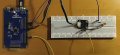
Reading the data from the BMI160 6DoF IMU:
UPR_20231118_205548.jpg

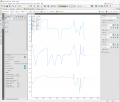
Manual shaking the IMU:
DATA_STREAMER_FORMAT_MDV.png
 
Last edited:

Ya’akov

Joined Jan 27, 2019
10,235
@Ya’akov
It's just a hobby rocket. Later, I can try to deliver CubeSat payload to 100 km.
I strongly suggest you find a good, active community of people working on flight controllers for high power rockets. It is much to specialized to treat as a general electronics topic.

There is a YouTube channel called BPS.space that is a very serious effort at getting a model rocket into space. I think you might try to contact him and see what he suggests. This is a video of a conference presentation on thrust vectoring. He has videos on spin control too. But, spin stabilization is actually a very important mechanism and isn’t at odds with getting the rocket to go “straight up”.


Thread Starter

Kevil

Joined Jun 28, 2020
224
I know this guy. Unfortunately, it's not a serious "professional" for me as he is programming his rockets in the Arduino IDE.

I am going to use the MATLAB & Simuling to get the PID parameters.

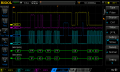
Testing the saving rocket telemetry data to SPI Flash Memory:
AT25DF_9Fh.png
 

Ya’akov

Joined Jan 27, 2019
10,235
Yes, he uses the Arduino IDE for legacy reasons as he said in one of his videos. I don’t think you should reject him because of that. He‘s successfully done what you want to do already and I am certain he has many more launches in his experience.

But, do what you want. I think it’s naive.
 

djsfantasi

Joined Apr 11, 2010
9,237
as he is programming his rockets in the Arduino IDE.
Interesting that you should make that comment. I attended a teleconference last night with Forrest Mims and several other scientists. They described several NASA, NOAA and other international scientific efforts all using THE ARDUINO AND THE ARDUINO IDE. So I can’t understand why you’d reject a project just because it uses the Arduino IDE.

To each their own, I guess.
 

LowQCab

Joined Nov 6, 2012
5,101
Standard Hobby-Model-Servos may be too slow to respond,
I would try PWMing 8 custom-wound, very-short-throw-Solenoids,
as well as adding Fixed-Nose-Fins.

I would also build a vertically oriented Wind-Tunnel for testing stability and response.
.
.
.
 

Thread Starter

Kevil

Joined Jun 28, 2020
224
Standard Hobby-Model-Servos may be too slow to respond,
I would try PWMing 8 custom-wound, very-short-throw-Solenoids,
as well as adding Fixed-Nose-Fins.

I would also build a vertically oriented Wind-Tunnel for testing stability and response.
For flights to about 3 km I assume to use C507 servos.
 

Ya’akov

Joined Jan 27, 2019
10,235
ATSAMD21 is not an Arduino MCU and can run up to 96 MHz, usually on 48 MHz. It can use DSP quaternion library too.

I just need to know the code for dual quaternion sliding mode to control the flight stability and get the right PID coefficients by MATLAB & Simulink.
There is no such thing as an “Arduino MCU”. There is an Arduino IDE and development environment that includes core support for a very large number of MCU development boards including some based on the SAMD21. In fact, I have several Seeed Studio SAMD21 boards and have used the Arduino IDE to program them.

There are some development boards produced the Arduino organization, and those can be called “Arduinos” because it is a brand name in that case. But just because a board is compatible with the Arduino development environment, it doesn’t become your dreaded ”Arduino”. And, if it did then your SAMD21 would be one.

“Arduino” isn’t a dirty word, and it doesn’t taint compatible architecures and dev boards.
 
Top