High WATT Variable DC power supply

Thread Starter

RickSmit

Joined Sep 13, 2024
76
One source of a mains transformer is a scrapped microwave transformer, you need to remove the secondary and wind on the new one with suitable gauge enameled wire.
Typically around 4 turns/volt.
Also punch out the magnetic shunt, if it has one..
I have transformer i can use, i have a broken 2000W solar inverter where i can get high power mosfets and a transformer already suited so 12v to 230v conversion i just need to make it 30V to 230v.....

a question, if i use a mosfet to vary the power output, there was said it might break the ZVS circuit because it is a pwm signal, would it help if i put a capacitor on the output before it goes into the induction heater to smooth the signal out?
 

Ian0

Joined Aug 7, 2020
13,132
a question, if i use a mosfet to vary the power output, there was said it might break the ZVS circuit because it is a pwm signal, would it help if i put a capacitor on the output before it goes into the induction heater to smooth the signal out?
No, that would break the MOSFET.
You would also need an inductor, and then you have made a buck regulator.
 

Futurist

Joined Apr 8, 2025
762
Hello all,,,, i have recently purchased a 1kw induction heater, but i do not have a sufficient power supply to drive it, my highest power supply adapter is 24V4Amp(~100W). and the induction heater is 350W minimum. So i decided to make my own and its been a long time coming. ...
Now i am here to ask how can i make the output a variable amp and variable voltage output, i wanted to do it with a potentiometer voltage divider, like one can do with a motor, but i do not think my potentiometers can run 25-30 amps., so i want to ask how can i make the output variable, high power MOSFETS? or do i add more windings to the transformer and and just get a variable switch? but i do not want to do that unless i really have to.
Please advice me with examples and explanations. Please.
View attachment 359995
Do they recommend any power supplies? can you direct me to the oven's website? is there a manual there?

The oven needs AC so why not simply use a variable transformer? Most (Amazon) seem to be 130v max, so you could attach a 36v fixed transformer between the oven and the variable transformer, giving continuous fine grained variability between 0 to 36v into the oven, very efficient too.

You NEED variable AC, not PWM or any other contrived solution, this is not a problem I'd see as an opportunity to learn about power supply design, very poor fit.
 
Last edited:

Irving

Joined Jan 30, 2016
5,132
Is this the heater in question (or very like it)?

https://www.amazon.co.uk/Voltage-Induction-Heater-Heating-Flyback/dp/B0C3D34F3R

1765030306545.png

If so it needs 50v @ 20A DC for full output, or, as suggested, 24 - 36v @ 3 - 6A for more general use. It is an oscillator so PWM is not an option, but an adjustable SMPS would be. Lots of caveats in product details recommend keeping input current below 15A unless using forced cooling or adding bigger/better heatsinks.
 

BobTPH

Joined Jun 5, 2013
11,523
I think your best bet for a DIY solution is a microwave oven transformer with a new multi-tap secondary, for instance, you could have 4 taps at 24, 28, 32 and 36V. Then all you need is a rotary selector switch, no electronics.
 

Reloadron

Joined Jan 15, 2015
7,891
View attachment 360060
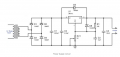
i found this circuit online. can someone please tell me what the ADJ is there, if i can how do i make one(ADJ)?
The ADJ is the Adjustable Pot to adjust the Vout. However, keep in mind that is not quite what you want. The LM317 (U1) is at best a 1.5 amp voltage regulator with adequate heat sink.

Years ago I used the same ZVS posted by Irving above. I used it for annealing brass. A prime consideration is first if you apply voltage to a ZVS it needs to be instant on. Meaning do not apply power slowly ramping it up. What happens is one mosfet will go into conduction and behave as a short. Oscillation will not happen. Eventually the conducting MOSFET will die a tragic death, something has to give.

For a 1.0 KW ZVA you really want a 50 Volt supply capable of 25 Amps. I would run with as suggested above, Hack an old microwave transformer and create taps when you wind a new secondary then find a rotary switch capable of handling the max current. The 50 volts at 25 amps is to leave headroom.

I used an old boat anchor (old liner supply) which weighs about 100 pounds. In your schematic above D1, D2, D3 and D4 would need to be heavy stud mount diodes capable of handling the current needs, the featured 1N4007 diodes are just 1.0 amp diodes. All you really want is a brute power supply and really there is no need for a regulated fancy supply.

Also, if you take the suggested micro wave oven transformer as mentioned earlier make sure when you wind the new secondary you use suitable wire gauge to handle the current.

Ron
 

MisterBill2

Joined Jan 23, 2018
27,552
My guess is that using an existing transformer in reverse will be a lot less work, and in addition it will not require any skill at all in transformer winding. AND, in regard to that statement that it needs an AC supply, I suggest reading post #1 and seeing that the system needs a DC supply.
AND, for induction hardening, the temperature achieved is proportional to the WATT SECONDS APPLIED to the steel being heated. So why is there a problem with applying full power, carefully timed???
 

Futurist

Joined Apr 8, 2025
762
Is this the heater in question (or very like it)?

https://www.amazon.co.uk/Voltage-Induction-Heater-Heating-Flyback/dp/B0C3D34F3R

View attachment 360065

If so it needs 50v @ 20A DC for full output, or, as suggested, 24 - 36v @ 3 - 6A for more general use. It is an oscillator so PWM is not an option, but an adjustable SMPS would be. Lots of caveats in product details recommend keeping input current below 15A unless using forced cooling or adding bigger/better heatsinks.
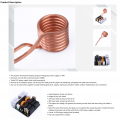
That looks like complete junk, from what I can see the helical coil consists of a short circuited copper winding, the entire helix seems to be a big blob of copper, a short circuit!

Once again @RickSmit may I see the website of the manufacturer? may I see the product specification? does it have a manual or instruction book? why do you refuse to answer these questions?
 
Last edited:

MrChips

Joined Oct 2, 2009
34,820
That looks like complete junk, from what I can see the helical coil consists of a short circuited copper winding, the entire helix seems to be a big blob of copper, a short circuit!
Are you not supposed to stretch out the coil so that the windings don't touch?
 

MisterBill2

Joined Jan 23, 2018
27,552
It might possibly be plastic coated tube. OR the whole product MIGHT BR JUNK!!! The item illustrated in that amazon link tends toward the junk as I see it. Others may not agree. Certainly the coil connections are toy level.
 

Thread Starter

RickSmit

Joined Sep 13, 2024
76
Unless I missed it, we are 34 posts in and have almost zero information about the heater. Photo? Photo of the data label / plate? Link to vendor site? Operating frequency? Datasheet?

ak
1765093948003.png1765094119528.png

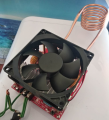
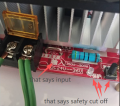
THIS i have said a few times. it is a ZVS induction circuit with main coil doing the heating. it requires 24v-36v about 11amp DC input, its something i bought online and as always they assume you already have the things needed for the stuff you buy.....but okay. i will send a picture. i added my own switch there.
1765094738429.png
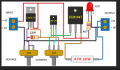
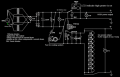
I have upgraded my circuit. to this. i split it into high and lower power outputs(AGAIN low power is for future use) LED are makeshift VOLTMETER so i can see my output amount without LCD screen..

ASSUMING NOW ALL MY COMPONETS ARE RATED FOR HIGH POWER.
am i correct in thinking that what ever i add to the high power side, it will ONLY draw what it needs to right???? or will the mains dump 36V10000amps in there just to blow it up?
 

MisterBill2

Joined Jan 23, 2018
27,552
The label on the device shown in post #36 is quite clear that DC is required: 24 to 36 volts. So THAT question is answered again.
And now, once again, I am asking as to why not simply control the TIME that the energy is applied?? I think that is frequently done in the induction hardening process, since time is much easier to control accurately. OR is that too different to even consider??
Certainly an adequate current non-regulated DC power supply is much simpler to create.
Or is this too far off topic??
 

Futurist

Joined Apr 8, 2025
762
The label on the device shown in post #36 is quite clear that DC is required: 24 to 36 volts. So THAT question is answered again.
And now, once again, I am asking as to why not simply control the TIME that the energy is applied?? I think that is frequently done in the induction hardening process, since time is much easier to control accurately. OR is that too different to even consider??
Certainly an adequate current non-regulated DC power supply is much simpler to create.
Or is this too far off topic??
I suspect you've fallen victim to junk @RickSmit . This isn't well designed IMHO, the fact you're having such trouble getting it to just run kind of proves that, I also suspect that device generate a lot of electrical and RF noise, probably has no FCC compliance certificate.

With the effort you seem willing to invest in the PSU, you might as well build the entire thing yourself.

Frankly at this point I'd recommend using two/three 12v car batteries.
 
Last edited:

MisterBill2

Joined Jan 23, 2018
27,552
After looking at the circuit shown in post #36 more closely, it looks like shunt zener diode regulation of both outputs. That is a poor choice for any high current power supply.
In addition, that entire circuit does not appear to be an adequate power supply.
 
Top