Facebook
 Google
 GitHub
 Linkedin
Hi all,
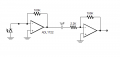
I am not an EE by training so please bare with me. I designed a photoconductor amplifier with two stages with a gain of 100x each. We want to measure signals that are typically around 1 muV from a modulated infrared light source (using a chopper wheel, maximum 1kHz).
Here is the circuit I came up with:
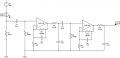
The bias voltage is provided by an external SMU, the op amps are battery powered. The schematic omits the bypass caps for both, the SMU and amps are bypassed by 0.1 and 10 nF ceramic caps. Currently, it is built using a perfboard and using dip sockets for the ICs.
The circuit works and we can detect the modulated signals both on a scope and using a lock in amplifier. For this particular application it is "good enough", however in the process of learning about these circuits I got interested and I would like to improve the design so I have a number of questions:
Thank you all!
I am not an EE by training so please bare with me. I designed a photoconductor amplifier with two stages with a gain of 100x each. We want to measure signals that are typically around 1 muV from a modulated infrared light source (using a chopper wheel, maximum 1kHz).
Here is the circuit I came up with:
The bias voltage is provided by an external SMU, the op amps are battery powered. The schematic omits the bypass caps for both, the SMU and amps are bypassed by 0.1 and 10 nF ceramic caps. Currently, it is built using a perfboard and using dip sockets for the ICs.
The circuit works and we can detect the modulated signals both on a scope and using a lock in amplifier. For this particular application it is "good enough", however in the process of learning about these circuits I got interested and I would like to improve the design so I have a number of questions:
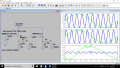
- There is a significant amount of noise. It seems to be random (I cannot see any characteristic frequencies other then my modulation using the FFT on the scope). Here is a link to a video of the scope readout. https://giphy.com/gifs/fdVrmojnIF4WE7PwGn As you can see, the readout "jitters" and I wonder what causes this. The scope is triggered by the external reference of the chopper, so it seems that the signal changes with time and does not always arrive at the scope at the exact time relative to the reference. What causes this? And is there any way of fixing this?
- I chose to use the ALS1722 since it is described in the specs as usable for "a broad range of precision applications requiring extremely low input signal power". Is this a good choice? Are there better op amps for this purpose?
- As I mentioned, the circuit is currently put together on a perfboard, inside a metal project enclosure for shielding. I currently use a bare 22 gauge wire soldered to the backside of the board as ground rail. How much, if any, improvement can I expect by actually creating a PCB with a dedicated ground plane and smd components? Is it worth using guarding techniques on the opamp input if making a custom PCB? Would an additional EMI shield on the board help?
Thank you all!



 pen circuit) and Suppression.