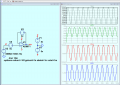
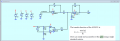
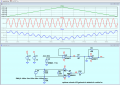
i also want to know advantage if opam AD8671 used instead place of AD8221 any noise increase? in LTspice simulation OpamAD8671 foolwer circuit dont show signal vack frlow from output pin to input pin while in case og AD8221 i observe back signal flow
i also want to know advantage if opam AD8671 used instead place of AD8221 any noise increase? in LTspice simulation OpamAD8671 foolwer circuit dont show signal vack frlow from output pin to input pin while in case og AD8221 i observe back signal flow
i also want to know advantage if opam AD8671 used instead place of AD8221 any noise increase? in LTspice simulation OpamAD8671 foolwer circuit dont show signal vack frlow from output pin to input pin while in case og AD8221 i observe back signal flow
Yes, i wonder what advantage of usinf AD8221 over AD8671? that sine wave will come from function generator of other circuit.
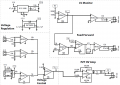
Also can you please tell me refer to original post circuit -
1) Why in first place instrumental amplifier AD8221 used instead can we use opam? what kind of problem we face if we use opam instead instrumental amplifier? As both work seems in principal .
2) Reverse also posible like if instrumental amplifer can be used in place of AD8671 voltage follower/ buffer circuit? if instrumental amplifier noise reduction is so much good.
3) It seems instrumental amplifer used as voltage follower/ buffer only in input or taking output . while other places opam used. Any reason for such use?
Thank for your answers . I want gain 1, that's why don't want to use any resistor between two RG resistors. I have read datasheet and books. Can you kindly please tell me-
1) Why in first place instrumental amplifier AD8221 used instead can we use opam? what kind of problem we face if we use opam instead instrumental amplifier? As both work seems in principal .
2) Reverse also posible like if instrumental amplifer can be used in place of AD8671 voltage follower/ buffer circuit? if instrumental amplifier noise reduction is so much good.
3) It seems instrumental amplifer used as voltage follower/ buffer only in input or taking output . while other places opam used. Any reason for such use?
Sorry i am asking too much
) Why in first place instrumental amplifier AD8221 used instead can we use opam? what kind of problem we face if we use opam instead instrumental amplifier? As both work seems in principal .
hi j,
Looking at post #1.
The AD8221 have inputs of In1 and In2, the signals of which may have a high common mode CMV voltage?
And a very low level differential voltage and so a INA is the best choice.
Do you have any information for the In1 and In2 signal inputs?
The AD221 being a INA type has a high CMRR specification
Clip from the d/s explains this: The AD8221 is a gain programmable, high performance
instrumentation amplifier that delivers the industry’s highest
CMRR over frequency in its class. The CMRR of instrumentation
amplifiers on the market today falls off at 200 Hz. In contrast,
the AD8221 maintains a minimum CMRR of 80 dB to 10 kHz
for all grades at G = 1. High CMRR over frequency allows the
AD8221 to reject wideband interference and line harmonics,
greatly simplifying filter requirements. Possible applications
include precision data acquisition, biomedical analysis, and
aerospace instrumentation.
I would suggest you look at the d/s for each of the INA and standard OPA's and compare their internal circuitry.
IN1 is a triangular/sine wave signal with a frequency range of 10-30 Hz and an amplitude of 1-5V. It functions as a high-voltage, low-frequency piezo driver, where the triangular/sine wave is superimposed onto a DC signal. IN2 is an error correction feedback signal, but I don’t have its specific details.
Can we generalize that for DC signals, a voltage follower/buffer op-amp with a gain of 1 is sufficient, while for non-DC signals, an instrumentation amplifier would be better? Additionally, if you observe the Mon Out and FF Out, an instrumentation amplifier is used instead of an op-amp. Despite researching this, I still don’t fully understand the rationale behind using an instrumentation amplifier in these cases. The person uses the AD8671 as a voltage follower buffer for high voltage, but later employs an instrumentation amplifier in the Mon Out and FF Out. I would like to understand the principles behind this choice.

 Facebook
 Google
 GitHub
 Linkedin