Here we go again, Round-abouts. !

Thread Starter

MaxHeadRoom

Joined Jul 18, 2013
30,758
Recent article in the news was the confusion in the US when a US state next door here introduced roundabouts.
Having grown up in the UK, coming to Canada in the early '70's, I was suprised by the number of gas wasting 4 way intersections.
The reason for the confusion IMO, is the foisting on the general public with the total lack of education on their useage.
The result here was drivers going the wrong way around etc, etc.
I had always considered them a boon, and was very glad I grew up with them.
 
Last edited:

BobTPH

Joined Jun 5, 2013
11,596
We call the rotaries here in Massachusetts, and they are everywhere. The rule is that the vehicle in the rotary has the right-of-way, but only about half the drivers seem to know that.
 

Ian0

Joined Aug 7, 2020
13,202
I’m in favour. There are five on my 15 mile drive to work. Traffic slows down but rarely stops, and when there is no traffic there is no needless waits like with traffic lights. Statistically, they are a lot safer than trafffic light (no equivalent of “running a red light” or you crash into the vegetation in the middle).
They work less well when traffic backs up in all directions.
I wouldn’t want to Live in Milton Keynes as it has 130 of them.
 

crutschow

Joined Mar 14, 2008
38,617
I like them in general for high traffic areas, but they are annoying when used in a residential area with a slow speed-limit and little traffic, where a side-street stop-sign would have been sufficient.
 
I like them in general for high traffic areas, but they are annoying when used in a residential area with a slow speed-limit and little traffic, where a side-street stop-sign would have been sufficient.
Until now I haven’t noticed or given thought to a couple factors. A full stop requires using maybe more gas than a non-stop round about. But, here near a university at times can be difficult. I don’t mind them.

kv
 

WBahn

Joined Mar 31, 2012
33,029
The problem I have seen with them here is that, when they first came in (and to some degree still today), there was a bandwagon effect in which everyone raced to put them in everywhere to show how they were keeping up with the latest trends, including at many places where, if a traffic circle weren't used, a simple 2-way stop would be used. They are very good solutions for certain types of intersections that have certain types of traffic patterns, and poor fits for other types of traffic patterns. A couple of traffic patterns where they aren't so good are places where side-street traffic is very minimal while main street traffic not so heavy so as to prevent side street traffic from getting in. Here, the main traffic has to slow down and then speed up, wasting energy, while the process also compresses traffic making it even harder for the side-street traffic to get through. Another place where they have difficult is during heavy traffic periods which can make it very difficult for traffic to enter. Part of this is because, at least around hear, almost all traffic circles have only one or two lanes, either entering/exiting or within them, and are physically quite small, thus having almost no distance between entry/exit points. Another downside is their inflexibility, making it hard for them to work well overall at intersections that see drastically different traffic patterns over the course of the day, week, or year, whereas stoplight intersections have the ability (though often not well utilized) to adjust there behavior, even in real time, to changing traffic conditions.

I suspect that if we were to list the top cost/benefit options for improving energy efficiency and/or reducing carbon footprint, working to optimally time and progress traffic lights would be pretty high on the list. It would also go a long way toward taming the frustration-induced reckless driving that is growing more common. In the Denver area, when I was a teenager, the major grid streets were very well progressed and, at the time, it was a rigid progression (no network interconnection to let them be controlled dynamically). They were set up so that if you travelled the speed limit, you would get through green-light after green-light from one end of the metro area to the other. At night, when traffic was light, it was not uncommon to go twenty or more miles, passing through dozens of traffic lights, without hitting a single red. But if you insisted on speeding, you would very quickly outrun the light progression and hit a red light. At busy intersections that were not on the major grid, lights were fully-instrumented and very responsive to changing traffic conditions. Some even had far-reach loops to detect traffic far enough out so that, at light traffic times, they were able to get nearly everyone a green light before they had to start slowing down. It was also not uncommon to have lights that went to flashing red/flashing yellow during very low-traffic conditions (usually over night) or perhaps flashing red all around. This eliminates one of the greatest sources of frustration, which is pulling up to a red light and then having to sit through an entire cycle, which at major intersections can be over three minutes, waiting for a green light. Even more frustrating when you pull up to make a left turn and just miss the trigger window and so now you have to sit through two complete cycles before finally getting a green arrow even though not a single other car came in any direction. Unfortunately, I see intersections (with new or newly redone lights) where I have to scratch my head at the thinking behind the control algorithms (and, increasingly, I shake my head and assume it must be AI controlled) that will give a green light for two seconds for the main road, that has traffic on it, and then give a full minute or more for the side road, that has zero traffic, then give a full amount of time for the left-turn lanes on the main road, even though they are completely empty, and then only let a few cars through the main road the next cycle because it's again only green for a few seconds. Or closely spaced lights (a block or less apart because they are at entrances to shopping centers and such) that are the only lights around, and yet aren't synchronized in any way such that it is not uncommon to get a green light at the first one and then barely miss the next one catching the yellow, then having this repeat again at the next light. It's not hard to imagine why people get frustrated and run the red lights.
 

Ian0

Joined Aug 7, 2020
13,202
Britain has had roundabouts a long time, you can tell from the height of the trees! They were often put in where there was no electricity supply for traffic lights IMG_2368.jpeg
(This is the first one I encounter on my way to work) They were commonplace when I passed my driving test in 1981. The work best if the amount of traffic turning into any road is about the same as the amount of traffic emerging from that road.
if one entrance is a one-way street so no traffic can turn into it, then they are hopeless, and no-one coming out of the oneway street gets a chance.
 

SamR

Joined Mar 19, 2019
5,513
After living in Alabama where a Yellow Light means "hit the gas Myrtle before it turns Red"... Round-a-bout confusion is not too bad a deal. Now if I can only convince my wife that Yield does not mean stop and then look to see if anything's coming. Yes, I married a Bama gal...
 

atferrari

Joined Jan 6, 2004
5,018
My daughter used to constantly criticize my driving speed down here, but now that she lives in Italy, near Milan, things have changed. Roundabouts everywhere over there, I only remember seeing a couple of traditional traffic lights in the entire area and I was really surprised by how fast she drives now, and how quickly everyone approaches the roundabouts. It actually works out quite simply: everyone just strictly obeys the yield triangles painted on the road.
 

WBahn

Joined Mar 31, 2012
33,029
Britain has had roundabouts a long time, you can tell from the height of the trees! They were often put in where there was no electricity supply for traffic lights View attachment 369983
(This is the first one I encounter on my way to work) They were commonplace when I passed my driving test in 1981. The work best if the amount of traffic turning into any road is about the same as the amount of traffic emerging from that road.
if one entrance is a one-way street so no traffic can turn into it, then they are hopeless, and no-one coming out of the oneway street gets a chance.
Even that one-lane roundabout is much larger in diameter than the largest roundabout I have ever seen here (in Colorado). I'll try to make a detour tomorrow to get a picture of what we have here.
 

WBahn

Joined Mar 31, 2012
33,029
After living in Alabama where a Yellow Light means "hit the gas Myrtle before it turns Red"...
There's certainly a lot of that here. I don't have a problem with it, too much, provided you actually get into the intersection (i.e., the front bumper crosses the threshold) before the light turns red (which is all that is legally required). There is a three second all-red delay between the light turning red for one direction and turning green for the other, and I constantly see cars entering the intersection after the light turns green for the other way, assuming the other person will see them and hesitate, which can be a very bad assumption. It's been getting steadily worse here, but I was recently in L.A. and reminded that we still don't hold a candle to the crazy way they drive.

When I was in Taiwan about 18 years ago I discovered that in the north of the country stop lights are strong suggestions and stop signs are veiled hints. In the south, they aren't even a mild heads-up and are completely ignored. Three times I saw cars (taxis, each time) drive on the sidewalk to get around traffic. What bothered me the most was how no one was willing to not enter an intersection that was already blocked, resulting in complete, and completely avoidable, gridlock.
 

BobTPH

Joined Jun 5, 2013
11,596
There is a three second all-red delay between the light turning red for one direction and turning green for the other, and I constantly see cars entering the intersection after the light turns green for the other way
I do a lot of walking in the city and I regularly see cars racing into the intersection after my walk light is on. If I didn’t watch for them, I am sure I would have been hit by now. I call this new shade of red “Worcester green”.

Soon after I moved here, I stopped quickly when my light turned yellow and was rear-ended. Now I check the rear-view mirror before stopping at a yellow as required.
 

MrChips

Joined Oct 2, 2009
34,982
I was once in a roundabout like that and couldn't decide which exit I needed to take.
I must have gone around about five times before exiting!
 

Thread Starter

MaxHeadRoom

Joined Jul 18, 2013
30,758
As I indicated, I am in favour of roundabouts, especially when replacing traffic lights .
But a recent develoment close to me had me shaking my head.
We have a perimiter highway that circles the city, in order that anyone by-passing the city will have no need to travel through the city itself, and clover-leaf junctions have been replacing traffic lights in order there will be no stopping for through traffic and those crossing the said perimeter.
This seems to work fine.
Now someone in city planning seems to have decided that is too simple, when the traffic-light intersection near me was ready for conversion.
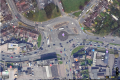
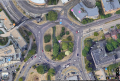
Someone came up with the idea that involved a bridge and two roundabouts! At a cost of 135Milion Can.
To me, It borders on something that Rube Goldberg/Heath Robinson would come up with! o_O
 
Top