Help with op-amp circuits

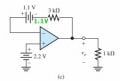
The voltage at the "+" input of the opamp is 2.2 V, so what must be the voltage at the "-" input?

No current flows into the inputs of an ideal opamp, so what must be the current in the 3k resistor?
 

dl324

Joined Mar 30, 2015
18,329
So v_o=1,1V
That's the answer for the circuit in post #24. Your answer in post #25 is correct for your problem.

You've been taught what the equations are for calculating gain for typical inverting and non-inverting opamps; those equations were derived by using the zero differential input voltage theorem and possibly the voltage divider equation. Using that theorem is how we solve the problems you were given.
 

Thread Starter

sebholm

Joined Dec 18, 2020
20
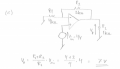
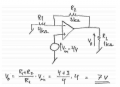
Okay thanks, it helped! Have solved 10 of these circuits now and got them correct. I can´t seem to solve this/figure out why you solve it this way:
1608489065800.png
 

Audioguru again

Joined Oct 21, 2019
6,826
The voltage gain for the non-inverting opamp is (3k/4k) + 1= 1.75 and since the input is 4V then the output is 7V if the opamp is powered properly (it has no power supply).
Your guesses work but are fine and correct.
I added some contrast to your sketch:
 

Attachments

dl324

Joined Mar 30, 2015
18,329
I can´t seem to solve this/figure out why you solve it this way
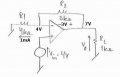
You can also solve it this way:
clipimage.jpg
Using the zero differential input theorem, the voltage at the inverting terminal is 4V. That causes a 1mA current in R1 in the indicated direction. Since the current entering and leaving a node is equal, the current in R2 is also 1mA. 4V + 3V makes the output 7V.
 
Top