Facebook
 Google
 GitHub
 Linkedin
Hello everyone,
One of my recent projects has been making computer controlled light systems in my house. Up till now I've been using low power ( < 50V) mosfets and LED's, with no problems.
Now I'm trying to PWM control a set of 50W Halogen lights (240V). I figured that being incandescent lights, they would not care if they were fed AC or DC. DC was easier to control for me, as I've already built the circuits (and no need to deal with triac's and the zero crossing). As such I decided to use a high power mosfet for switching, with a 4N25 optocoupler to shield the hot side from the PIC microcontroller and other low-voltage components.
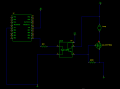
The circuit is attached. It is rather simple. When testing, I took Vcc up to 30V using 5W lamps without any problems (this is as far as my bench psu can provide).
However when I fed it mains DC* (attached to 50W lamp), I blew the fuse, the optocoupler and the mosfet in one swoop.
Replacing the blown components and tested at 30V again, and it all works as intended. Further attempts at mains power (with a lower rated 3A fuse) resulted in the fuses just blowing.
As this is my first foray into mains electronics (up till now its all been low voltage), there could be something simple yet specific to high voltages that I am getting wrong, so any help appreciated.
The mosfet is an IRFP350, rated at Vmax of 400V and 16A, and the optocoupler should also be able to handle it (there was no Vmax specified in the datasheet I saw, but a Vtyp of 150V), so I don't believe I've pushed the components beyond their limits.
* Mains AC, full-wave rectified with no smoothing.
One of my recent projects has been making computer controlled light systems in my house. Up till now I've been using low power ( < 50V) mosfets and LED's, with no problems.
Now I'm trying to PWM control a set of 50W Halogen lights (240V). I figured that being incandescent lights, they would not care if they were fed AC or DC. DC was easier to control for me, as I've already built the circuits (and no need to deal with triac's and the zero crossing). As such I decided to use a high power mosfet for switching, with a 4N25 optocoupler to shield the hot side from the PIC microcontroller and other low-voltage components.
The circuit is attached. It is rather simple. When testing, I took Vcc up to 30V using 5W lamps without any problems (this is as far as my bench psu can provide).
However when I fed it mains DC* (attached to 50W lamp), I blew the fuse, the optocoupler and the mosfet in one swoop.
Replacing the blown components and tested at 30V again, and it all works as intended. Further attempts at mains power (with a lower rated 3A fuse) resulted in the fuses just blowing.
As this is my first foray into mains electronics (up till now its all been low voltage), there could be something simple yet specific to high voltages that I am getting wrong, so any help appreciated.
The mosfet is an IRFP350, rated at Vmax of 400V and 16A, and the optocoupler should also be able to handle it (there was no Vmax specified in the datasheet I saw, but a Vtyp of 150V), so I don't believe I've pushed the components beyond their limits.
* Mains AC, full-wave rectified with no smoothing.
Attachments
-
 11.3 KB Views: 53