Facebook
 Google
 GitHub
 Linkedin
dear list,
i have just finished making a touch sensitive keyboard, where each of the touch nodes output 5v logic as you touch them.
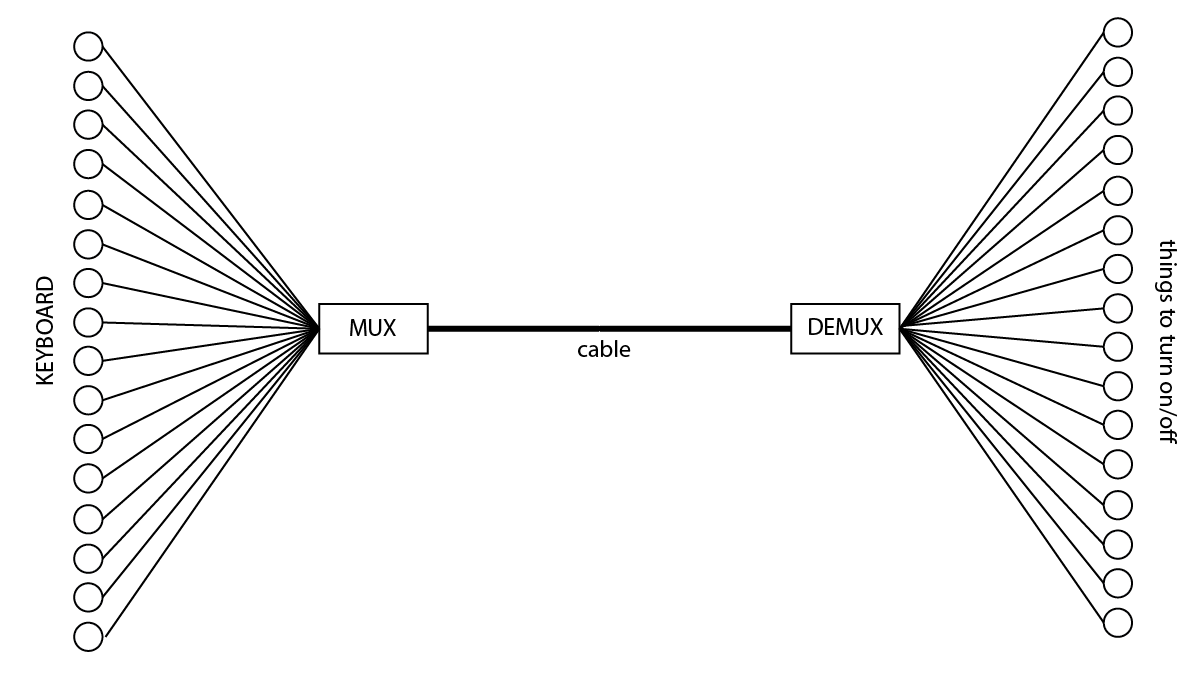
i need these signals to be sent to another module through a cable, to turn things on/off - so rather than using a bulky 30 wire cable to get the control signals where i need them, i thought the 4067 multiplex breakout from sparkfun might come handy :: https://www.sparkfun.com/products/9056
i understand this mux chip can also serve as a demultiplexer, however i dont quite understand how to pack the button states into a single datastream on the keyboard side, and how to unpack them on the other.
would i be able to use another 4067 chip in reverse? or do i need an arduino to scan through the inputs at high speeds?
here is a diagram of what i need to do:
any thoughts would be greatly appreciated!!
all the best,
-úlfur
i have just finished making a touch sensitive keyboard, where each of the touch nodes output 5v logic as you touch them.
i need these signals to be sent to another module through a cable, to turn things on/off - so rather than using a bulky 30 wire cable to get the control signals where i need them, i thought the 4067 multiplex breakout from sparkfun might come handy :: https://www.sparkfun.com/products/9056
i understand this mux chip can also serve as a demultiplexer, however i dont quite understand how to pack the button states into a single datastream on the keyboard side, and how to unpack them on the other.
would i be able to use another 4067 chip in reverse? or do i need an arduino to scan through the inputs at high speeds?
here is a diagram of what i need to do:
any thoughts would be greatly appreciated!!
all the best,
-úlfur