help with combinational logic problem

Thread Starter

Coefficient

Joined Sep 5, 2012
75
Sometimes ambiguous questions are asked to see if the student knows enough to know that's the case.

What I would do is ask clarifying questions. If that isn't possible, or allowed, solve the problem and state your assumptions.
Is what you posted in your first post the exact wording of the problem?
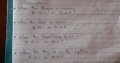
that's the exact wording of the problem.....
For simple problems like this, just reading the conditions solves the problem; but won't necessarily give the simplest expression. A Kmap makes obtaining the simplest expression easy and using one couldn't be considered wrong or misguided unless the instructions prohibited their use.
if this question is simple,kindly assist with the steps as i have tried attempting it at all,Using KMap method or any other method would help.believe me when this answer is detailed down here,i will understand provided it is not advanced.like i said,this is applied question,any method employed is welcomed as far as the answer is correct
 

Thread Starter

Coefficient

Joined Sep 5, 2012
75
View attachment 121648

First, what is a "headlarm"? Do you mean that the headlight is on?

Ask your self if this makes sense. First, why are the top two rows identical? Do you have a column that you aren't showing us?

Look at the third (and fourth) row. You are showing that the alarm is on if the headlight is on, the key is not in the ignition, and the door is not open. Is that one of the situations in which the alarm is supposed to sound?

Take a moment to be sure that you understand the problem. There is no point trying to find a solution to a problem that you don't understand.
it is head lamp .a constructive explanation would help me understand this question..if i understood this in the first place, i wouldn't have brought it up here.
Thanks for the response
 

WBahn

Joined Mar 31, 2012
32,844
What is it, specifically, that you are struggling with?

Do you understand what the behavior is supposed to be?

Do you understand what your input signals and output signals are?

How many inputs do you have? What are they? What does each possibility for each input represent?

How many outputs to you have? What are they? What does each possibility for each output represent?

Do you understand what a truth table is?

Can you make an attempt at putting together a complete truth table?
 

dl324

Joined Mar 30, 2015
18,328
if this question is simple
We don't do homework problems. You won't learn and we won't be there to take your tests.

Using the description of the problem, write a description of the conditions that will trigger an alarm; making sure to use AND and OR to describe the conditions.

For example. Sound the alarm if the door is open AND the light is on ... Then assign variables for each condition and write the boolean equation.
 
Last edited:

Thread Starter

Coefficient

Joined Sep 5, 2012
75
I am about to bow out, since I don't think going back and forth helps the TS. But I think this thread illustrates a common problem. A simple problem to us brings forth discussions of how every possibility might be addressed. Sometimes, alternatives arise, which have no bearing on the original problem.

Granted, there are times when this is appropriate. I am not talking about those. In the cases I have described, we confuse and frustrate the TS.

He has not been taught about kmaps. There is no hint in his description that his instructor expects the simplest solution. In reality, how could he, since he had not taught the subject yet?

Ponder whether the forum has done the TS a disservice.
i think it doesn't matter the method employed here so far it is an assignment and you must get it correctly. Kindly assist with any method to enable me understand. I understand easily when taught,i brought it up here because i don't know it.there are problems i handle on my own without bringing it up here.
Thanks for your response so far
 

WBahn

Joined Mar 31, 2012
32,844
it is head lamp .a constructive explanation would help me understand this question..if i understood this in the first place, i wouldn't have brought it up here.
Thanks for the response
Do you understand the concept of: The alarm should be turned on if the car door is open while the engine is running.

Do you understand the concept of: The alarm should be turned on if the car door is open while the headlamps are on.

Do you understand the concept of: The alarm should be turned on if the car door is open while the key is in the ignition.

Do you understand the concept of: The alarm should be turned on if ANY of the prior three conditions are true?

If not, then let's not go any further until you do.

If you do understand all of these concepts, then the next step is to define your input and output signals.
 

WBahn

Joined Mar 31, 2012
32,844
i think it doesn't matter the method employed here so far it is an assignment and you must get it correctly.
Well, in that case, just PM me your name, your university's name, the course number, your instructor's name, and their e-mail address. That way I can go ahead and cut out the middleman and work it out nice and neat for you and submit it directly for grading so that you can get the credit you deserve for it.
 

Thread Starter

Coefficient

Joined Sep 5, 2012
75
Well, in that case, just PM me your name, your university's name, the course number, your instructor's name, and their e-mail address. That way I can go ahead and cut out the middleman and work it out nice and neat for you and submit it directly for grading so that you can get the credit you deserve for it.
i am here to understand sir and not to pass the assignment only,i am sorry for the wrong use of words
 

Thread Starter

Coefficient

Joined Sep 5, 2012
75
We don't do homework problems. You won't learn and we won't be there to take your tests.

Using the description of the problem, write a description of the conditions that will trigger an alarm; making sure to use AND and OR to describe the conditions.

For example. Sound the alarm if the door is open AND the light is on ... Then assign variables for each condition and write the boolean equation.
thanks for the idea,i am beginning to catch a bit
 

Thread Starter

Coefficient

Joined Sep 5, 2012
75
Do you understand the concept of: The alarm should be turned on if the car door is open while the engine is running.

Do you understand the concept of: The alarm should be turned on if the car door is open while the headlamps are on.

Do you understand the concept of: The alarm should be turned on if the car door is open while the key is in the ignition.

Do you understand the concept of: The alarm should be turned on if ANY of the prior three conditions are true?

If not, then let's not go any further until you do.

If you do understand all of these concepts, then the next step is to define your input and output signals.
i understand all of these..i was thinking it could only get one output signal,i mean for the alarm to sound.
 

WBahn

Joined Mar 31, 2012
32,844
i understand all of these..i was thinking it could only get one output signal,i mean for the alarm to sound.
Okay, so you have one output signal. But saying you have one signal to sound the alarms isn't enough. You need to define its levels. Does the alarm sound when it is HI, or when it is LO?

You need to do the same for your input signals. How many? What do they each mean? What level tells you what?
 

djsfantasi

Joined Apr 11, 2010
9,237
i think it doesn't matter the method employed here so far it is an assignment and you must get it correctly. Kindly assist with any method to enable me understand. I understand easily when taught,i brought it up here because i don't know it.there are problems i handle on my own without bringing it up here.
Thanks for your response so far
WBahn is an excellent teacher. He is proceeding along the path I started. For example, he has also asked you to identify your inputs and outputs.
 

Thread Starter

Coefficient

Joined Sep 5, 2012
75
Okay, so you have one output signal. But saying you have one signal to sound the alarms isn't enough. You need to define its levels. Does the alarm sound when it is HI, or when it is LO?

You need to do the same for your input signals. How many? What do they each mean? What level tells you what?
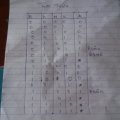
Please see the attached and comment on it
WBahn is an excellent teacher. He is proceeding along the path I started. For example, he has also asked you to identify your inputs and outputs.
 

Attachments

dl324

Joined Mar 30, 2015
18,328
Reduced image:
upload_2017-3-3_10-54-19.png
E=engine running
D=door
H=headlamp
K=key in ignition

Please define what the column headings mean. When you start using Kmaps, you'll find that arranging rows in gray code format (single variable changing between rows), will make it easier to populate the maps.

EDIT: never mind, it was in the other photo in a long winded description

When you're writing the expression, you can use the don't cares to simplify the logic. You say you haven't studied Kmaps yet?

I wouldn't consider the rows you marked as don't cares, don't cares.

If you gave some thought to the table, you'll understand why you should have made D the first column instead of engine running. The alarm can't sound unless the door is opened.
 
Last edited:

dl324

Joined Mar 30, 2015
18,328
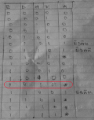
Is the row circled in red really a don't care? What is the primary condition required for any alarm event?
upload_2017-3-3_11-18-10.png
 

WBahn

Joined Mar 31, 2012
32,844
Please see the attached and comment on it
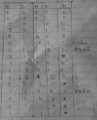
Comment #1: Don't use multi-megabyte files to convey things that can be conveyed in a tiny fraction of that. Just because you have a cell phone that can take a picture with several million pixels doesn't mean you have to subject members (many of whom have slow connections) to that. Scaling to an image width of somewhere between 300 and 500 pixels is usually a safe bet, particularly if you crop out the unneeded portions first. This entire process can be done in a minute or two with Paint or similar program.

Consider the following scaled down image:

20170303_104250-1.jpg
It is 46 kB as opposed to over 1800 kB -- less than 3% of the size of the original.

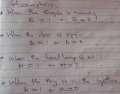
This is a good start, but you haven't actually specified what the states mean. For instance, saying that E = 1 or E = 0 when the engine is running technically says that E can take on either value when the engine is running. This would be similar to saying that when I'm at home the TV could be on or it could be off. As a result, you can't use the state of the TV to say whether or not I am at home. But if I say: I'm at home: TV = ON, else TV = OFF, then you know that if the TV is ON, that I am at home and if the TV is OFF that I am not.

A slight rewording of these information is all that is needed. For instance, consider:

E: Indicates whether or not the engine is running. TRUE = running.

20170303_104257-1.jpg

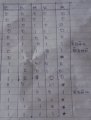
Does the * entries mean "don't care"?

If so, ask if this makes sense.

You are saying, for instance, that if the car door is open and the headlamp is on and the key is in the ignition, that you don't care whether the alarm is on or off. Is that truly the case?

As another example, you are claiming that if the door is closed while the engine is running, the key is in the ignition, and the headlamps are on that you also don't care whether or not the alarm is on. Is that truly the case?

Remember how important I said it was to be sure that you understood what the problem was asking for otherwise it would be nearly impossible to correctly solve it?
 

dl324

Joined Mar 30, 2015
18,328
and comment on it
Don't be discouraged. You are making progress.

If you had described the E variable as:
When the Engine is running, E=1. When the Engine is not running, E=0.
Intent would have been clearly understood.

Or you could have simply said:
E = Engine running. It would be understood that 1 (True) means it's running and 0 (False) means it is not running.

The point we've made about don't cares is that, if you think about it, they aren't really don't cares.
 
Last edited:

Thread Starter

Coefficient

Joined Sep 5, 2012
75
Comment #1: Don't use multi-megabyte files to convey things that can be conveyed in a tiny fraction of that. Just because you have a cell phone that can take a picture with several million pixels doesn't mean you have to subject members (many of whom have slow connections) to that. Scaling to an image width of somewhere between 300 and 500 pixels is usually a safe bet, particularly if you crop out the unneeded portions first. This entire process can be done in a minute or two with Paint or similar program.

Consider the following scaled down image:

View attachment 121751
It is 46 kB as opposed to over 1800 kB -- less than 3% of the size of the original.

This is a good start, but you haven't actually specified what the states mean. For instance, saying that E = 1 or E = 0 when the engine is running technically says that E can take on either value when the engine is running. This would be similar to saying that when I'm at home the TV could be on or it could be off. As a result, you can't use the state of the TV to say whether or not I am at home. But if I say: I'm at home: TV = ON, else TV = OFF, then you know that if the TV is ON, that I am at home and if the TV is OFF that I am not.

A slight rewording of these information is all that is needed. For instance, consider:

E: Indicates whether or not the engine is running. TRUE = running.

View attachment 121752

Does the * entries mean "don't care"?

If so, ask if this makes sense.

You are saying, for instance, that if the car door is open and the headlamp is on and the key is in the ignition, that you don't care whether the alarm is on or off. Is that truly the case?

As another example, you are claiming that if the door is closed while the engine is running, the key is in the ignition, and the headlamps are on that you also don't care whether or not the alarm is on. Is that truly the case?

Remember how important I said it was to be sure that you understood what the problem was asking for otherwise it would be nearly impossible to correctly solve it?
Don't be discouraged. You are making progress.

If you had described the E variable as:
When the Engine is running, E=1. When the Engine is not running, E=0.
Intent would have been clearly understood.

Or you could have simply said:
E = Engine running. It would be understood that 1 (True) means it's running and 0 (False) means it is not running.

The point we've made about don't cares is that, if you think about it, they aren't really don't cares.
hello All,

let me retry,all the responses so far got me more confused,
i appreciate everyone.
my intent was not to include "don`t care",thought i could bring it in.as earlier advised,i will have to re-read the question to enable correct my error.
 
Top