Help with analyzing a DC circuit

Thread Starter

mapisto

Joined Dec 25, 2009
36
Hi,
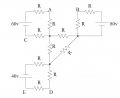
I've got a circuit which i have no idea what i'm supposed to do with. some of the resistors are in series, which simplifies the who business, but there are also more than 1 voltage sources and i've got no idea what to do with those.

please help :(

i've attached the sircuit.

thanks!!

p.s- i'm supposed to find the following voltages: Vab, Vae, Vcb, Vbd, Vda.
 

Attachments

Last edited:

t_n_k

Joined Mar 6, 2009
5,455
Ask yourself if there is any current flowing in the three resistors formed as a triangle at the "center" of the circuit....
 

Thread Starter

mapisto

Joined Dec 25, 2009
36
Ask yourself if there is any current flowing in the three resistors formed as a triangle at the "center" of the circuit....
I see what you mean, the current won't even go there and would stay in each of the 3 little parts of the circuits which have voltage sources of their own....

thanks!!
 

t_n_k

Joined Mar 6, 2009
5,455
The trick now is to realize how you would determine the potential differences mentioned as part of the question - for instance how would you determine Vab?
 

Thread Starter

mapisto

Joined Dec 25, 2009
36
That's right - where is the common reference node for Va & Vb?
that always got me cunfused : \

well, from KVL i know that i'll have to calculate the voltage drop upon one resistor ( which will be devided equaly from the total resistance because all the have the same resistance) and remove it from the total voltage coming out from the source (that's for the first resistor that is the closest to the source and which the current flow through him first). then for the second one, i'll take the voltage which was in the first one and remove from it the same amount of voltage which i've removed in the first one.

then between those 2 resistors, the voltage upon the coil will be the same in every spot. so i can place the imaginary nod in the corner let's say... and then do the same to the other spot which i want to check it with.

is that right ? : \
 

t_n_k

Joined Mar 6, 2009
5,455
You can choose any point as a reference node. Interestingly, since no current flows in the central triangle of resistors you can remove them from the analysis and replace them with a single common node - the potential anywhere around the triangle loop is the same. This "substituted" node could then be used as a reference node.

This is a valid approach as long as no additional loading is applied to the circuit - for instance, by placing a resistor between A & B. Drawing current between A & B would then mean current would flow in the resistor triangle.
 

Thread Starter

mapisto

Joined Dec 25, 2009
36
This is a valid approach as long as no additional loading is applied to the circuit - for instance, by placing a resistor between A & B. Drawing current between A & B would then mean current would flow in the resistor triangle.
I'm sorry, I didn't quite understand your last phrase (the one i've quoted).
could you please explain your meaning?

thank you for your patience.
 

miguel cool

Joined Mar 15, 2010
9
Well to develop a current into a device ther must be a voltage deferential.. And to develop a current in a circuit ther must be a closed circuit.
So in a basically you have three circuits: the one with the source of 60V, the second with the source of 80V, and the tird of 40V. The voltaga diference in the resistors that conect them is . . . surprise 0V, and that is becasue there are no a return path, closed circuit, in order to flow current between each circuits with the others.

If you are still with doubts give me thor e-mail and I'll send you the simulation.

greetings
 
Top