Help with AM modulator

Thread Starter

PRS

Joined Aug 24, 2008
989
Well, I don't know how "big time" I am, but I have written articles for QST for about 35 years. :)

The original Collins mechanical filters were at 455, because that was the standard I.F. frequency for single conversion receivers long before then. 455 was historically chosen as a good compromise between bandwidth and image rejection...the images were well above the standard broadcast band. It was also low enough so there was no feedthrough ("blow-by") at 455 because there were no licensed broadcasters there.

In a way the 455kc standard is kind of like how we ended up with 4'6" spacing between American railroad rails. :)

Eric
I figured there had to be something arbitrary about the choice, but it created the situation where variable capacitors for the tuners could be reasonably small.

As for railroad gauges, I read that the Chinese opted for a gauge differing from that of the Soviet Union for purposes of national defense. So the trains had to stop at the border and transfer their freight and passengers.
 

BR-549

Joined Sep 22, 2013
4,928
On the original circuit. Install bypass cap on collector of Q1, the rf input stage. Q2 is output amp and Q3 is audio amp. Bypass cap needs low reactance at input rf frequency. Connect 1000 ohm resistor from right side of Vout to ground. Construct C-L-R series circuit. Choose C and L to resonate at rf input frequency. Make R 1000 ohms. Set aside. Disconnect audio and rf input. Apply power. Note voltage on collector of Q2. Connect scope to Vout. Apply rf input signal and look at scope. You should have a rectified rf signal at Vout. If you do....here's the important part....the voltage can be no greater than 1/2 the voltage you noted earlier. If you have a full sine(or more than half) at Vout Or Vout is greater than 1/2 supply voltage.................replace 8.2k ohm resistor with 15k linear pot. Q3 idle current controls Q1 operating point or conduction angle. Adjust pot until Vout is rectified. After rectifying, replace resistor at Vout with CLR circiut. Look at amplitude at Vout now. It should be a sine wave. If amplitude of Vout is greater than 4-4.5 volts...........adjust 1,5k resistor for 4-4.5 volts. Now you can Modulate. Don't over drive it.....no valleys to zero or flat tops in envelope. 10-4 good buddy.
 

Thread Starter

PRS

Joined Aug 24, 2008
989
Thanks for the advice, BR-549, I'm interested to see if your suggestions work and I'll probably try them before this weekend is out. But let me see if I got your ideas straight:

On the original circuit. Install bypass cap on collector of Q1, the rf input stage.
As I understand it, you're calling the upper left transistor Q1, the upper right as Q2 and the bottom transistor Q3.... Just why bypass the collector of Q1 when it has no resistor but is just a wire going to Vcc? Are you concerned with getting rf on the Vcc supply line?

Q2 is output amp and Q3 is audio amp. Bypass cap needs low reactance at input rf frequency. Connect 1000 ohm resistor from right side of Vout to ground. Construct C-L-R series circuit. Choose C and L to resonate at rf input frequency. Make R 1000 ohms. Set aside.
I don't understand the need for a tuned output. I wanted a modulator that could pass all bands from 300 kHz to 30 MHz. A tuned output would wreck that ability. This is not a transmitter, but the modulator. I found an LM1496 or LM1596 can do what I want it to do, including cancel out the center frequency to produce a DSB signal.

Disconnect audio and rf input. Apply power. Note voltage on collector of Q2. Connect scope to Vout. Apply rf input signal and look at scope. You should have a rectified rf signal at Vout.
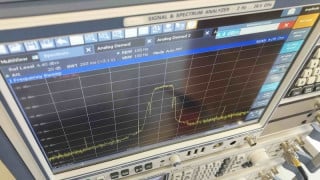
I included an oscillograph with the OP. The output was not rectified; it was linearly modulated like two signals in an audio mixer.

If you do....here's the important part....the voltage can be no greater than 1/2 the voltage you noted earlier. If you have a full sine(or more than half) at Vout Or Vout is greater than 1/2 supply voltage.................replace 8.2k ohm resistor with 15k linear pot. Q3 idle current controls Q1 operating point or conduction angle. Adjust pot until Vout is rectified.
By rectified, do you mean chopped in half by a horizontal line as per a diode? Or do you mean an AM modulated signal?

After rectifying, replace resistor at Vout with CLR circiut. Look at amplitude at Vout now. It should be a sine wave. If amplitude of Vout is greater than 4-4.5 volts...........adjust 1,5k resistor for 4-4.5 volts. Now you can Modulate. Don't over drive it.....no valleys to zero or flat tops in envelope. 10-4 good buddy.
I'll do as you said, but I'd like to leave out the tuned circuit. Is it possible to not use a tuned circuit at the output and still get AM modulation? I'm not sure, but I think you're suggesting using Q2 as per Bill Marsden's diode. Is this right?

Incidentally, my understanding of how this circuit works is that the AF signal at the base of Q3 is varying the current through Q2 and this make the amplitude of the RF signal passing from Q1 to Q2 "dance to the beat of the drum" so to speak.
 
Last edited:

BR-549

Joined Sep 22, 2013
4,928
Hello Paul, in Yakima. I am very sorry. When I first read your post, and you mentioned 300 khz to 30 mhz tuning range, and then saw your circuit, I naturally assumed that you wanted to amplitude modulate a 1 mhz signal and then hetrodyne(mix,multiply) to the operating frequency. With this circuit, you could vary the frequency of the rf very little. How's come? Look at all the caps in the rf path. At 300 khz, the Xc is high. At 30 mhz, Xc is quite low. The transistors have Xc too. This is just the first of many reasons you will not be successful. The output tuned circuit is what establishes the envelope. AM is the dirtiest and therefore the most dangerous transmission. The output tuned circuit is what filters this crap out. To do what you want would require frequency sys. and a good dsp card. I suggest you try discrete frequency transmission and reception first. I would also suggest that you build a couple of oscillators first......you have to understand how these work, before you proceed. Good luck to you, and if you want help it will be my pleasure.
 
Top