Facebook
 Google
 GitHub
 Linkedin
Hi all,
This is my first post so forgive me if it's in the wrong location.
I've run into a peculiar situation with a project.
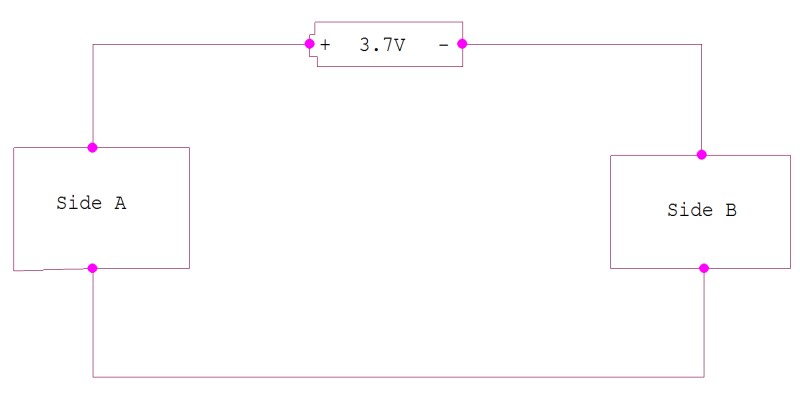
The circuit consists of a loop with regions (sides A and B) connected through a single lipo battery cell (see picture). Each side contains a microprocessor, and has the ability to short itself out of the loop (through a power MOSFET), to allow the other side access to the terminal of the battery that would normally be blocked by the opposite side. (Side A shorts itself out so side B can access the positive battery terminal, and then the opposite happens) Each side has a capacitor to power itself with while in the shorted configuration (while the other side is charging it's capacitor).
Right now, the circuit works perfectly once it's running. The microprocessors on each side cycle their power MOSFETs to keep themselves alive and the circuit is stable.
The problem is that the circuit can't start on its own when power is first connected. One side needs to be low impedance initially, to allow the other side to charge it's capacitor and then short itself out so the other side can do the same.
I've been searching for a way to put a normally closed switch across side A (in series with a current-limiting resistor), which will be closed without power. This way, when the battery is first connected, side B will wake up and short itself out, creating potential across side A (and the current limiting resistor) allowing side A to wake up.
I've looked into depletion mode MOSFETs and JFETs, but I can't figure out how to switch them open without using a level shifter of some kind to make a -3.7V supply from the available +3.7V. Space is extremely tight, so making a dedicated -3.7v supply just to switch a depletion mode FET isn't really feasible (unless there is a single chip solution of some kind that I haven't discovered).
Is there any component or IC that will passively be low impedance with no voltage applied, but then change to high impedance when positive voltage is applied to it? There is a free channel available on the microprocessor to drive something with, but of course only between 0V and 3.7V is available.
Many thanks for the help,
This is my first post so forgive me if it's in the wrong location.
I've run into a peculiar situation with a project.
The circuit consists of a loop with regions (sides A and B) connected through a single lipo battery cell (see picture). Each side contains a microprocessor, and has the ability to short itself out of the loop (through a power MOSFET), to allow the other side access to the terminal of the battery that would normally be blocked by the opposite side. (Side A shorts itself out so side B can access the positive battery terminal, and then the opposite happens) Each side has a capacitor to power itself with while in the shorted configuration (while the other side is charging it's capacitor).
Right now, the circuit works perfectly once it's running. The microprocessors on each side cycle their power MOSFETs to keep themselves alive and the circuit is stable.
The problem is that the circuit can't start on its own when power is first connected. One side needs to be low impedance initially, to allow the other side to charge it's capacitor and then short itself out so the other side can do the same.
I've been searching for a way to put a normally closed switch across side A (in series with a current-limiting resistor), which will be closed without power. This way, when the battery is first connected, side B will wake up and short itself out, creating potential across side A (and the current limiting resistor) allowing side A to wake up.
I've looked into depletion mode MOSFETs and JFETs, but I can't figure out how to switch them open without using a level shifter of some kind to make a -3.7V supply from the available +3.7V. Space is extremely tight, so making a dedicated -3.7v supply just to switch a depletion mode FET isn't really feasible (unless there is a single chip solution of some kind that I haven't discovered).
Is there any component or IC that will passively be low impedance with no voltage applied, but then change to high impedance when positive voltage is applied to it? There is a free channel available on the microprocessor to drive something with, but of course only between 0V and 3.7V is available.
Many thanks for the help,