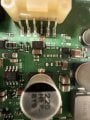
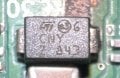
I have a Telecommunications board from a car which I believe has had water damage from the aerial above it.

Thread Starter

StuartNeedsHelp

Joined Nov 9, 2025
5
Hi all.
Apologies but I didn't know where to post this.

Long story short is I have a Telecommunications board from a car which I believe has had water damage from the aerial above it. It a common issue and throwing up errors on the dash. I have removed it and found damage mainly to the 12v+ pin and trace. The pin is actually blown off from the track and showing no continuity but could easily be re soldered on.
Can anyone point me in the right direction on what to test to narrow down if there is any other issues?

The next component down (CNY Z 843) shows continuity and the same resistance both directions across it.

There is also continuity between the burnt track of the +'ve (after scrapping the protective layer off) and the in-tact negative trace next to it. Should that be normal?

I'm sceptical to just solder the pin back to the trace in case it causes more damage when I plug it back in and power it up.

Any help or advice would be welcomed. Thank you.
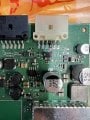
IMG_3339.jpegIMG_3151.jpegIMG_3152.jpeg
 

Thread Starter

StuartNeedsHelp

Joined Nov 9, 2025
5
What resistance does it show?

Was one side of "CNY" supposedly connected to the burnt +12 V input?
Check to see if the other side is connected to GROUND input.
Thanks for your reply. So the resistance starts at about 23 but then dropped to a stable 15ohms both ways.

Currently there is continuity between both the +'ve trace (where I scrapped the coating off in between the detached input pin and that CNY component) and the -'ve trace next to it.

I assumed one side was on the +'ve and one on the -'ve and from Professor Google thought it might have been like a mini fuse type component that burnt out if overpowered to protect everything after it but I really don't know.
 

MrChips

Joined Oct 2, 2009
34,655
I suspect that it is a transient voltage suppressor which should be installed between +12V and GROUND.
It is to protect sensitive electronic devices from voltage surges above a certain threshold. It should register as an open circuit or very high resistance.
 

Thread Starter

StuartNeedsHelp

Joined Nov 9, 2025
5
I suspect that it is a transient voltage suppressor which should be installed between +12V and GROUND.
It is to protect sensitive electronic devices from voltage surges above a certain threshold. It should register as an open circuit or very high resistance.
Do you mean it should read open circuit when fully functioning? As in as this is showing continuity across the pos and neg trace and only 15ohms across the TVS, that it has done its job and blown, potentially due to water ingress which is the known problem, to save the rest of the board?

If that is the case, after cleaning the board up with isopropyl alcohol which I have already done, do you think if I replace the TVS and re-sold the pin to that trace it could be back to up and running again? Obviously, as long as the contributing water ingress element has been resolved so it don't happen again. The car manufacturer want £2200 to just replace the whole thing. But I hate going to all that trouble if it just a component that I could replace myself.

Thanking you for your help by the way. :)
 

Thread Starter

StuartNeedsHelp

Joined Nov 9, 2025
5
You can take a chance and simply remove the TVS and test the board with a 12V battery.
If it works, then yes, you can install a new TVS. The TVS does nothing until it sees an over-voltage pulse.
Do you reckon I would be able to remove it with a standard soldering iron with a really fine tip? Or is it a heat gun kind of job?
 

MrChips

Joined Oct 2, 2009
34,655
Do you reckon I would be able to remove it with a standard soldering iron with a really fine tip? Or is it a heat gun kind of job?
For SMD resistors, capacitors, diodes, etc., I use two soldering irons, one on each pad. It is likely that the SMD has a bit of glue underneath it during assembly. You need to allow the heat to penetrate to the SMD body and then it should come loose easily.
 

Thread Starter

StuartNeedsHelp

Joined Nov 9, 2025
5
Thank you x
For SMD resistors, capacitors, diodes, etc., I use two soldering irons, one on each pad. It is likely that the SMD has a bit of glue underneath it during assembly. You need to allow the heat to penetrate to the SMD body and then it should come loose easily.
Thank you MrChips.
I've got two irons so that should work. I'll get the Mrs on the tweezers then. lol.

ChatGPT is suggesting
  • Automotive 12 V → SMAJ16A

  • Does that sound about right
 
Top