Take my help with a grain of salt as I stumbled a lot in this class, but I'll take a stab at this.
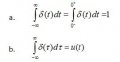
a) The delta function describes an impulse, or a sharp spike from zero in a graph. The area under the spike is always 1, so as you bring the start and end points closer the amplitude gets higher and higher approaching infinity.
b) The unit step function basically describes the action of a switch being flipped. If you were looking at a graph, y would equal 0 for all values of x < t. At x = t the "switch is flipped" and the graph jumps discontinuously to y = 1 and stays that way for all x > t.
Equation a) represents the definite integral between limits whih can be represented by a a single numerical value.
Equation b) represents the indefinite integral and the limits of integration are not strictly necessary. Indefinite integrals are always given in functional form and that functional form can be evaluated between the limits. If you do that you get 1 - (0) = 1
The expression in b) is "more complete" because it says everything that is relevant.
I think that (b) is simply wrong. The left hand side is IDENTICAL to the left hand side of (a) and therefore the two right hand sides have to be equal. Also, the LHS of (b) has no linkage to the parameter t at all.
The fact that the variable of integration is t in one and z in the other is irrelevant because the variable of integration is a dummy variable that does not survive the integration process in a definite integral.
To make (b) valid, the limits of integration need to be from -oo to t.
If I recall (from 30 years ago), the integral of an indefinite integral adds an arbitrary constant. When you take the limits, the constants in the two limit expressions cancel out.
I agree that the notation in b) is ah...less than rigorous. I also agree that indefinite integrals have arbitrary constants which can often be chosen a zero without loss of generality. As it happens the functional form and the evaluation with the limits produces a consistent result between a) and b).

 Facebook
 Google
 GitHub
 Linkedin

 12.5 KB Views: 41