If I use one end of secondary wire and a center tap to create power supply,
can I ground the another end of the secondary wire (unused) or use a wire cap to be floated?
If I should ground, better to tie with the center tap??
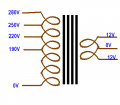
From 7 to 1 the resistance increases and these wire are primary wires.
I live in Pakistan. i did bachelor in telecom. i am using this transformer in ups. i am feeding 220V 50hz at primary. At secondary i am getting 12V. this transformer is center tap.
If I use one end of secondary wire and a center tap to create power supply,
can I ground the another end of the secondary wire (unused) or use a wire cap to be floated?
If I should ground, better to tie with the center tap??
For instance, if I want to make a single end 12v power supply out of this transformer, I`m wondering for the another end, which is supposed to use for -12v line. If I short it with the center tap, that would destroy the transformer by drawing too much current?
How would it be difference btw 4-diode configuration and 2-diode one?
If I use one end of secondary wire and a center tap to create power supply,
can I ground the another end of the secondary wire (unused) or use a wire cap to be floated?
If I should ground, better to tie with the center tap??
I am not sure whether this counts as half or full wave but as far as the transformer winding is concerned it is full wave. It has one end of the winding grounded.
I am not sure whether this counts as half or full wave but as far as the transformer winding is concerned it is full wave. It has one end of the winding grounded.
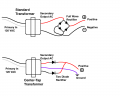
This drawing shows two ways to hook up a transformer. The first is a transformer without center tap. Assume for the sake of argument it's a 12 volt output. The second is a transformer WITH center tap. Assume for the sake of argument it's a 24 volt output with center tap. From top and bottom leads (in the picture) you get 24 volts. BUT the center tap to either leg is going to be 12 volts. This is the situation where you can use just two diodes. Both drawings will produce the same sine wave.
This drawing shows two ways to hook up a transformer. The first is a transformer without center tap. Assume for the sake of argument it's a 12 volt output. The second is a transformer WITH center tap. Assume for the sake of argument it's a 24 volt output with center tap. From top and bottom leads (in the picture) you get 24 volts. BUT the center tap to either leg is going to be 12 volts. This is the situation where you can use just two diodes. Both drawings will produce the same sine wave.

 Facebook
 Google
 GitHub
 Linkedin