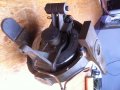
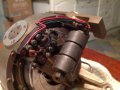
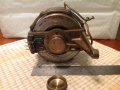
Gyroscope psu

atferrari

Joined Jan 6, 2004
5,012
Hola Keith

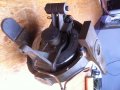
Here follows the answer I got from my friend (verbatim) and then what I hope is a passable translation:

Agustín , buenas tardes
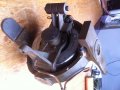
Me parece que es un gyroscopo , pero no de un gyrocompass, salvo de un equipo muy viejo, anterior a las segunda guerra mundial.
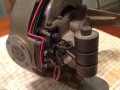
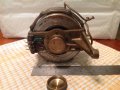
Los tubitos de bronce que ves , son la lubricacion de los rulemanes.
Las pesas son las las que le dan un par antagonico a las manijas que salen hacia adelante como si algun brazo se atornillara alli.
Los gyros recibian alimentacion al gyroscopo de arriba y no de costado como este .

Habria que consultarle , como llega la alimentacion al gyroscopo ?? si por flexibles o algun tipo de carbon
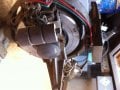
Si en al foto ultima loque se ve alimentado , es una bobina o un sensor . Los gyros tenian dos bobinas que trabjaban de sensores para mantenerlo derecho. Estas bobinas alimentaban la entrada de un amplificador tipo servo y permitian que el seguidor siguiera ( sic ) al gyroscopo en su orientacion o en los cambios de rumbo.
Fijate que te dice
TRANSLATION
It seems to me a gyroscope but no from a gyrocompass (used in ships, he means) unless from a very old model, previous to WWII.

The small brass pipes are to lubricate the bearings.

The weights (counterweights?) provide an antagonic pair (force) to the handlers protruding (ahead?) as if a handler (arm) is bolted there.

Gyros (in gyrocompasses) were fed from the overhead and not from the side as this one.

You should ask him (that is,
to you, Keith) how the power comes to the gyro if through the flexible or through some type of carbon (hope this is correct and makes sense).

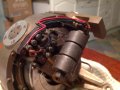
Yes, en tha last picture, where it is powered (?), there is a coil or a sensor.

Gyros had two coils (?) working as sensors to keep it upright. These coils fed the input of a servo type amplifier allowing the follower to follow the heading of the gyroscope or when the course was altered.

See what he says.

TEXT ENDS HERE.

Coloquial text is not always easy to translate. Sorry.

I recall seen the gyroscope of a Whitehead torpedo probably from around 1940-1950. Its gyroscope (air compressed propelled) had a, what I believe, much smaller toroid. But I could be wrong.

My suggestion: if you provide any further pictures, could you show it close to something allowing to appreciate size? Even a graduated ruler (centimeters) would help.
 
Last edited:

Thread Starter

Keith Robinson

Joined Nov 30, 2014
53
Hi, thanks for your response. I couldn't tell if it was ac or DC my meter couldn't tell me. I don't have a scope now so couldn't seem to find out how to differentiate. I bought a smart new meter digital, but that didn't help! Couldn't find any UTube to help me either. I have several really old panel meters, some ac some DC but they all register voltage ! Quite exasperating that. I would imagine it's AC but can't really say. Horizon seeking would sound logical, still doesn't help to ID the voltage type, amount or wiring layout. I don't know if the red green and black would signify anything.
Still trying to upload pix. Thanks
Keith
 

Attachments

Thread Starter

Keith Robinson

Joined Nov 30, 2014
53
Hola Keith

Here follows the answer I got from my friend (verbatim) and then what I hope is a passable translation:


TRANSLATION
It seems to me a gyroscope but no from a gyrocompass (used in ships, he means) unless from a very old model, previous to WWII.

The small brass pipes are to lubricate the bearings.

The weights (counterweights?) provide an antagonic pair (force) to the handlers protruding (ahead?) as if a handler (arm) is bolted there.

Gyros (in gyrocompasses) were fed from the overhead and not from the side as this one.

You should ask him (that is,
to you, Keith) how the power comes to the gyro if through the flexible or through some type of carbon (hope this is correct and makes sense).

Yes, en tha last picture, where it is powered (?), there is a coil or a sensor.

Gyros had two coils (?) working as sensors to keep it upright. These coils fed the input of a servo type amplifier allowing the follower to follow the heading of the gyroscope or when the course was altered.

See what he says.

TEXT ENDS HERE.

Coloquial text is not always easy to translate. Sorry.

I recall seen the gyroscope of a Whitehead torpedo probably from around 1940-1950. Its gyroscope (air compressed propelled) had a, what I believe, much smaller toroid. But I could be wrong.

My suggestion: if you provide any further pictures, could you show it close to something allowing to appreciate size? Even a graduated ruler (centimeters) would help.
Having trouble uploading pix
 

Attachments

ISB123

Joined May 21, 2014
1,236
The gyroscope is probably made by Jack & Heintz Co.(Jack & Heintz Precision Industries).
http://www.google.com/patents/US2413285

Quote from patent description:
"This invention relates in general to gyroscopic assemblies and more particularly to the construction thereof and the lubrication system for the moving parts thereof."
So it looks like those 2 tubes are there to lubricate things.


PS

OK I'm wrong you said its made by Sperry which I didn't see but that gyro assembly really looks similar.
 
Last edited:

jpanhalt

Joined Jan 18, 2008
11,087
I would be a little cautious of a modern VFD. KB Drives make some with variable voltage, but not to the level you probably need. You say the unit spools up on 28V AC, but not to full speed. Most modern VFD's are at 220VAC; although, you might find one that is 110VAC. Those voltages would be way too high. Was the bearing lubricant air or liquid? Sperry was pretty technically advanced. I don't think it is unreasonable to at least consider air-lubricated bearings. Could bearing drag be the reason you are not getting to full speed?

John

@ISB123 We cross posted. Interesting patent -- particularly with regard to evacuation and the lubricant. Maybe the speed limit is because it is running in air.

John
 

Thread Starter

Keith Robinson

Joined Nov 30, 2014
53
The gyroscope is probably made by Jack & Heintz Co.(Jack & Heintz Precision Industries).
http://www.google.com/patents/US2413285

Quote from patent description:


So it looks like those 2 tubes are there to lubricate things.


PS

OK I'm wrong you said its made by Sperry which I didn't see but that gyro assembly really looks similar.
Hello again, sorry if Im not getting back fully to anyone, im still struggling with posting, especially pictures. Im using a PC now which seems better all round. The ipad was all over the place.

This is the most info ive got from Sperry over many years.

You do get electric or air powered gyroscopes.
In this case it is electric and the pipes do appear to be for lubrication.
The fact it requires lubrication means that it was running for
long periods and hence not on something like a torpedo gyro ..
Some gyros had a mercury levelling system. Those pipes are not for that.
It could be an aircraft or ship gyroscope. The configuration suggests
an aircraft rate gyroscope (also called a turn indicator) but I could
be wrong (so many types were made). I think the ‘arm’ in the centre
gimbal would have been connected to a spring type configuration.
I would also suggest it is 1950s rather than 1940s.
Sperry made them in the UK as well as in the US.
It will need a nice pure sinewave. Various voltages were
used but the cycles tended to be 400 cycles. 400 cycles at 24 volts or
sometimes 12 volts ended up being the standard in aircraft.


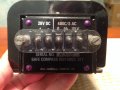
the only time Ive had it running was by using a variac from the 240v ac mains. it was set to about 100V ac and one connection through a capacitor to emulate three phase. it runs but not very fast, even when increasing the voltage. I recently bought a mains to 28v DC PSU which then ran an inverter giving 400hz ouput - this didnt run the gyro at all. which is when I sought help from this forum.
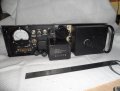
I am uploading some recent pix. one of the inverter that wont power the gyro and one of a peice of kit that looked likely but was dead expensive on ebay, and the vendor wouldnt comment about it at all, so i didnt buy it. thanks again to all for your much appreciated comments
Keith
 

Attachments

atferrari

Joined Jan 6, 2004
5,012
Hi Keith

After seeing your last two pictures, my friend checked with a colleague and they both concur on this being a gyro used in planes (rather old ones). He suggested to ask people involved in avionics from many years ago. He remarked that electrical wires seem quite old as well.
 

Thread Starter

Keith Robinson

Joined Nov 30, 2014
53
Hi Keith

After seeing your last two pictures, my friend checked with a colleague and they both concur on this being a gyro used in planes (rather old ones). He suggested to ask people involved in avionics from many years ago. He remarked that electrical wires seem quite old as well.
Hello, thanks for that, and to your colleauge also. It all helps to narrow down where to look. kind regards Keith
 

atferrari

Joined Jan 6, 2004
5,012
its more likely to be 400hz then, if it is aviation kit, would you or your colleague hazard a quess as to the voltage?
I am the messenger here only, Keith. :p In the past I've been the user of the echosunders, radars and gyrcompasses he has repaired many times when calling our homeport. In the beginning, even a DF...
I will ask him in my next contact.
 
Top