I'm looking for advice on a grounded wand for a Tesla Coil. I have tried one connected directly to ground that does not generate longer sparks than those that go into the air.
I bought it from Information Unlimited just before the old man died and they went under. It's a BTC50, supposed to throw out 4 foot sparks into the air (more like 2.5').
To draw a maximum possible spark for a given voltage, first, you need to avoid any other voltage drops in the circuit, then, use a pointed end on the "wand".
So you tied the wand to "ground", was that connected to the "common" side of the Tesla coil circuit?? Or just what was it connected to??
Do you have any technical information about your specific coil system?? If the oscillation is not at the secondary coils resonant frequency then the voltage will not be as great.So some adjustment may be required.
I bought it from Information Unlimited just before the old man died and they went under. It's a BTC50, supposed to throw out 4 foot sparks into the air (more like 2.5').
This is their ground wand demo. I'm seeing the sparks distance to wand being shorter too. The wand it not a magnet for sparks. IMO The into air discharges are longer because the air surrounding the coil becomes ionized (charged) and is easier (takes less energy) for sparks to travel in. When the ground wand is moved into that ionized air, it discharges the air near the grounded conductor back to neutral (uncharged), making harder for coil discharges to travel in that media.
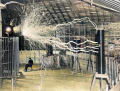
Certainly the formation of a spark depends on the field intensity, which is affected by quite a few different variables besides voltage. Everything, such as humidity and air currents will affect the distance and direction that an arc will jump. and none of that would be explained in a cartoon-channel video. Consider just the path of the spark in the picture shown: It is not a straight line, but rather looping up towards vertical as it approaches the discharge ball on top of the coil. THAT effect is caused partly by the hot air current from the heat of the arc. In addition, the longer an arc persists, the greater the concentration of ionized air in the path of the arc . THAT is why an arc can be stretched once it is struck. Even a puff of tobacco smoke can have a real effect on an arc length. ( for some really graphic scenes, look at an arc-flash safety video.)
Certainly the formation of a spark depends on the field intensity, which is affected by quite a few different variables besides voltage. Everything, such as humidity and air currents will affect the distance and direction that an arc will jump. and none of that would be explained in a cartoon-channel video. Consider just the path of the spark in the picture shown: It is not a straight line, but rather looping up towards vertical as it approaches the discharge ball on top of the coil. THAT effect is caused partly by the hot air current from the heat of the arc. In addition, the longer an arc persists, the greater the concentration of ionized air in the path of the arc . THAT is why an arc can be stretched once it is struck. Even a puff of tobacco smoke can have a real effect on an arc length. ( for some really graphic scenes, look at an arc-flash safety video.)
The cartoon video wasn't posted as an explainer of WHY sparks are long or short, it was posted as an example to show WHAT the difference in sparks is into the grounded wand vs into air.
I gave my explanation of why the difference with grounded metal and you gave an excellent explanation of sparks in general.
Now some questions: Did the device ever produce the four-foot long sparks?? Did the device come with an information package that possibly included an actual circuit schematic?? Some higher quality products even come with actual service and adjustment information, since they are deemed to be worth repairing. Many other products are considered by their manufacturers and marketing teams to NOT BE WORTH REPAIRING.
In addition, there are undoubtedly some very specific conditions specified for producing such long sparks, possibly very low humidity and some specific air temperature.
It may also be that some adjustments are required for the very best performance to be achieved. Certainly there is some optimum frequency that produces the longest sparks.
AND it might also be that the power supply voltage to the oscillator circuit needs to be higher than the standard adjustment.
Where is the output voltage amp meter and HV probe for this 3A @100kV placed at? When those sparks are discharging, that discharge is not reactive power.
Where is the output voltage amp meter and HV probe for this 3A @100kV placed at? When those sparks are discharging, that discharge is not reactive power.
Consider also that if the company "went under" "From Information Unlimited just before the old man died and they went under." that probably they were aware of what was going on and may not have delivered quite as good a product.
Besides that, just like any other piece of equipment, it must be just right to deliver optimum performance. Certainly that would include having the primary and secondary resonant at exactly the same frequency. AND, in addition, undoubtedly having the power supply able to deliver enough current at some voltage, which may not be quite what the TS wound up with.
AND since we have no information at all as to any of those details, it is rather difficult to understand the answer. With zero information and a video of unverifiable claims, all that is possible is guesses.
I am not aware of any formula specific to Tesla coil discharge voltages.
But they are very impressive, and a great project to build.
The part that I always wonder about is how the magnetic field produced by the coil at the very bottom couples all the way up to the top. Do you suppose that an electric fence pulser could also produce lightning pulses from a Tesla type coil?? Or maybe a CD-type ignition coil driver? THAT could be simple to implement, because I have a "Mark Ten CDI box. I could trigger it with a simple door buzzer . THAT could be interesting, maybe.
But I don't want to be guilty of hijacking a thread. So that is all of that string.
Wasn't Tesla considering wireless power transmission once? I read a few biography books about him and he seems to have died leaving behind an air of mystery about his ideas.
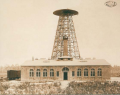
This is his old Wardenclyffe site, the tower was long ago demolished, I don't know if there was any merit to his idea.
But they are very impressive, and a great project to build.
The part that I always wonder about is how the magnetic field produced by the coil at the very bottom couples all the way up to the top. Do you suppose that an electric fence pulser could also produce lightning pulses from a Tesla type coil?? Or maybe a CD-type ignition coil driver? THAT could be simple to implement, because I have a "Mark Ten CDI box. I could trigger it with a simple door buzzer . THAT could be interesting, maybe.
But I don't want to be guilty of hijacking a thread. So that is all of that string.
Yes, impressive to children but not to electrical engineers. A changing electric field is also a changing magnetic field. There is only one EM force entity, with electric and magnetic components that are expressed from the single EM entity depending on the circuit and the space surrounding that circuit. The electrical energy in the space surrounding the Tesla shifts from mainly electric to mainly magnetic and back again depending on the impedance/electrical properties of the space containing the EM energy and the circuits generating that EM energy.
Wasn't Tesla considering wireless power transmission once? I read a few biography books about him and he seems to have died leaving behind an air of mystery about his ideas.
This is his old Wardenclyffe site, the tower was long ago demolished, I don't know if there was any merit to his idea.
Completely BS engineering and a waste on money as his backers soon discovered. No mystery about his ideas, the guy was a total crackpot in his later years and electrical science had far progressed beyond when learned in his youth as a electrical engineer (he was never close to being an expert in electric science) and he was intellectually incapable IMO of moving beyond the electrical engineering theory of 1880's.
Completely BS engineering and a waste on money as his backers soon discovered. No mystery about his ideas, the guy was a total crackpot in his later years and electrical science had far progressed beyond when learned in his youth as a electrical engineer (he was never close to being an expert in electric science) and he was intellectually incapable IMO of moving beyond the electrical engineering theory of 1880's.
Not really. It was and is a useless contraption that amazes those not versed in the electrical sciences. The conman in his chair selling snake-oil. That part is the perfect picture.
The picture of the dawn of the electrical age.
Michael Faraday FRS (1771- 1867) an English scientist, not a showman like Tesla.
Faraday is responsible for the extensive study of electromagnetism, a field that changed the way human beings live on this planet. In order to pay homage to him, "Farad" was originally coined by Latimer Clark and Charles Bright in 1861, for a 'unit of quantity of charge,' which by 1873, had become a 'unit of capacitance'. In 1881 at the International Congress of Electricians in Paris, the name Farad was officially used for the unit of electrical capacitance.
Albert Einstein kept a picture of Faraday on his study wall, alongside ones of Isaac Newton and James Clerk Maxwell. Physicist Ernest Rutherford stated:
"When we consider the magnitude and extent of his discoveries and their influence on the progress of science and of industry, there is no honor too great to pay to the memory of Faraday, one of the greatest scientific discoverers of all time.”
The "wireless transmission of energy" is in common use today as a communications method. No impressive sparks when it is working properly, but certainly lots of data. So Tesla had the theory right, just goofed on the application and the scale.
And still, the part that is not so clear to me is how the very non-symetrical coil arrangement of the Tesla coil works. Logic says that the primary coil should be around the middle of the secondary coil, NOT down at the bottom end.

 Facebook
 Google
 GitHub
 Linkedin