Facebook
 Google
 GitHub
 Linkedin

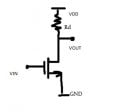
In a common source stage with resistive load, the approximate gain is given by
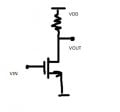
Av=-gm*Rd. [Figure attached]
Now, the book I'm referring to, Analog CMOS Design by Razavi, says that if we increase Rd, we increase the gain(that's fine), but we also DECREASE THE VOLTAGE SWING. I didn't get this; isn't the output still moving from Vdd (at Vin<Vth) to some value Vout=Vin-Vth (so that our MOS is in saturation).
In fact, if we increase the gain using Rd, then the circuit will achieve this Vout at smaller Vin, thus increasing the voltage swing?
Where am I going wrong?
Attachments
-
 9.1 KB Views: 12