FX29 Compression Load Cells

Thread Starter

Aldan.David

Joined Sep 7, 2022
5
FX29 Compression Load Cells
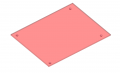
Is this suitable for making a weighing platform ( 800 x 500 mm)?
There will be 4 load cells in the platform.
1662541115807.png1662541115807.png
 
Last edited by a moderator:

Thread Starter

Aldan.David

Joined Sep 7, 2022
5
Hello Ericgibbs, thank you for the reply,

Material - SS
thickness - 2mm ( may add 3d printed parts for strengthening the plate.)
Max. weight of the expected load is 50kg.
Eg:-to weigh packages of different sizes and weight.
 

Thread Starter

Aldan.David

Joined Sep 7, 2022
5
Hi Eric, Thank you very much.
It will great if u can suggest me a load cell suitable for the application.
Iam looking for a compact load cell, and it should meassure the exact value, even if the load is off centred.

Thanks.
 

ag-123

Joined Apr 28, 2017
294
In the online "flea" markets you may find these stuff
https://www.aliexpress.com/wholesale?catId=0&SearchText=load+cell
https://www.amazon.com/s/ref=nb_sb_noss?field-keywords=load+cell
Note that some of these has questionable functionality, no documentations, no safety guarantees.
You would likely need to "trial and error" all that calibrations.

Then of course there are the "proper" ones that is pre-calibreated and well made e.g.
https://www.loadcellshop.co.uk/all-products
https://www.omega.com/en-us/force-strain-measurement/c/load-cells
https://www.artechloadcell.com/
https://www.bosche.eu/en/load-cell
etc. a Google search would find lots more entries.
 
Last edited:

ag-123

Joined Apr 28, 2017
294
For "fun project" type stuff, you could make do with those "flea market" ones, found video on youtube
Do note that they are not necessarily safe, hence, you should not place heavy loads on them.
 

WBahn

Joined Mar 31, 2012
32,702
Hi Eric, Thank you very much.
It will great if u can suggest me a load cell suitable for the application.
Iam looking for a compact load cell, and it should meassure the exact value, even if the load is off centred.

Thanks.
If you really need to measure "the exact value", then give up now since this is an impossible task. If the package's true weight is 42.5694258742369 kg and your scale reports it as 42.5694258742493 kg, are you really saying that this is unacceptable?

You need to come up with a set of specs for how close is close enough. That spec is critical for determining which load cells are acceptable and which ones aren't. It will also determine whether or not you need to account for side loads on the cells as a result of plate bending which, again, will also play a role in load cell selection and cell mount design.
 

ericgibbs

Joined Jan 29, 2010
21,390
It will great if u can suggest me a load cell suitable for the application.
Iam looking for a compact load cell, and it should measure the exact value, even if the load is off centred.


hi Aldan,
Assuming the platform plate is 'stiff' enough, and you want to weigh 'off-platform-centre' accurately, I would suggest 50kG load cells.
For the resolution of the load cells, I would expect it to be in the order of +/-0.05kG.
The accuracy of the indicated weight will depend upon the supporting electronics.

How do you plan to amplify the Load cell signals and display the weight.?

Remember, the Load cells must also be mounted/supported on a strong enough 'stiff flat base', under the platform.

E[/QUOTE]
 

Irving

Joined Jan 30, 2016
4,995
Before you worry about which load cells you seriously need to consider your force plate...

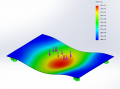
2mm of 316 SS sheet isn't going to come close to useful as this simple simulation shows: a 50kg load 200mm x 100mm in the centre gives a displacement of nearly 15mm! And that ignores the plate's own weight!

1662564506503.png


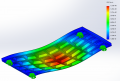
Reinforcing with something 3D printed - here I've used high-fill ABS bars 25mm high, 15mm wide - helps a bit - the displacement is only 1.4mm but that's still too much for any level of accuracy.

1662564830374.png


Realistically you'll need around 10mm SS sheet for a displacement of 0.15mm and if you're looking for high precision measurement, probably double that.


As to load cells, the ones already identified work well as long as you calibrate the system. You don't say what precision you need but we used similar load-cells as those (as used in the Wii balance board) to weigh up to 100kg - using 4 x100kg rated cells. They were good enough to measure to 1g using the top 17 bits of the HX711 24 bit ADC, though noise in the system (inc vibrations through the solid concrete floor from road traffic 30m away) ultimately limited accuracy.
 

Irving

Joined Jan 30, 2016
4,995
A commercially available product, with a platform 500 x 400mm, 60kg with 10g resolution is only around £400 ($450). the 800 x 500mm platforms tend to be for heavier loads, starting at 300kg (50g)
 

sparky 1

Joined Nov 3, 2018
1,218
TE Connectivity FX29 white paper discusses its process and some of the differences with other load cells.
Because you are specific about that load cell then the suitability is not just any old design. The suitability also depends on the application.
Optimizing Compact Load Cell Design for Performance (te.com)
The I2C looks promising. The FX29 material properties and circular heat map might be of some indication to designing
the translation of force for example the tendency to impart some rotation translated from the platform in many designs. A design to reduce ankle fatigue shows how flexture design reduced that issue. Beyond the flexible membrane of the cell the platform frame shape being equi-distant like a circle
is helpful in compensating for force being off center. With large scales more cells can be used to compensate. The size and shape usually concidered asthetic or practicle however optimizing an FX29 takes on more criteria. Getting the suitability correct for the design of specialized scales is one of the keys to success when considering marketability.
Single Degree of Freedom Rotational Flexure on Behance
 
Last edited:

Jerry-Hat-Trick

Joined Aug 31, 2022
775
To keep things simple, I'd recommend using maybe 12mm MDF or plywood for a platform, maybe with a stainless steel cover purely for appearance. It doesn't matter if it flexes a bit so long as you have a 50kg loadcell at each corner, maybe with a small steel plate (Meccano?) actually pressing on the sweet spot of the loadcells. The HX711 50kg loadcells mentioned above are probably accurate enough unless you are looking for better than 0.5% of FSD accuracy and they can be bought inexpensivly with the necessary amplifier electronics. The total weight is the sum of the loads measured on the four loadcells wherever you put the CG of the load so careful calibration is important (with maybe linearisation look-up tables) after which repeatability should be pretty good. Hysteresis is harder to process out - possible if your processor measures often enough to determine whether the static load is less than the load just before, which is likely whenever you place a weight on the platform.
 

MisterBill2

Joined Jan 23, 2018
27,159
Platform flexing DOES MATTER IF it puts an off-axis load on a load cell. But if all four have ball-links and there is no off-axis force then OK. And for the platform, bend down lips on all four sides to gain a lot of stiffness. Your concern is not "precision, whatever that means, it is accuracy and resolution that matter. And for that you must indeed have a specification that describes maximum error and the degree of resolution.
 

Thread Starter

Aldan.David

Joined Sep 7, 2022
5
If you really need to measure "the exact value", then give up now since this is an impossible task. If the package's true weight is 42.5694258742369 kg and your scale reports it as 42.5694258742493 kg, are you really saying that this is unacceptable?

You need to come up with a set of specs for how close is close enough. That spec is critical for determining which load cells are acceptable and which ones aren't. It will also determine whether or not you need to account for side loads on the cells as a result of plate bending which, again, will also play a role in load cell selection and cell mount design.
HI,
+/-10 gms are acceptable
 

Thread Starter

Aldan.David

Joined Sep 7, 2022
5
Before you worry about which load cells you seriously need to consider your force plate...

2mm of 316 SS sheet isn't going to come close to useful as this simple simulation shows: a 50kg load 200mm x 100mm in the centre gives a displacement of nearly 15mm! And that ignores the plate's own weight!

View attachment 275776


Reinforcing with something 3D printed - here I've used high-fill ABS bars 25mm high, 15mm wide - helps a bit - the displacement is only 1.4mm but that's still too much for any level of accuracy.

View attachment 275777


Realistically you'll need around 10mm SS sheet for a displacement of 0.15mm and if you're looking for high precision measurement, probably double that.


As to load cells, the ones already identified work well as long as you calibrate the system. You don't say what precision you need but we used similar load-cells as those (as used in the Wii balance board) to weigh up to 100kg - using 4 x100kg rated cells. They were good enough to measure to 1g using the top 17 bits of the HX711 24 bit ADC, though noise in the system (inc vibrations through the solid concrete floor from road traffic 30m away) ultimately limited accuracy.

HI, Irving
i really appreciate your effort,
+/- 10 gms are acceptable and i will consider your points while i dsicuss with my team.

Thank you very much
 

Jerry-Hat-Trick

Joined Aug 31, 2022
775
+/- 10 gms are acceptable
Hi David, +/- 10gm is accurate, if accuracy is what you mean - I think it's important, as already mentioned, to consider the difference between resolution and accuracy - even respected weighing scale manufacturers publish specifications which dodge the important questions.

Good commercial loadcells may have in the region of 0.02% nonlinerarity, 0.02% hysteresis and maybe 0.01% non-repeatability - which may be additive. 10gm is 0.02% of 50kg so with good loadcells well calibrated and with a lookup table to correct for linearity and some clever software to correct for hysteresis you are in with a shout, but I recommend to get the best loadcells you can afford. +/- 10gm is itself 0.02% of your 50kg. And we haven't even mentioned the linearity of the loadcell amplifier or the A/D conversion.

The datasheet for the FX29 loadcells (which, by the way, I quite like the look of from a price/performance point of view) show 1% nonlinearity, 0.8% hysteresis and 0.8% repeatability) so they are probably not good enough to achieve your goal. But most users are genuinely unaware how inaccurate their scales are. For them, they only notice issues with repeatability, especially if scales don't return to zero and some manufacturers cheat by automatically re-setting to zero if the find that the reading has dropped to below maybe 0.02% of scale. Users are typically more impressed with resolution than actual accuracy which they can't check anyway. So if they see a scale which reads 50.000 they think it's more accurate than 50.00 even though the third decimal point may be fudged and filtered so it doesn't jump about.

As well as knowing a bit about your application, it would be interesting to know how you plan to calibrate if you are happy to share? For good calibration the calibrator should have an order of magnitude better accuracy than the device being calibrated although three times is probably adequate. Using calibrated weights is ideal and 10, 20 and 30kg weights can be combined to give enough points to provide correction for linearity. Maybe the four loadcells should have an initial calibration before installation but the procedure for checking that readings are the same wherever weights are loaded deserves some thought.

I hope you'll update us on how it goes!
 

MisterBill2

Joined Jan 23, 2018
27,159
For industrial manufacturing, one percent max error is usually called high accuracy, with 3% being fairly standard. At least that is how we did things. Deviation from normal was usually the warning that the process had drifted and correction was required.
 
Top