Facebook
 Google
 GitHub
 Linkedin
Hello all,
This is my first post in this forum and glad to be here. I am currently studying about Fourier transforms in discrete time domain and bumped into the following doubt.
As per book, what I understand is that for discrete time aperiodic signals the frequency components ranges from -pi to +pi continuously. Now say I take two sinusoid component of some signal, Cos(2pi(n/4.5)) and Cos(2pi(n/9). These components have a fundamental frequency of 4pi/9 and 2pi/9 respectively. But when I plot them, I notice both seem to have the same fundamental period as 9 samples/oscillation.
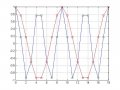
I have uploaded my plot above. the blue plot indicates Cos(2pi(n/4.5)) and the red on is Cos(2pi(n/9)). If they both the same fundamental period, they also should have the same fundamental frequency. But as per their equations the frequencies vary. Please let me know if I have missed some detail.
This is my first post in this forum and glad to be here. I am currently studying about Fourier transforms in discrete time domain and bumped into the following doubt.
As per book, what I understand is that for discrete time aperiodic signals the frequency components ranges from -pi to +pi continuously. Now say I take two sinusoid component of some signal, Cos(2pi(n/4.5)) and Cos(2pi(n/9). These components have a fundamental frequency of 4pi/9 and 2pi/9 respectively. But when I plot them, I notice both seem to have the same fundamental period as 9 samples/oscillation.
I have uploaded my plot above. the blue plot indicates Cos(2pi(n/4.5)) and the red on is Cos(2pi(n/9)). If they both the same fundamental period, they also should have the same fundamental frequency. But as per their equations the frequencies vary. Please let me know if I have missed some detail.