Fourier transform - Why we need it?

Thread Starter

mickonk

Joined Apr 6, 2015
13
Hi. I'm familiar with Fourier series but I have some hard times in learning Fourier transform. Why we use it? What's purpose of Fourier transform? Here is one signal and plot of Fourier transform of that signal:
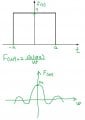
furije.jpg

What this graph tells us? Thanks in advance.
 

WBahn

Joined Mar 31, 2012
32,732
The Fourier series is valid for periodic signals. The Fourier transform extends these concepts to aperiodic signals.
 

Papabravo

Joined Feb 24, 2006
22,059
It allows us to treat systems in the time domain or the frequency domain as an aid to solution and understanding of behavior.
 

Thread Starter

mickonk

Joined Apr 6, 2015
13
Thanks for replies.
One more thing. Let's say I have some circuit with nonperiodic voltage source and I want to find response of some component in circuit, for example voltage across component. Using Fourier transform I should "convert" my excitation from time domain to frequency domain, find response in frequency domain using standard techniques (using KVL and KCL, or Nodal analysis etc), and then apply inverse Fourier transform on response I got in frequency domain to get response in time domain, right?
 

joeyd999

Joined Jun 6, 2011
6,216
Thanks for replies.
One more thing. Let's say I have some circuit with nonperiodic voltage source and I want to find response of some component in circuit, for example voltage across component. Using Fourier transform I should "convert" my excitation from time domain to frequency domain, find response in frequency domain using standard techniques (using KVL and KCL, or Nodal analysis etc), and then apply inverse Fourier transform on response I got in frequency domain to get response in time domain, right?
If the signal is non-periodic, this suggests an initial condition (transient response). I think Laplace would be more appropriate.
 

Thread Starter

mickonk

Joined Apr 6, 2015
13
Hi joeyd999.
Here is my circuit.
kolo.jpg

v0(t) is response I want to find. I would use FT to represent vi(t) in frequency domain (I will get Vi(w)), find VO(w) and then apply inverse FT on VO(w) to get vo(t), right?
 

MrChips

Joined Oct 2, 2009
34,656
The Fourier Transform gives you a graphical representation of the frequency spectrum (only one of the many good reasons for learning about the FT).

Here is a classic example of the Fourier Transform: Colour TV broadcast signal.

What is the frequency spectrum of a B&W TV signal?
With a horizontal scan frequency of 31.5kHz the frequency spectrum looks like the teeth of a comb spaced every 31.5kHz.

When they added color, where did they find the extra bandwidth to provide the colour (chrominance) information?
The stuck it in between the intensity (luminance) signal.


MrChips

Joined Oct 2, 2009
34,656
The output of the circuit is the convolution of the input signal with the response function of the circuit.

Convolution in the time domain becomes a multiplication in the frequency domain.

Hence to take advantage of the Fourier transform, you take the FT of the input signal, multiply it with the frequency response of the circuit and then take the inverse FT to get back to the time domain.
 

tonyStewart

Joined May 8, 2012
231
This Java Applet lets you draw waveforms in the time domain or frequency domain and the other is automatically computed.
You can vary the number of harmonics, turn on the sound change the frequency and listen to what you are seeing.

The usefulness depends on your imagination but it applies to sound waves, filter design, amplifier distortion, RF, and harmonic bearing analysis in big power generators and millions of other topics.

http://www.falstad.com/fourier/ ( requires Java approval. )

You can select LOG view AMplitude and Phase view then select different waveforms and see the spectrum and phase of each harmonic.
 

MrAl

Joined Jun 17, 2014
13,673
Hello,

I believe using Laplace would be a little simpler.
The transform for the exponential is 2/(s+3), and after finding your circuit Laplace which will be something like 1/(s*R*C+1), then you just multiply the two together, then find the inverse transform. Finding the inverse transform usually involves partial fractions and looking up the matching inverse(s) in a table. You dont have to evaluate any integrals.
For this problem you should get a somewhat rounded looking one time only pulse in the time domain.
 

Thread Starter

mickonk

Joined Apr 6, 2015
13
Thanks for replies.
@MrAl,
Thanks for suggestion but the point was in finding response using FT because I'm studying FT right now :)
 
Last edited:

WBahn

Joined Mar 31, 2012
32,732
Hi joeyd999.
Here is my circuit.
View attachment 83657

v0(t) is response I want to find. I would use FT to represent vi(t) in frequency domain (I will get Vi(w)), find VO(w) and then apply inverse FT on VO(w) to get vo(t), right?
Correct.

From a practical standpoint, one big difference between FT and LT is that with the Laplace transform (if you are using the one-sided transform, which is usually the case) you can't tell anything about what was happening before t=0 other than capturing its effect upon the state of the energy storage devices at t=0- (i.e., the initial conditions). The FT, on the other hand, extends to t=-oo and, as a consequence, you don't need to deal with initial conditions. As a result, there are circuits/problems that are easier to solve using one compared to the other.
 
Top