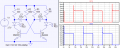
Formula to Calculate exact Time period and tON time of Bistable Multivibrator

Thread Starter

khatus

Joined Jul 2, 2018
115
What is the time period(T) and on time (tON)time of this bistable multivibrator?


I got the following result from Chat GPT.


But after substituting the values i get,
R = 10kΩ

C= 220μF T = -2 ×10×10^3×220×10^-6× ln ( 1 - 0.7/3.7 )

VCC = 3.7 volt T= -4.4 × ln (0.8108)

e = 2.718 T= -4.4 × -0.2097

VBE = 0.7 volt T= 0.92268 second 922.68 milli second.

But after simulating it in LTSPICE, I get the following result. Which shows the time period is nearly (532 -501) milli second.

Ltspice_simulation.JPG


I want to know the correct formula to calculate the exact Time period and tON time?
 

Alec_t

Joined Sep 17, 2013
15,101
The calculated times won't be exactly the same as real-world times, for various reasons; e.g component manufacturing tolerances, dependence of Vbe on temperature, leakage currents, supply voltage drift, .....
 

WBahn

Joined Mar 31, 2012
32,702
What do you mean by "exact"? Something that will give you an answer that matches the physical circuit to an infinite number of sig figs?

In engineering, "exact" is a pretty meaningless term, except in very narrow instances such as some (not all) digital systems.

If you mean a much better approximation, then you need to look at the assumptions your calculations are making.

You are assuming things like:

Vbe = 0.7 V
Vcesat = 0.2 V
Ib = 0

Furthermore, you are assuming that the LED current plays no role in determining the state of charge on the capacitors.

Probably even more significant, you are assuming that the circuit changes instantly from one side being on and the other side being off to the opposite. It doesn't (as the simulation reveals). It goes through a transition in which the transistor is in its active region and so the beta of the transistor has to be taken into account, but the beta changes significantly as the transistor moves through this region.

Relaxing these assumptions, for the most part, involves using the Ebers-Moll model of the transistor and will likely lead to a set of equations that have no closed-form solution, but that must be solved numerically. But even then, they are leaving out things that the simulator is taking into account, such as parasitic capacitances and the changing of beta under different conditions. But even the simulation models are only approximations compared to real devices.
 

neonstrobe

Joined May 15, 2009
199
There are two problems with the standard "old" formulation in regards to this circuit.
First of all, that old approximation only held, in the main, with old Ge transistors where Vbe was about 0.15V and Vcc was, well pretty high compared. With silicon the Vbe of about 0.65V is more significant than that and has a bigger effect, and that old formulation really isn't correct.
Secondly, when an LED is used as a load (never a good idea as shown, it should have limiting resistors) the collector voltage does not swing the full rail so the effective Vbe which turns the "on" device "off" is not going to be the full rail voltage Vcc but much less, so with a lower voltage swing, it takes less time to charge and then swap over transistors.
If you want the circuit to work "as simulated" first, calculate the effects of Vbe and then switch the LEDs using properly resistor-limited additional transistors to buffer the oscillator from the load.
OK here's my formula for a silicon multivibrator: fosc=1/{-2RC.log[(Vcc-Vbe)/(2Vcc-Vbe)]}.
It assumes that the collector load is much less than the base load (typically Rb~100x Rc) and Vce(sat) is around 0.1V (like the Ge transistor, is low).
You can add Vce(sat) too if you want. And, to be really pedantic, the collector load especially if that is significantly higher than 1/100th of the base timing resistor. It's surprising how often the old formula keeps appearing.
 

Danko

Joined Nov 22, 2017
2,135
Circuit, interesting for calculation:
1737238704012.png
ADDED:
In calculation, D1 and D2 can be eliminated (shorted), but instead accept Vce(sat) of transistors equal 2V.
NOTE:
In this circuit voltage on capacitors do not changes its polarity in action.
 

Attachments

Last edited:

WBahn

Joined Mar 31, 2012
32,702
Note that this circuit is quite different than the one the TS posted because the LEDs are now in the path of the capacitors.
 
Top