Formation of a video signal by television camera...??

Thread Starter

Himanshoo

Joined Apr 3, 2015
265
Hello guys...

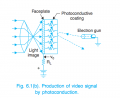
As we know that the resistance of a photoconductive material changes as an optic image is focussed on it...followed by electron beam scanned over the material to generate a video signal....
Video signal is nothing but the altered value of current flowing through the photoconductive material due to difference in resistance caused by the optic image through which it is exposed....
The thing which i don't get is that how an electron beam causes current to flow in the photoconductive material...?? What is its role??
Screen Shot 2016-06-07 at 9.55.11 am.png
 

Sensacell

Joined Jun 19, 2012
3,789
The E- beam acts as a switch or multiplexer, selecting each pixel in turn as it scans over the sensor. The beam supplies the current that flows through the photo conductive material.
 
Last edited:

Thread Starter

Himanshoo

Joined Apr 3, 2015
265
The beam supplies the current that flows through the photo conductive material
Ok I agree that the beam supplies the current that flow through the photoconductive material..but then what is the use of the battery beneath the load resistance as seen in the figure..
 

Sensacell

Joined Jun 19, 2012
3,789
Ok I agree that the beam supplies the current that flow through the photoconductive material..but then what is the use of the battery beneath the load resistance as seen in the figure..
It's a bias voltage to make the drain plate more positive- and therefor more attractive to electrons lurking on the surface.
 

Thread Starter

Himanshoo

Joined Apr 3, 2015
265
It's a bias voltage to make the drain plate more positive- and therefor more attractive to electrons lurking on the surface.
Sorry to be a little naive....
but what kind of bias voltage is applicable to this scenario..
do you refer the photoconductive material to be some kind of drain terminal...??
what difference would it make without the battery...??
 

DickCappels

Joined Aug 21, 2008
10,661
Yes, the target electrode is like a drain, or better yet, the plate of an electron tube. With no battery (target voltage = cathode voltage) there would be little or no net flow of current.

Target voltage was usually around +30 to +50 volts for vidicons and plumbicons when the cathode is run near ground. The cathode was often taken to a high positive voltage during retrace blanking so the grid 1 voltage could be fixed at a voltage that provided just enough current to reliably discharge the target.
 

Thread Starter

Himanshoo

Joined Apr 3, 2015
265
Yes, the target electrode is like a drain, or better yet, the plate of an electron tube.
So its the battery that is causing the current to flow across the photoconductive material since there should be some voltage difference that is necessary for any current to flow across any circuit...
when there is no battery present the target and the cathode would be equipotential hence no current will flow across the circuit thus no video signal would be generated..and during the blanking period the both target and cathode voltage is made intentionally equal to hide the retrace..
But my original question remains the same...what is the use of electron beam..if the entire current is supplied by the difference in cathode and target voltage..???
 

DickCappels

Joined Aug 21, 2008
10,661
The electron beam scans the target area in a raster and discharges the built up charge. If there was no beam, the target would not be scanned.
 

Sensacell

Joined Jun 19, 2012
3,789
The electron beam is current- the flow of electrons = current.

The magic is that its a steerable beam of current, either by magnetic or electrostatic deflection.
The deflection system is what makes the beam scan across the plate.
 

AnalogKid

Joined Aug 1, 2013
12,287
There have been several different television camera sensors over the years, and most are discussed here:
https://en.wikipedia.org/wiki/Video_camera_tube

Some acted as a plate of capacitors, charged up by the optical image and discharged through the electron beam. Others looked like an array of diodes. Other than all of them being based on an electron beam in a vacuum tube, here is no one single technology or or operational theory.

ak
 

Thread Starter

Himanshoo

Joined Apr 3, 2015
265
Some acted as a plate of capacitors, charged up by the optical image and discharged through the electron beam
Actually I am mistaken here...earlier I thought that its the battery which causes current to flow in the circuit generating the video signal..but its not the case ..with further research I got to know that the light of the image generates positive charge on the scanned surface which is discharged by the scanning beam...
However text says that
"As the beam scans the target plate, it encounters different positive potentials on the side of the photolayer that faces the gun. Sufficient number of electrons from the beam are then deposited on the photolayer surface to reduce the potential of each element towards the zero cathode potential. The sudden change in potential on each element while the beam scans, causes a current flow in the signal electrode circuit producing a varying voltage across the load resistance RL."

If the positive potential is discharged (neutralized) by the electron beam then how current seems to flow in the circuit..??
 

AnalogKid

Joined Aug 1, 2013
12,287
The positive potential is discharged by the movement of electrons from the beam into the area to neutralize the positive charge with negatively-charged electrons. Electron movement *is* current.

ak
 
Top