For those who understand rectifiers

Thread Starter

studiot

Joined Nov 9, 2007
4,998
Thank you , Electrician, for your fascinating input.
Perhaps there is begining to be some interest generated in my original observation, which was to the effect that if you could totally remove the ripple you could not charge the capacitor! A bit tongue in cheek but still helpful to understanding the underlying action.

Yes things change again once you introduce real components with real series resistances.
 

loosewire

Joined Apr 25, 2008
1,686
I will have to post drawings to get my point across to
new students a picture is worth a thousand words.
Then all your long responces would make more
sense,easy to follow.
 
I will have to post drawings to get my point across to
new students a picture is worth a thousand words.
Then all your long responces would make more
sense,easy to follow.
Have a look at the eBook:
http://www.allaboutcircuits.com/vol_6/chpt_5/6.html

Have you tried searching on the Web?

http://www.kpsec.freeuk.com/powersup.htm

http://en.wikipedia.org/wiki/Bridge_rectifier

http://en.wikipedia.org/wiki/Rectifier

http://hyperphysics.phy-astr.gsu.edu/Hbase/electronic/rectbr.html

http://www.electronics-tutorials.ws/diode/diode_6.html

http://www.mae.wmich.edu/faculty/Ghantasala/ME335/power supplies-low pass filters.htm

There should be something here to meet your needs.
 
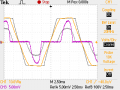
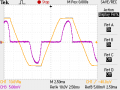
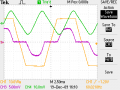
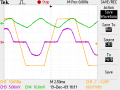
Here are two scope captures showing the effect I spoke of earlier.

I've added a third trace; the green trace is the ripple voltage across the capacitors.

The first image shows the ripple voltage with 40,000 μF of filter caps.

The second image shows the ripple with 140,000 μF.

Notice that the ripple voltage is substantially smaller with the extra 100,000 μF, but the diode current is unchanged. Adding more capacitance does not cause the current pulse to become shorter and taller, which it would if the source impedance were zero.
 

Attachments

Thank you , Electrician, for your fascinating input.
Perhaps there is begining to be some interest generated in my original observation, which was to the effect that if you could totally remove the ripple you could not charge the capacitor! A bit tongue in cheek but still helpful to understanding the underlying action.
It seems to me that you've got cause and effect reversed. The way I would put it would be to say that if you want to charge the capacitor with pulses, then there will be ripple voltage.

But, you can make the ripple as small as you want by making the capacitance very large; make it infinite and there will be no ripple.

Of course, if the capacitor were infinite, you might have to wait a long time to get the DC voltage up to where you want it! Is that what you mean when you say that if you removed the ripple, you couldn't charge the capacitor? Because, how else could you "remove the ripple"?
 

Wendy

Joined Mar 24, 2008
23,797
By special request of a 3rd party...


Capture1


Capture2


Ripple1


Ripple2


Not everyone knows how to view attachments I think.

I had this discussion about a year ago, someone had a simulator that showed the total voltage dropping to .7 of the peak output of a transformer. I claimed it tended more to the peak, they believed their simulation, and we agreed to not agree. My understanding of theory still involves the total voltage tending toward the peak value of the DC pulse.
 

Attachments

Last edited:

Thread Starter

studiot

Joined Nov 9, 2007
4,998
It seems to me that you've got cause and effect reversed. The way I would put it would be to say that if you want to charge the capacitor with pulses, then there will be ripple voltage.

But, you can make the ripple as small as you want by making the capacitance very large; make it infinite and there will be no ripple.

Of course, if the capacitor were infinite, you might have to wait a long time to get the DC voltage up to where you want it! Is that what you mean when you say that if you removed the ripple, you couldn't charge the capacitor? Because, how else could you "remove the ripple"?
No I don't mean that at all, I meant what I said and offered the subject for discussion.

The plain fact of the matter is that once the capacitor is charged up to the peak voltage it is a physical impossibility for the rectifier output to charge it further.
In fact there can be no charging current until the capacitor voltage falls below that of the rectifier output. This situation only occurs for a short period in any cycle and is the reason why charging occurs in short bursts. Another name for this variation of voltage on the capacitor is - yes - ripple. So if there were no ripple there would be no charging beyond the intial charge period.

Of course that begs the question where does the load current come from.
Well during the period the rectifier output voltage is greater than that on the capacitor the load current is (mostly) supplied by the rectifier. At this time it also charges the capacitor.
When the rectifier voltage is less than that on the capacitor the load current comes from the capacitor - ie it discharges through the load. During this part of the cycle no current is supplied by the rectifier.
 

loosewire

Joined Apr 25, 2008
1,686
You have the scope wave forms,why not follow the images
and match the math to the formula and the true statement.

The scope may not be calibrated correctly
and all scopes could have a slight variation.
So there is no perfect answer.
 
Last edited:

loosewire

Joined Apr 25, 2008
1,686
A dc square wave by battery is that perfect dc.
I guess there is no atomic clock in electronics,
because the tolerence of components is always a factor.
 
Last edited:
I had this discussion about a year ago, someone had a simulator that showed the total voltage dropping to .7 of the peak output of a transformer. I claimed it tended more to the peak, they believed their simulation, and we agreed to not agree. My understanding of theory still involves the total voltage tending toward the peak value of the DC pulse.
I've captured scope traces for the case of a very large capacitance.

Have look at the image labeled Ripple1. The orange trace is the transformer secondary voltage. You'll notice that it's not very sinusoidal; the top of the sine wave is quite substantially clipped off.

The flat top voltage that you see on the orange trace is equal to the cap voltage (plus two diode drops). The diodes act like switches; when they conduct, they connect the transformer secondary to the cap, and during the diode conduction interval the voltage on the cap is the same as the voltage at the transformer secondary (with a two diode drop difference). When you have a large filter cap, the ripple voltage is small. You can see that the ripple is only 25 millivolts P-P. The ripple is also on top of the orange trace, but because the ripple is only 25 mV P-P the orange trace looks quite flat topped at 25 volts on a scale of 10 V/cm.

Since the cap is so large that its impedance is substantially less than the transformer's impedance, when the diodes conduct the current pulse isn't enough to change the cap voltage very much (25 mV in this case). Thus, the sine wave that would normally be at the transformer secondary is substantially clipped, and the cap voltage doesn't reach the sine wave peak.

However, if the cap is small enough that its impedance is larger than the transformer impedance, then the cap voltage begins to approach the peak of the sine wave.
 
So if there were no ripple there would be no charging beyond the intial charge period.
If there were "...no charging beyond the initial charge period..." then it follows that the capacitor is charged. If "...there were no ripple...", then that means the capacitor remains charged to a constant voltage. This is your supposition.

If there is a load (we are supposing a load, aren't we?), and the capacitor remains charged to a constant voltage (how I don't know, but it must be so if there's no ripple and the capacitor was initially charged), then the load will see a constant voltage. It sounds like perpetual motion to me. Your supposition leads to an impossible conclusion.

You just can't have a situation of no ripple in isolation from everything else.

You say:

"...the thing would not work without the ripple."

I think you have it backwards. It isn't that the ripple makes the thing work; it's that the working of the thing that makes the ripple.
 

Thread Starter

studiot

Joined Nov 9, 2007
4,998
I think you have it backwards. It isn't that the ripple makes the thing work; it's that the working of the thing that makes the ripple.
Yes you said that once, but offered no proof or explanation so here goes, how to prove the egg came before the chicken.

Consider starting at the unpowered situation. Further for convenience allow the supply voltage to rise from zero in a positive direction. I note you did not show this first cycle on your scope traces.

Further assume the supply (TX and rect) is sufficient to meet any demand ie for the moment ignore the supply output resistance.

The capacitor is uncharged so its voltage will rise in accordance with the first quarter cycle of the voltage waveform to the peak. During this quarter cycle additional current is also drawn by the load from the supply, not the capacitor.

Once the capacitor has reached the peak voltage, the supply voltage starts to fall so cannot charge the capacitor further. The capacitor, now the greatest source of voltage in the system cannot discharge through the supply as it is blocked by the rectifier.
However it can and does commence discharging through the load. Concequently its voltage starts to fall. Meanwhile the transformer voltage falls to zero and makes a negative excursion, which is blocked by the rectifier, making the supply voltage zero. (If the rectifier is full wave this excursion is inverted so the next stage is shortened and occurs twice as often.) Eventually the supply voltage passes zero again and again starts to rise in a positive direction. All the while the capacitor voltage continues to fall as it discharges through the load. Finally the supply voltage rises above the now lower capacitor voltage and commences charging the capacitor again.

This cyclic lowering of the capacitor voltage is a necessary precondition for recharging the capacitor.

Because it is a precondition I maintain that the ripple 'allows the thing to work'.

I realize that this is a bit of a chicken and egg paradox I'm sure you are well acquainted with. I also realize that suitable choice of supply output resistance or load resistance can lead to time constants with the capacitor that can upset this and lead to situations as you have described with increasing the capacitance. If you had also shown measurements and traces with successively lower loads as well as higher capacitances, you would have seen the pattern reassert itself.

Please remember also that the object of this thread is to inform those who don't know about this aspect of rectifiers and make them think about it, rather than create an adversarial debate. So thank you for your contribution, especially the traces.
 
Last edited:
Please remember also that the object of this thread is to inform those who don't know about this aspect of rectifiers and make them think about it, rather than create an adversarial debate. So thank you for your contribution, especially the traces.
The subject of this thread, which was started by you, is:

"For those who understand rectifiers", not "For those who don't understand rectifiers"

Furthermore, the very first thing you said in the very first post, was:

"Discuss the following statement", which seems to me to be an invitation to discuss.

You may think we're having an "adversarial debate", but I intended my responses to some of the things you said to be a "discussion". I disagree with some of your assertions, and I am discussing them.

If you had also shown measurements and traces with successively lower loads as well as higher capacitances, you would have seen the pattern reassert itself.
What "pattern" are you referring to?
 
In an earlier post, you said:

Most textbooks start with a statement like

'The capacitor charges up to the peak value of the input voltage.'

If this were simply true then the capacitor would thenceforth always be equal or greater than the input voltage. Therefore no more curent could flow into the capacitor. Therefore no current could flow out of the capacitor into the load.
The texts never fail to point that after the initial charging of the capacitor, the load will partially discharge the capacitor, a point that you have left out of your description.

It's just not true that "Therefore no current could flow out of the capacitor into the load." If the capacitor is charged, and the load is connected, then of course current will "flow out of the capacitor into the load", thereby creating ripple.

This is the "working of the thing", and this is what creates the ripple.

The texts all describe the "...cyclic lowering of the capacitor voltage...", and all that I checked show the capacitor being charged with pulses of current.
 
Top