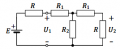
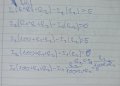
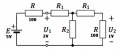
Show your loop equations (or your node equations -- your pick).Well its more like me trying to solve random circuits during summer break, but the problem is I don't even know where to start with this one, Ive tried writing both loop and node equations but there is always an extra unknown
Your equations use I1 and I2 but you don't define what those are. Don't make us guess (and, more to the point, don't make yourself have to guess at some point or the grader guess when it's for credit).I got to there and realized im missing something:/View attachment 301045
Yeah, you assumed correctly I1 is the mesh on the left and I2 is the mesh on the right both are circulating clockwise. Would I2 just be U2/R?Assuming (and forcing people to assume is never a good thing) that I2 is the mesh current circulating clockwise in the right-hand mesh, can you look at the information in the problem and solve for I2 by inspection?
Well, what does Ohm's Law have to say about it?Would I2 just be U2/R?
Yes, your loop equations are correct (I'm only looking at the top two equations).Hi, first of all i'd like to apologize for not answering for a week i've had a hectic few days. Would you mind clarifying some things for me please, because english is not my first language and i'm a little confused? Are my loop equations correct? And if they are am I just supposed to solve I2 or I1 and then i'm only left with R1 and R2 being unknowns so i just put that in the ratio?
Nope.So just to be 100% sure I1 is U1/R which is 30mA right?
So it would be E-U1 which is 5V-3V divided by R which is 100 Ω and that would make I1 20mA right?Nope.
You are falling into the all-too-common trap of throwing the nearest voltage at Ohm's Law and hoping something sticks.
Remember, Ohm's Law relates a resistance of a resistor to the current through THAT resistor and the voltage across THAT resistor.
Is U1 the voltage across R?
Correct.So it would be E-U1 which is 5V-3V divided by R which is 100 Ω and that would make I1 20mA right?
Thank you very much, i couldn't have done it without your help!Correct.
At this point, you can either solve your two loop equations using R1 and R2 as your unknowns, or you can continue an ad hoc analysis piecemeal, which is pretty simple for this problem.
You know the voltage to the left of the left-most R1, the current through that R1, and then you know the current through the right-most R1 and the voltage at the right of that R1. With just that you can solve for R1.
You're welcome. What did you get as the R1/R2 ratio?Thank you very much, i couldn't have done it without your help!