Expensive lab gear vs cheap and cheerful

If I spend more money on an lab instrument am I likely to get a better instrument?


  • Total voters
    17

Wuerstchenhund

Joined Aug 31, 2017
189
If you spend more money you will most certainly get a better instrument - better in performance, functionality and support. But that should not be surprising.

However, the real question is if it makes sense spending extra for a better instrument. An this depends on the situation. For example, someone who works with signals up to say 10MHz is unlikely to benefit from a signal generator that instead of 20MHz goes up to say 100MHz, i.e. the benefit of the larger model is zero. On the other hand, someone who say works on lots of SMPS would very likely benefit from a higher BW (i.e. 500MHz - 1GHz) scope with power analysis option over say a 100MHz simple scope. In short, it depends on the measurement task if a more expensive test instrument will provide a benefit (i.e. monetary return) or not.
 

dl324

Joined Mar 30, 2015
18,403
If you spend more money you will most certainly get a better instrument - better in performance, functionality and support. But that should not be surprising.
I wouldn't say that that's a foregone conclusion.
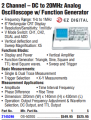
upload_2018-2-24_10-23-45.png
There are a large number of used analog scopes from very reputable manufacturers for significantly less than $400 (subtracting function generator functionality from the above offering).

Of course, said used scopes would have sold for thousands of dollars when they were new.

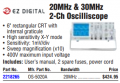
This scope came up in a search for analog scopes at Jameco, but it's unclear from the catalog description that that's the case:
upload_2018-2-24_10-27-52.png
 

Wuerstchenhund

Joined Aug 31, 2017
189
I wouldn't say that that's a foregone conclusion.
View attachment 146893
There are a large number of used analog scopes from very reputable manufacturers for significantly less than $400 (subtracting function generator functionality from the above offering).
Analog scopes? Really?

I don't know how to say this so that it doesn't sound harsh, but really, no-one in his right mind would (or should) buy an analog scope in this day and age as a working scope. No-one.

There's a reason why pretty much every notable manufacturer has given up making them more than a decade ago. Even Iwatsu, the last big brand that offered analog scopes, stopped making them in 2009. GW Instek still lists a few on its homepage but as far as I know production has stopped a while ago.
The few that are still made (like the one in your example) are mostly Chinese (Atten/Gratten?) low-quality scopes which combine antique technology with shoddy build quality which some shops try to flog off to people who don't really know any better for exorbitant prices. I'm sorry but if someone really considers $500 for an analog low-quality 20MHz scope as a worthwhile investment he needs to get his head examined.

Even for a beginner, unless you're completely broke and are offered a working analog scope for free or a few bucks, you're much better off spending a bit of money and get a DSO. Hell, even a 2nd hand HP 54645D (which is a MSO, i.e. DSO and logic analyzer) can often be found in working condition for less than $150. Better get a digital scope and learn how to use it properly than invest money in an obsolete piece of kit and learn outdated methodology.

Of course, said used scopes would have sold for thousands of dollars when they were new.
Yes, back in the '70s or the '80s. Today, most of them are pretty much scrap value. Some models (like the Tek TDS7k Series) still has its fans but even those are bought mostly by collectors of old test gear.

Also, simply due to their age, most of these old scopes have long passed the zenith of their useful service life, and very likely to fail in the near future. Even worse, many analog scopes contain proprietary components which are now unobtainium, making them very difficult or impossible to repair unless you find a donor unit which has the specific component working (and then you still don't know how long it will last, as the replacement part will also be 20+ years old). And aside from parts, to fix one you usually need a second (working) scope.

Don't get me wrong, there's nothing wrong if you still work with an analog scope. But when talking about new test equipment analog scopes simply have no place.

This scope came up in a search for analog scopes at Jameco, but it's unclear from the catalog description that that's the case:
View attachment 146894
That's an analog scope.
 
Last edited:

WBahn

Joined Mar 31, 2012
32,965
OK, I don't know how to say this so that it doesn't sound too harsh, but really, no-one in his right mind would (or should) buy an analog scope in this day and age. No-one.
Analog scopes do one thing that digital storage scopes don't do well at all -- they let you very quickly get a feel for the linearity of a circuit. You put a moderately fast triangle wave into the circuit and display the output on the scope with a free-running trigger using a relatively faster time base. You adjust the amplitude so that the display is nearly filled. If the circuit is linear the scope will spend as much time in any part of the display as any other and the entire screen will appear as a constant-tint fuzz. If the circuit is not linear, you will get horizontal bands of either darker or lighter shades depending on the slope of the transfer function in that region.

You can pull similar tricks to get a quick feel for the overall health of an entire imager IC without capturing the image at all.
 

MrChips

Joined Oct 2, 2009
34,948
Analog scopes? Really?

I don't know how to say this so that it doesn't sound too harsh, but really, no-one in his right mind would (or should) buy an analog scope in this day and age as a working scope. No-one.
That is rather harsh. I would rather have a used analog scope than no scope at all. I have a Tek 422 20MHz scope on my workbench. It's over 50 years old and works like a charm.
 

Wuerstchenhund

Joined Aug 31, 2017
189
That is rather harsh. I would rather have a used analog scope than no scope at all. I have a Tek 422 20MHz scope on my workbench. It's over 50 years old and works like a charm.
That is fine (and I agree with that any scope is better than none at all) but this is completely irrelevant to the topic at hand. Unless you really want to argue that a Tek 422 is a sensible investment for someone looking for a new working scope in 2018?


Analog scopes do one thing that digital storage scopes don't do well at all -- they let you very quickly get a feel for the linearity of a circuit. You put a moderately fast triangle wave into the circuit and display the output on the scope with a free-running trigger using a relatively faster time base. You adjust the amplitude so that the display is nearly filled. If the circuit is linear the scope will spend as much time in any part of the display as any other and the entire screen will appear as a constant-tint fuzz. If the circuit is not linear, you will get horizontal bands of either darker or lighter shades depending on the slope of the transfer function in that region.
You can do exactly the same with a DSO in persistence mode.

or just feed the source signal in Ch1 and the output in Ch2 and then select math A-B. If the line is flat then there's no non-linearity (assuming there's no significant phase change because of the circuit of course).
 
Last edited:

WBahn

Joined Mar 31, 2012
32,965
You can do exactly the same with a DSO in persistence mode.
The intensity of the line in persistence mode is independent of how long the trace was in that position. It only records that it was there. That isn't enough.

or just feed the source signal in Ch1 and the output in Ch2 and then select math A-B. If the line is flat then there's no non-linearity (assuming there's no significant phase change because of the circuit of course).
To do that there's a lot of set up involved when working with a multiplexed imager and you have to be all synched up and you only get information about one channel. With an analog scope you can have an answer for your entire imager in just a couple minutes with virtually no set up.
 

ebp

Joined Feb 8, 2018
2,332
Someone recently posted an image from a Rigol scope. I have no idea what model or whether it was being used advantageously, but if it was being used properly and the image represented its capabilities, if someone gave me one for free said individual would become persona non grata. The scope might get used as a foot stool. I prefer a small plastic wedge for a doorstop.

I've used a high quality DSO, that I think was about $12K at the time, with "persistence mode" - it wasn't completely horrible.
 
Last edited:

dl324

Joined Mar 30, 2015
18,403
Analog scopes? Really?
Yes, really.

All of my digital scopes are 2 channel and I find that I frequently use 3 or more when I'm working on circuits. I could probably get by with 2, but why bother when I can have more?

With analog scopes, I don't need to worry about what signals I want to view because I don't have to worry about aliasing or how much time the scope is actually blind while it's processing the data. There have been a number of times when a problem simply revealed itself while I was staring at some waveforms. Unless you know a lot about the type of "glitch" you were looking for, it's easy to miss single shot or low frequency events with a DSO.

Unless I need the capabilities of a digital scope, I use an analog scope. Unless I just "wanted" to use a digital scope.

Most of my test equipment is vintage and it satisfies my needs quite well.
 

recklessrog

Joined May 23, 2013
985
Whilst I cannot speak from firsthand experience with high quality modern digital 'scopes, I did try out a couple of moderately high priced ones about 6 years ago and I did not get on well with them. The display detail of fast transients was very poor and difficult to interpret, (4 bit sampling) in comparison with even an old 50 mHz 80's analog 'scope. General performance + intuitive feel came nowhere near to that of any of my Phillips/fluke series of analog and combiscopes that are both analog and digital.
However, as with computers, technology moves on quickly, and I'm sure that for the same cost, far better instruments are available now. As I am retired and electronics has reverted to "Hobby" level, I have no need for topline lab quality test equipment and could not expect my old mid 1990's 'scopes to compete with the same level modern ones.
I run a small electronics club, and some of the members say they prefer their relatively cheap digital 'scopes to my "antiques" so there you have it.
But, in answer to the original question posted by the T.S, buy the best you can afford after carefully researching that the equipment will be fit for your current and foreseeable future requirements.
 

Wuerstchenhund

Joined Aug 31, 2017
189
The intensity of the line in persistence mode is independent of how long the trace was in that position. It only records that it was there. That isn't enough.
That is only correct if intensity is set to 100% (or the scope has a shitty persistence implementation). If set below 100% then the intensity depends on how often the trace has passed through that point, ie. exactly the same behavior as phosphor on an analog scope.

With better DSOs which have colored persistence you can also generate a heat map which better shows small differences in brightness than the monochrome variant.

or just feed the source signal in Ch1 and the output in Ch2 and then select math A-B. If the line is flat then there's no non-linearity (assuming there's no significant phase change because of the circuit of course).
To do that there's a lot of set up involved
It's a BNC tee and a BNC cable to feed the source to the scope. Doesn't sound like a lot to me.
 

Wuerstchenhund

Joined Aug 31, 2017
189
Yes, really.

All of my digital scopes are 2 channel and I find that I frequently use 3 or more when I'm working on circuits. I could probably get by with 2, but why bother when I can have more?
As with my reply to MrChips above, that is all well and fine (and no-one wants to take that away from you) but it's completely irrelevant in the context of the topic. And the reality is that no-one (except these Atten/Gratten crappy analog scopes from your examples) makes analog scopes any more, not even Tektronix who probably made the most advanced ones and who has lost the technical leadership crown ever since.

With analog scopes, I don't need to worry about what signals I want to view because I don't have to worry about aliasing or how much time the scope is actually blind while it's processing the data. There have been a number of times when a problem simply revealed itself while I was staring at some waveforms.
If you can't capture a problem that you can see on an analog scope then I'm sorry but either your DSO is really poor or you're doing something wrong.

In my more than 30 years I yet have to see a glitch that could be seen on an analog scope but not on a DSO.

Unless you know a lot about the type of "glitch" you were looking for, it's easy to miss single shot or low frequency events with a DSO.
That's wrong. Any event you can capture on an analog scope you can capture on a decent (i.e. non-shitty) DSO easily. Even the current crop of bottom-of-the-barrel DSOs like the $400 Rigol DS1054z can do mask testing which will show you any issue on a repetitive signal, so you don't even have to know what problems you're looking for.

More advanced scopes like those from LeCroy and Keysight even have tools to find anomalies in non-repetitive signals.

On a good DSO properly set up, I can just let the scope sit there running while I fetch a coffee, and when I come back the scope not only tells me what glitches were in the signal, it also presents me with a table with the exact time stamp of each glitch's occurrence, which often helps to narrow down the source of the problem.

Unless I need the capabilities of a digital scope, I use an analog scope. Unless I just "wanted" to use a digital scope.
Most of my test equipment is vintage and it satisfies my needs quite well.
Again, that is well and fine, but the topic of this thread is "Expensive lab gear vs cheap and cheerful" and not "Does dl324's collection of vintage gear satisfy his needs". You work with the gear you have because you happen to have it, but if you didn't own these scopes, would you buy exactly these scopes today, or something else?


Whilst I cannot speak from firsthand experience with high quality modern digital 'scopes, I did try out a couple of moderately high priced ones about 6 years ago and I did not get on well with them. The display detail of fast transients was very poor and difficult to interpret, (4 bit sampling) in comparison with even an old 50 mHz 80's analog 'scope. General performance + intuitive feel came nowhere near to that of any of my Phillips/fluke series of analog and combiscopes that are both analog and digital.
I don't know what you used (and it's a shame you can't remember any manufacturer name or model no) but if it was really something that used 4bit sampling then for sure it was no general purpose scope (which all use 8+bit sampling and have been doing so for more than 20 years).

Of course, with 4bit sampling (i.e. 16 steps) it's no surprise any signal would look like crap compared to even a very basic analog scope, but frankly this is more down to a very poor choice of digital "scope" (if you can call it that) than representing the technical stand of digital scopes in general, not in 2012 nor in 2002. The fact that you said it couldn't even hold up with a Philips CombiScope shows that, whatever it was, was probably not meant for what you were using it for.

However, as with computers, technology moves on quickly, and I'm sure that for the same cost, far better instruments are available now.
Yes, but also the price level for a decent new DSO has shifted down a lot, which these days is $400 for the Rigol DS1054z.
 

WBahn

Joined Mar 31, 2012
32,965
That is only correct if intensity is set to 100% (or the scope has a shitty persistence implementation). If set below 100% then the intensity depends on how often the trace has passed through that point, ie. exactly the same behavior as phosphor on an analog scope.

With better DSOs which have colored persistence you can also generate a heat map which better shows small differences in brightness than the monochrome variant.


It's a BNC tee and a BNC cable to feed the source to the scope. Doesn't sound like a lot to me.
Thanks for completely altering the context of what I said to fit your narrative.

Responding to the snippet, "To do that there's a lot of set up involved" is not the same thing as responding to, "To do that there's a lot of set up involved when working with a multiplexed imager ...."

Not much point continuing the discussion if that's what you're going to do. Tata.
 

Wuerstchenhund

Joined Aug 31, 2017
189
Thanks for completely altering the context of what I said to fit your narrative.

Responding to the snippet, "To do that there's a lot of set up involved" is not the same thing as responding to, "To do that there's a lot of set up involved when working with a multiplexed imager ...."
I snipped it because I didn't feel its relevant in my reply's context but maybe that was wrong (and if you think that's the case then you could have just said so with a lot less drama).

Anyways, the point is that what you want to do ("very quickly get a feel for the linearity of a circuit") doesn't require the use of an analog scope.
 

WBahn

Joined Mar 31, 2012
32,965
I snipped it because I didn't feel its relevant in my reply's context but maybe that was wrong.

Anyways, the point is that what you want to do ("very quickly get a feel for the linearity of a circuit") doesn't require the use of an analog scope.
I haven't looked at the DSO market in some time. How expensive is a DSO that has the kind of persistence mode you are talking about (let's say a 100 MHz, 2 channel scope to keep things on the low end)?
 

Wuerstchenhund

Joined Aug 31, 2017
189
I haven't looked at the DSO market in some time. How expensive is a DSO that has the kind of persistence mode you are talking about (let's say a 100 MHz, 2 channel scope to keep things on the low end)?
That really depends on what you want and your opinion on "hacking".

The cheapest variant would probably be the Rigol DS1054z at $400 which is a 50MHz 4Ch scope but for 100MHz BW would need to be hacked (which really is just entering a code that's generated on a website, and aside from more BW also gives you more memory, serial decode and advanced triggers).

If you want a proper big brand scope then the lowest entry would be the Keysight DSOX1102A (2Ch 100MHz) which is around $650. It's downside is the poor quality of the included passive probes (the scope itself is fine!), so if you would go for this on you'd probably want to add another $30 or so for some better probes).

Both scopes have variable persistence (which is what you're looking for). Older cheap scopes like the widely used Rigol DS1102 or the still sold Siglent SDS100CML/CNL/CFL only offer infinite persistence which wouldn't work for what you want to do.

That's for brand new scopes.
 
Last edited:

BobaMosfet

Joined Jul 1, 2009
2,211
Your work is only as good as your knowledge and tools. Buy a high-end tool from a reputable company and you likely will never need to repurchase it. I would suggest this if you go towards 'cheaper' types of DMMs and so forth- test them against a known good instrument on the spot. I've purchased such things blind, got them on the bench and found out they were bad. I won't do that again. If a store won't let me open it and test it right there, I don't want it from them. I finally stopped getting cheaper DMMs, and went with Fluke. Hands down, won't ever look at another brand, or even need to buy another one. For scopes, I took advantage of the hey day when carriers were dumping all this switch gear, test equipment, etc, and got a TekTronix I couldn't justify personally today it'd be so expensive. Again, hands-down, best purchase I ever made. Cheap is fine for hobby, but if you're serious- better is just that-- better.
 

BobaMosfet

Joined Jul 1, 2009
2,211
Home stuff wierd. Work stuff even wierder.

Even though I worked nearly 30 years at one place, a lot of the stuff was bought before my time. It was very difficult to buy general purpose stuff because stuff had to be tied to contracts.

  1. There were lots of Sorenson power supplies for running lamps until we got a 1 kW Solar simulator Xenon bulb and consolodated testing. They eventually all failed the same way and were easily fixed. It was important to be able to replace failed equipment quickly with a spare.
The same was true for vacuum gauges. Nearly all were the same model. An 843 Varian. They were easy to fix. Main problems were the filter caps on the -15 V supply, or spilled acetone on the plastic meters, bad relays because of the ripple on the -15 v supply and re-lamping)

kronos thickness monitors I didn't fix. They were all TTL.

We had a number of HP x-y recorders and again, they were easy to fix. The problems were slide wire lubercation and pot replacement. An occasional electrostatic hold down.

Fluke multimeter were mostly display replacements.

The Keithley stuff seemed to be better. One voltage source I fixed by writing a program to exercise a relay every 10s overnight.
An electrometer, I burned out a 100 ohm protection resistor. I also found a serious design flaw. Keithley had a $200 minimum order, so a simple part was tough to get.

I worked with Oriel a number of times and got stuff repaired (sometimes re-engineered) for free. I made changes myself until they made much better solutions. The spark gap was a normal thing to replace.

Repair of Keithely stuff almost ended up being 1/2 the cost of the instrument.

A schematic always helped. I added parts to a thermocouple scanner, I converted digital thermometers to analog out, I modified a bunch of Eurotherm temp controllers so they all had the same pin-outs. I had access to a sense resistor in a Kikisui power supply. I had to sign an NDA to get a power supply schematic. I wont mention the name.

Stuff that was difficult to fix or send away I had to fix like a 100 kV 0.1A, 1948 X-ray power supply or a 10 kV 1.5 E-gun power supply.

The last manager I had did not believe in my style and nano-managed. The one prior knew that I helped the organization overall and i could keep things running smoothly and running safely. In one case one professional and a graduate student spent the entire weekend trying to fix an measuring system that was sparking. When I came in on Monday, I had the problem identified in 5 minutes. A bad ground in an outlet strip.

At home, we can look at me being a little kid with a Micronta (radio Shack) meter, then an Eico FET TVM kit, then a fluke 77 and now a bunch of meters. One DVM I got free from Circuit Specialists. Scopes were the same way. I got one from High School free, then a hugh tube/transistor HP military scope, then a Kikasui scope and then a Tek TDS series scope.

I have a bunch of test equipment from ebay that needs minor repairs that i still haven't done. The price was right, e.g.
A voltage source with a bad IEEE board (sold as non-working and really cheap). I disconnected the board and it works fine. A dead current source that needs some work, three Keithley 480 picoammeters. two had the same problem, just not 100% fixed. A Keithley frequency couter that has buttons that need replacing. A nanovoltmeter that just needs some mechanical stuff. I want to make a low-thermal adapter, but the company hasn't responded. A few Keithley 5 digit DVM's.

The TDS scope really needs the NVRAM replaced and a floppy emulator installed.

So, there is a lot of work involved with used older stuff.

Now, it appears you have to spend time reverse engineering stuff to even try to fix it. That's an area I need to work on. I have two simple cordless phone charger bases. One I fixed easily. the other is much harder. They aren't really chargers. They just provide a current limited source and an indicator of some sort.

I need to work on better reverse engineering techniques.
I admit, I also have TDS360. With a working FloppyDrive. I love it-- and I still have good 3.5" floppies.
 
The TDS340 was an impulse buy, I wish I got higher BW. Plans are to add a USB floppy emulator drive (have it) and to change the Dallas clock chip. That's harder because you have to remove it and back-up the firmware/calibration and put the firmware on the new chip. The chip isn't socketed.
 

Wuerstchenhund

Joined Aug 31, 2017
189
Your work is only as good as your knowledge and tools.
100 ACK, that's a given. And knowledge not only includes your circuit and its components but also your test equipment.

Buy a high-end tool from a reputable company and you likely will never need to repurchase it.
I wish this was true, but unfortunately it isn't. Not because of durability (modern test gear in general is very reliable and requires minimal maintenance) but because of performance and features.

For example look at scopes: we get more BW (the fastest scopes go to 100GHz today), faster sample rates, more sample memory, ADCs with more than 8bit resolution, new or improved advanced analysis tools, support for new buses and serial communication standards and so on. Spectrum Analyzers get better RF performance at lower prices, with much wider analysis BW which is required for modern communication signals. Rigol just announced its new Real-Time SA, which is pretty much the king class of SAs, at a price that not too long ago only bought you a conventional swept SA.

Even if you look at cheaper kit that's used for hobbyists, there's a lot of change. If you bought a Rigol DS1052 (a simple 2Ch 50MHz scope with tiny low-res screen, low update rate, and only a very basic set of features) in say 2010, half a decade down the line you get 4 channels, tons of memory, and more features for less money.

Often it's not that the old tool fails, it's just that the new tool offers many advantages over the old tool which can save time and make life much easier.

I would suggest this if you go towards 'cheaper' types of DMMs and so forth- test them against a known good instrument on the spot. I've purchased such things blind, got them on the bench and found out they were bad. I won't do that again. If a store won't let me open it and test it right there, I don't want it from them. I finally stopped getting cheaper DMMs, and went with Fluke. Hands down, won't ever look at another brand, or even need to buy another one.
DMMs are one of the things were not a lot has changed over the last years (or even the last two decades), so naturally if you buy a quality meter then there's usually a lot less desire to replace it a few years down the line.

For scopes, I took advantage of the hey day when carriers were dumping all this switch gear, test equipment, etc, and got a TekTronix I couldn't justify personally today it'd be so expensive. Again, hands-down, best purchase I ever made. Cheap is fine for hobby, but if you're serious- better is just that-- better.
Well, when it comes to digital scopes, there's actually not a lot that is much worse out there than Tektronix. Back in the analog days, Tek was king, and made some of the best analog scopes that existed. Unfortunately, when analog scopes died out, Tek didn't really 'get' digital scopes so they tried to mimick analog scope behavior (I guess Tek probably would have preferred to continue building analog scopes until eternity), and most of its digital scopes were/are pretty poor or downright horrible (ie. lock up whenever anything demanding is required, or have an UI designed by someone who must have hated all humans).

I actually blame Tek for some of the, shall I say 'dislike', older engineers had or still have towards digital scopes.

Over the years, Tek has sold re-hashed versions of its old scope designs, often with only marginal improvements. The lack of innovation has driven lots of customers away, and when Tek was taken over by Danaher most of the good engineers left. Today, Tek mostly relies on its laurels from the good old days, with little direction where to go (which is also visible in the new Tek MDO5 Series, which is pretty much a scope without a real target market), and even the once great Tek support has declined notably.

As a institutional purchaser of test equipment, we pretty much don't buy Tek, and have so for many years. Sometimes we invite Tek to send us equipment for evaluation, but usually it just can't measure up with what other brands offer. Today, if you need an advanced mid-range or high-end scope you go to LeCroy (they do stuff no-one else is doing) or Keysight, and for your standard bench scopes you go to Keysight or R&S.

I know in forums like these where many people know Tek from the old days and have fond memories of its great scopes the natural thing for many is to look for Tek when thinking about buying a digital scope, but this is a great example why past experience doesn't necessarily extrapolate to the present.
 
Top