dcbingaman
- Joined Jun 30, 2021
- 1,065
Correct, can you answer why? Is it the current that is the same or the voltage that is the same for all three resistors?They look like they are in series.
r1 and r3 is getting all of the current. The current is splitting between r2 and r4.It is r1 and r3 but can you explain why?
Excellent. Do you want to try to tackle the original problem again? Just identify in the original circuit which are in series and which are in parallel as the first step.r1 and r3 is getting all of the current. The current is splitting between r2 and r4.
In series the current is the same so they have current in common. In parallel they voltage is the same so they have voltage in common.A resistor in a circuit might have a voltage across it and current flowing through it given by Ohm's Law:
I = V/R
Resistors in series have one thing in common. What is it, current or voltage?
Resistors in parallel have one thing in common. What is it, current or voltage?
To me it look like r1 , r2 and r3 are in series.Correct.
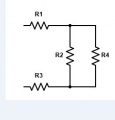
Hence in the following circuit diagram, which resistors are in series and which resistors are in parallel?
(This is a trick question).
View attachment 247819
Is the current through R2 the same as that in R1?To me it look like r1 , r2 and r3 are in series.
Technicaly r4 would be in series with r1 and r2.Is the current through R2 the same as that in R1?
Why is R2 selected instead of R4? Why is R2 any different from R4?
I mean technicaly r4 would be in series with r1 and r3.Technicaly r4 would be in series with r1 and r2.
No.I mean technicaly r4 would be in series with r1 and r3.
Correct. I can see where you are going wrong. When you analyze the circuit FIRST identify resistances that are in parallel. Then identify resistance that are in series.They look like they are in series.
Ok, imagine you are an electron and you want to get from the input terminal of this circuit to the output terminal.To me it look like r1 , r2 and r3 are in series.
Here is an easier question that I know you know the answer to this. This IS NO DIFFERENT than the circuits we where just looking at:I mean technicaly r4 would be in series with r1 and r3.

We don't need analogies for this. Let us stick to using resistors, circuit topology and Ohm's Law.Here is an easier question that I know you know the answer to this. This IS NO DIFFERENT than the circuits we where just looking at:
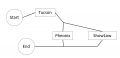
View attachment 247825
Ok the lines are roads/highways the boxes are locations. You are at the circle start and want to get to the circle end and you are only allowed to use the highways (lines) I provided.
Questions:
1. Do you have to go through Tucson to get from start to end?
2. Do you have to go through ShowLow to get from start to end?
3. Do you have to go through Pheonix to get form start to end?
If you have to go through a certain city to get to your destination then that city is in series in this 'circuit'
If you have a choice between 2 or more cities, those cities are in parallel to each other.
Probably true. The TS though is struggling with the principle after the original attempts to help explain it. This is why I have turned to an analogy, it could be the inroad that helps the TS. Everyone thinks a little different from each other.We don't need analogies this. Let us stick to using resistors, circuit topology and Ohm's Law.
| Thread starter | Similar threads | Forum | Replies | Date |
|---|---|---|---|---|
| P | Need help with finding the equivalent R | Homework Help | 5 | |
| P | Determine the equivalent resistance | Homework Help | 14 | |
| T | Thévenin Theorem - Problem with equivalent voltage & resistance | Homework Help | 10 | |
| F | Basic equivalent resistance problem | Homework Help | 3 | |
| G | Quick question about equivalent resistance problem | Homework Help | 4 |