Energizing a valve controller so it can open and close

Thread Starter

oromero00

Joined May 2, 2025
3
Hello, I have a valve with an actuator that works with 12 V DC. For the valve to open, it needs 12 V DC, and to close, it needs inverted polarity of the same 12 V DC.

I am trying to automate this via a 2-wifi switch in a way that each switch has a different polarity output. When doing some tests, one of the wifi switches did not close, and this burnt out one of the 120 to 12VDC converters.

Is there any type of device you are aware of that I can use for this purpose without the risk of having two sources (inverted polarity) hitting my valve actuator at the same time?

Thank you!
 

crutschow

Joined Mar 14, 2008
38,316
Okay, another game of 20 questions:

You said one of the WiFi switches did not close.
So do you have two switches or does it have two outputs?

How can we help you if we don't know exactly what you have?
 

crutschow

Joined Mar 14, 2008
38,316
Continuing this tedious game:

Sorry but I'm not clairvoyant.
I don't know what a "2-wifi switch" is or how it's connected to whatever else you have.

Post a diagram of how all the parts you have are connected if you want any further response to your problem.
 
Last edited:

AnalogKid

Joined Aug 1, 2013
12,043
Is there any
information

you are aware of that
we
to answer your question?

Data on the wifi switch - link to web page where you bought it, datasheet, app notes, etc.

Data on the power supplies - link to web page where you bought it, datasheet, etc.

Data on the valve

Your schematic / wiring diagram. We have zero information to work with, and know nothing about your skill set for this project. This could be a simple wiring error - OR - you could have to replace everything.

ak
 

MisterBill2

Joined Jan 23, 2018
27,164
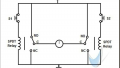
rather than being concerned about the "wifi switches", given that they provide a 120 volt AC output, the circuit shown in post #1 is partly correct. BUT there is also a huge error, in that the same mains voltage is applied to the valve that requires only 12 volts. THAT is a fatal flaw that will burn out the 12 volt supply.

So here is the correct scheme: Each of those two SPDT relays will need to be relays with a 120 volts AC coil, and each relay coil will connect ONLY to that one wifi switch output, not anything else.
The motor portion of the circuit will be similar to what is shown in post #1, BUT NO CONNECTIONS TO THE RELAY COILS!!!
The two relays must have 120 volt AC coils to match the wifi controller outputs.
The valve coil will connect between the common contacts of the two relays, as shown. The N.O. contacts of both relays will connect to the 12 volt supply positive terminal, and the two N.C. contacts from the two relays will connect to the 12 volts supply negative terminal. now one relay operating will apply one polarity to the coil, and the other relay operating will supply the opposite polarity to the valve coil. AND if both relays are operated nothing will happen.
This is a classic reversible motor circuit that works very well.
 

kami100

Joined Apr 30, 2025
6
To make a valve controller open and close, it must be supplied with the correct power (usually 24V DC or 120V/230V AC depending on the model) and control signal. For on/off valves, this usually takes the form of a simple digital signal (for example, voltage to the “open” or “close” terminal). For modulating valves, it could be an analog signal like 4-20mA or 0-10V. A controller powered and signaled will now power the actuator to turn the valve to the proper position. Some systems as check sensors also send confirming signals back reporting what position the valve is in.
 

MisterBill2

Joined Jan 23, 2018
27,164
To make a valve controller open and close, it must be supplied with the correct power (usually 24V DC or 120V/230V AC depending on the model) and control signal. For on/off valves, this usually takes the form of a simple digital signal (for example, voltage to the “open” or “close” terminal). For modulating valves, it could be an analog signal like 4-20mA or 0-10V. A controller powered and signaled will now power the actuator to turn the valve to the proper position. Some systems as check sensors also send confirming signals back reporting what position the valve is in.
Please look at the first sentence of post #1! The TS is very clear that this particular device is different in that it requires a polarity reversal. That is quite different from most solenoid operated valves.
 
Top