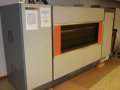
Wow! I wonder what that storage would cost in today's dollars. About that same timeframe, I saw the drum storage on a Univac 1100 series computer. Very impressive. I think this is the one I saw:
Most people I knew did not have a disk on their homebrew computer at the time Eliza was done using the XPL0 programming language. If they did, it was an 8" floppy. I was using tape until I got an Apple][.
4500 pounds is the weight of a Ford Explorer -- that explains it.
(Look at the Weight per kilobyte spec at the bottom).
This answers my earlier question: $134,400 + $41680 = $176,000 in 1968. $176,000.00 in 1968 had the same buying power as $1,227,976.40 in 2016
But you could put up to 8 of them on one controller for only about $10,000,000 total (in 2016). A big savings over needing 8 controllers.
Specifications (FASTRAND II)
Storage capacity: 22,020,096 36-bit words = 132,120,576 6-bit FIELDATA characters = 99 megabytes (8-bit bytes) per device
Drum rotation rate: 880 RPM (14.7 rotations per second) Heads: 64 Sector size: 28 36-bit words Track size: 64 sectors (1,792 36-bit words)
Track density: 105 tracks per inch
Average Access time (seek time plus rotational latency): 92 milliseconds
Data transfer rate: 26,283 36-bit words per second = 118 kilobytes per second (8-bit bytes) on 1100 series machines Recording density, one-dimensional: 1,000 bits per inch (along one track)
Recording density, two-dimensional: 105,000 bits per square inch of drum surface
Max FASTRAND devices (drum units) per controller: 8 Controller price: $41,680 (1968 dollars)
FASTRAND device price: $134,400 (1968 dollars)
Weight per FASTRAND device: 4,500 pounds
Weight per kilobyte: 6 ounces (170 g)
Wow! I wonder what that storage would cost in today's dollars. About that same timeframe, I saw the drum storage on a Univac 1100 series computer. Very impressive. I think this is the one I saw:
Most people I knew did not have a disk on their homebrew computer at the time Eliza was done using the XPL0 programming language. If they did, it was an 8" floppy. I was using tape until I got an Apple][.
In 1985 when I got my first computer I had the option of getting a full-height 5-1/4" 10 MB hard drive. It would have only cost an additional $1500. I opted to live with dual full-height 5-1/4" 360 KB floppy drives instead.
In 1985 when I got my first computer I had the option of getting a full-height 5-1/4" 10 MB hard drive. It would have only cost an additional $1500. I opted to live with dual full-height 5-1/4" 360 KB floppy drives instead.
Yeah, "only" $1500.
When asked how much a computer would cost Thom Renick always told the asker $5000. His logic was based on "Pay me now or pay me later". The total of all of the stuff you need (computer, monitor, printer, Modem, scanner...) is still the same once you are done buying. This applied back in the 80's and still mostly applies now. Sure you get a GHz multiple core processor with GigaBytes of memory, TerraBytes of hard drive and a monitor worthy of a drive-in theater but it still costs you $5000, all told.
Yeah, "only" $1500.
When asked how much a computer would cost Thom Renick always told the asker $5000. His logic was based on "Pay me now or pay me later". The total of all of the stuff you need (computer, monitor, printer, Modem, scanner...) is still the same once you are done buying. This applied back in the 80's and still mostly applies now. Sure you get a GHz multiple core processor with GigaBytes of memory, TerraBytes of hard drive and a monitor worthy of a drive-in theater but it still costs you $5000, all told.
I used the same figure for a very long time -- in fact that first computer I bought was a TI Pro and, with all the software I bought with it, came in right at $5000. I replaced it in 1991 with a decked out 486DX-50 and that system set me back $5000. The next machine I bought was a 200 MHz Pentium-Pro in 1995 for a lease-back to my employer and it was $6000 thanks to a 21" Trinitron monitor. Over the next decade I purchased many machines for lease-back and they tended to be pretty top-end PCs and the cost started shrinking from $5000 to about $2500 when I bought the last one (which actually sucked for me since the lease payments were based on purchase price). But if I had set them up as a gaming machine it would have still been $5k -- fortunately we didn't need high-end graphics capabilities, just processing (admittedly. "fortunately" is a bit relative in this case).
Today I think you are probably still looking at $5k for a top-end gaming machine, but I think average-Joe set-ups can be had for a fraction of that.
Wow, these figures are amazing. However, I've never bought a gaming machine. As far as "the average Joe" machine, we sell a basic business setup with 23" flat screen monitor for about $1,000. It has 8GB memory and 300GB harddrive. And that's with our markup over the distributor.
Wow, these figures are amazing. However, I've never bought a gaming machine. As far as "the average Joe" machine, we sell a basic business setup with 23" flat screen monitor for about $1,000. It has 8GB memory and 300GB harddrive. And that's with our markup over the distributor.
In the $1000 range was about what I had in mind. You can get a decent box for $500 to $800 and if you then throw larger monitor and an all-in-one printer at it, you are in that $1000 range. I priced machines a couple months ago and it wasn't hard to get into the $3000 range on a non-gaming machine, but the gaming machines still seemed to push that $5k level pretty hard.
Alice is more of a comedian
judge: merry christmas
ALICE: Merry Christmas to you too, judge.
judge: stop calling me judge
ALICE: What is your real name?
judge: alice
ALICE: Can I help you?
judge: no
ALICE: Is there anything you want to tell me?
judge: yes
ALICE: Whoa.
judge: never mind
ALICE: OK, Thanks for trying to explain that to me.
judge: I did not
ALICE: I thought you did.
judge: that is weird
ALICE: Weird Good or Weird Bad?
judge: bad
ALICE: What do you need it for?
judge: catching mice
ALICE: Tell me about your mother.
I do find that Eliza is annoying with her "Tell me more..."
Although with Alice then the conversation does wander.
AIDayley
Lieutenant: Is scotty in engineering?
James T. Kirk: All right. We'll triangulate on him. We'll let Lieutenant explain what happened to his wife. Remember my instructions, Lieutenant. Keep a tight fix on us. If we let out a yell I want an armed party down there before the echo dies.
Is anyone familiar with this program! It's birth was in the 60s and could be run from Arpanet. It purported to be a therapist and would respond to your statements and questions in that manner. It was an early artificial intelligence program developed to pass the Turing test. Initially, it can appear to be a human but careful selection of your responses revealed its origins.
I've found the source code, written in an old BASIC dialect. I am converting it to FreeBASIC, a C-like dialect.
It is widely claimed that some high fraction of users were fooled into thinking they were conversing with a human therapist. I always found this not to be any evidence of having achieved artificial intelligence, but rather evidence that it is trivially easy to achieve natural stupidity.

 Facebook
 Google
 GitHub
 Linkedin



 About that same timeframe, I saw the drum storage on a Univac 1100 series computer. Very impressive. I think this is the one I saw: