Electronic Level Indicator using LM3914

Thread Starter

RodneyB

Joined Apr 28, 2012
698
Well with Zero understanding pure Luck only I have got the Opto to switch on the MOSFET. I have no idea how or why. Now before I connect it to the LM3914 I would like to be sure that I am on the right track.
 

Attachments

ScottWang

Joined Aug 23, 2012
7,501
Thank you for this. For M2 I have IRF730 which will easily switch this current. R8 does this need to be a 10 Watt resistor?
IRF730 is not appropriate for this application, it is for the high voltage over 50V and more, if you using it at here, the Vds will be too high, because the Rds=1Ω is too big, you could calculate the V=I*R, you may use IRF540 or IRF640.

I can not get a 2SA684 from our local electronics supplier but can get a BC557 will this do the Job. I have Drivers for the LED's if this will be better to eliminate such a large resistor for current limiting for the LED
The BC557 is ok for the n mosfet, but it is not for the TIP41, I forgot to modify the bjt number 2SA684(1A) to 2SA733 (100mA) or 2N3906(100mA).

Using this circuit then I wont have to use the opto is that correct
If everything is match what I thought then it will be ok and no need to use the opto bjt.
 

ScottWang

Joined Aug 23, 2012
7,501
Well with Zero understanding pure Luck only I have got the Opto to switch on the MOSFET. I have no idea how or why. Now before I connect it to the LM3914 I would like to be sure that I am on the right track.
When we using the EE components to design then we need to follow what the datasheet notes as close as we can.

4N35:
Forward Voltage (IF = 10 mA),Vf typ=1.15V, max = 1.5V
Collector–Emitter Saturation Voltage (IC = 0.5 mA, IF = 10 mA), VCE(sat) , typ= 0.14V, max= 0.3 V

Note that the LED, Vf max=1.5 V, If=10 mA.
Calculates the R3 in your circuit.
R3 = (Vcc-Vf)/If
= (12V-1.5V)/10 mA
= 10.5V/10 mA
= 1050 Ω
Choose R3 = 1K.

Note that the transistor, Ic=0.5 mA, Vce(sat) = 0.3 Vmax.
Calculates the R1 in your circuit.
R1 = (Vcc-Vce)/Ic
= (12V-0.3V)/ 0.5 mA
= 11.7V/0.5 mA
= 23.4K
Choose R1 = 22K.
 

ebeowulf17

Joined Aug 12, 2014
3,307
Well with Zero understanding pure Luck only I have got the Opto to switch on the MOSFET. I have no idea how or why. Now before I connect it to the LM3914 I would like to be sure that I am on the right track.
If I'm reading the drawings right, the only change was eliminating the top resistor (between 12V supply and opto isolator, ultimately feeding MOSFET gate?) If so, I'm not surprised that helped. I thought it was odd you only had 7V going to gate. I'm assuming gate voltage now is very close to 12?

Regardless of explanation, I'm glad you've got it working. Well done!
 

MrCarlos

Joined Jan 2, 2010
400
Hello RodneyB

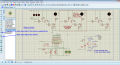
I prepared what I call: the heart of your Electronic Level Indicator.
Probably this stage with the LM3914 and other associated devices, not the power secction, You already have finished.

Look carefully at the video. Note that functions as you have been requesting.

You can run the simulation that I am enclosing You, in your Proteus ISIS Version. 8; "Play" in a while, move or change it all with the intention of learning how to handle this simulator.

Note: Sorry The video is to big to Upload, let me make Short. . .
 

Attachments

Thread Starter

RodneyB

Joined Apr 28, 2012
698
Hello RodneyB

I prepared what I call: the heart of your Electronic Level Indicator.
Probably this stage with the LM3914 and other associated devices, not the power secction, You already have finished.

Look carefully at the video. Note that functions as you have been requesting.

You can run the simulation that I am enclosing You, in your Proteus ISIS Version. 8; "Play" in a while, move or change it all with the intention of learning how to handle this simulator.

Note: Sorry The video is to big to Upload, let me make Short. . .
Thank you so much for the simulation and the video. Once this project is finished I want to really learn how to use the simulator. This makes life so much easier. I see from the simulation, that by adjusting RV2 you can make sure that the LED's light correctly without jumping.

Thank you for all your Help.
 

MrCarlos

Joined Jan 2, 2010
400
Hello RodneyB

One thing is to simulate our electronic designs in a simulator and another, often different, is to build the same circuit with real devices. Be careful with this.
(Again see post Your #45).

I joined the circuit in my message #67 with one suggested by ScottWang in His message #57. (TIP41 From an opto transistor_RodneyB_ScottWang.gif).
I'll attached for you to play with.

You'll notice a similar problem that you mention in Your post #45. This is a fault simulator Proteus ISIS Version 8.
It is not possible for the circuit attached to the message #67 not present this problem however where I am attaching now manifest.
Furthermore it seems that the LM3914 does not work correctly for failure presented.

For analysis:
Set the jumper on Dot mode.
Adjust Selector AC DC in DC.
Sets the Level Selector at DC 2.
Add a DC VOLTMETER: R10, Next to the connector 4 and Ground.
Add a DC VOLTMETER: Q4 collector and Ground.
You do the same with R5 and Q2.

Click the Run button.
As you turn the switch Level Control notes readings in DC VOLTMETER’s.
Reasoning about what is happening when the aforesaid failure occurs.

Now your turn to make Your design replacing transistors BJT by N-MOSFET as suggested by ScottWang.
(Ref: LM3914 For NMOS FET RodneyB ScottWang.gif).

Good Luck.
 

Attachments

Thread Starter

RodneyB

Joined Apr 28, 2012
698
Hello RodneyB

One thing is to simulate our electronic designs in a simulator and another, often different, is to build the same circuit with real devices. Be careful with this.
(Again see post Your #45).

I joined the circuit in my message #67 with one suggested by ScottWang in His message #57. (TIP41 From an opto transistor_RodneyB_ScottWang.gif).
I'll attached for you to play with.

You'll notice a similar problem that you mention in Your post #45. This is a fault simulator Proteus ISIS Version 8.
It is not possible for the circuit attached to the message #67 not present this problem however where I am attaching now manifest.
Furthermore it seems that the LM3914 does not work correctly for failure presented.

For analysis:
Set the jumper on Dot mode.
Adjust Selector AC DC in DC.
Sets the Level Selector at DC 2.
Add a DC VOLTMETER: R10, Next to the connector 4 and Ground.
Add a DC VOLTMETER: Q4 collector and Ground.
You do the same with R5 and Q2.

Click the Run button.
As you turn the switch Level Control notes readings in DC VOLTMETER’s.
Reasoning about what is happening when the aforesaid failure occurs.

Now your turn to make Your design replacing transistors BJT by N-MOSFET as suggested by ScottWang.
(Ref: LM3914 For NMOS FET RodneyB ScottWang.gif).

Good Luck.
HI

I built the see saw over the weekend. One thing I never took into account and not quite sure how to deal when the see saw is at the same level.

I used proximity switches to show the different positions of the see saw, they turned on a relay which then turned on the signal voltage to the LM3914. When the see saw is level two proximity switches come on and this caused chaos. I tried to move the proximity switches but then this didn't show level.

I realised that the relays could have switched on the LED's without the rest of the circuit, however the clicking relays was also a problem and wont be good in the long term.

Using the 12 Volt battery unfortunately the unit would not switch above 8 Volts. So I had to put in a 20 Volt power supply which then caused a problem with all the 12 Volt LED's

So I think I need some direction in the fine tuning of this project
 

MrCarlos

Joined Jan 2, 2010
400
Hello RodneyB

I do not know what use relays. Maybe for another part of the design that we have not seen.
I guess you mention proximity switches are activated with a piece of magnet.

You could use these proximity switches for connecting the LM3914 different voltage levels eliminating the relays.

In likely that the physical form of the magnet piece two proximity switches are activated simultaneously.
You could use a ferromagnetic sheet folded into U and mount it on the magnet to concentrate the magnetic lines.

You can use a power supply of 12 V for the LED's and a 20 volts to the rest.

I Hope this help you.
 
Top