Driving high power LED like Xenon strobe

LesJones

Joined Jan 8, 2017
4,509
For a fixed flash energy shorter pulses require higher flash power. Consider a 100 joule flash. If the flash duration is 1 second then the power is 100 watts. If it is 1 mS then the power is 100 KW. If you have listend to what many people have told you about the characteristics of LEDs then you will realise that the only solution is to get an LED with a high power rating. I think the biggest I have seen are 100 watts rating. If the duty cycle is low you would probably not need a heat sink.

Les.
 

Thread Starter

seanstevens

Joined Sep 22, 2009
323
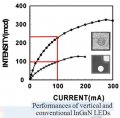
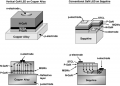
Forgive my ignorance but what is a vertical LED? interesting though, not much of improvement given the increase in current...
 

Danko

Joined Nov 22, 2017
2,176
"Current crowding is one of the major issue that impedes the development of the efficient GaN-based high power light emitting diode (LED). Generally, there are two types of LED configurations, namely lateral configuration and vertical configuration needed to be experimentally fabricated to study the effects of current crowding on LED electrical and optical performance. In order to minimize the cost and time required to examine the full effect of the current crowding problem inside the devices, an identical free standing active LED layers with same contact size, material and thickness for both configurations are simulated by using ISE TCAD."
http://ieeexplore.ieee.org/document/6487203/
vertical_LED.png
 
Last edited:

KJ6EAD

Joined Apr 30, 2011
1,581
I'll just offer a couple of unwanted wet blanket comments.

I don't think I've seen an LED that could pulse more than 4X it's continuous current rating without damage.

Beware of accelerated phosphor degradation (thermal delamination) in pulsed applications.
 

Thread Starter

seanstevens

Joined Sep 22, 2009
323
Noted and valid. 4x seems to about right. as for thermal, the duty cycle would be very low, 1Hz or 2Hz max, i think that wont be a major issue - last famous words!
 
The problem is that the LED light is not proportional to current a high levels. The light output saturates, and further current is just wasted as heat.
Are you sure about this? If so, how do you find the inflection point?
I'm trying to overdrive a 50 watt IR LED array by charging up a big cap and dumping it across the array with a low side MOSFET for 1mS every 48mS. I'm trying to maximize light output without frying (any more) arrays.
 

MisterBill2

Joined Jan 23, 2018
27,673
I have seen several cameras with LED flash included, so there are lots of them around. But they also, with no exceptions, have electronic cameras, not film cameras. the difference being that the xenon flash time is determined by the tube and the capacitor, while there is some timing circuit controlling the LED flash. So just about every aspect is different. Probably the manufacturers of the LEDs intended for flash duty have a recommended circuit that will provide the performance that they claim for their device, and I suggest that as a good starting point.
 

Thread Starter

seanstevens

Joined Sep 22, 2009
323
Are you sure about this? If so, how do you find the inflection point?
I'm trying to overdrive a 50 watt IR LED array by charging up a big cap and dumping it across the array with a low side MOSFET for 1mS every 48mS. I'm trying to maximize light output without frying (any more) arrays.
I did a little experimenting with some LEDs and super capacitors, essentially similar to what you want to do i.e. dumping large current in to LEDs. I started with a single CREE 1A LED and very very low internal resistance lowside MOSFET this property is obviously important) and large value capacitors like 4700uF and as the values went up, so did the current in to the LED. My drive/flash pulse was 20mS and the current waveform was roughly 20% 20mS and then it narrowed in to a spike going as high as 6A and the LED survived being mounted on a small 1x3cm aluminum PCB. to get the current waveform to be uniform over the pulse with I replaced my capacitor with a 5.5V 1F supercap, that gave me a nice clean square current waveform similar to the drive pulse and the light output was very good. I managed to get 10A out of the cap when it dumped its charge into 2 LEDs in parallel, matching their specs.
Supercaps are expensive though, mine was £10 each. I also tried 3 in series and a number of LEDs in series and the results were good.

I have seen several cameras with LED flash included, so there are lots of them around. But they also, with no exceptions, have electronic cameras, not film cameras. the difference being that the xenon flash time is determined by the tube and the capacitor, while there is some timing circuit controlling the LED flash. So just about every aspect is different. Probably the manufacturers of the LEDs intended for flash duty have a recommended circuit that will provide the performance that they claim for their device, and I suggest that as a good starting point.
As far as I know, the xenon flash intensity or Joules is determined by the voltage across the cap and its capacitance, not the timing. The timing is handled by the shutter. Phone cameras and some others use a specific chip to deal with the shutter/sync timing and the way the battery is backed up by a supercap to be able to dump a massive current in to the LED to produce a bright flash.
 

MisterBill2

Joined Jan 23, 2018
27,673
I did a little experimenting with some LEDs and super capacitors, essentially similar to what you want to do i.e. dumping large current in to LEDs. I started with a single CREE 1A LED and very very low internal resistance lowside MOSFET this property is obviously important) and large value capacitors like 4700uF and as the values went up, so did the current in to the LED. My drive/flash pulse was 20mS and the current waveform was roughly 20% 20mS and then it narrowed in to a spike going as high as 6A and the LED survived being mounted on a small 1x3cm aluminum PCB. to get the current waveform to be uniform over the pulse with I replaced my capacitor with a 5.5V 1F supercap, that gave me a nice clean square current waveform similar to the drive pulse and the light output was very good. I managed to get 10A out of the cap when it dumped its charge into 2 LEDs in parallel, matching their specs.
Supercaps are expensive though, mine was £10 each. I also tried 3 in series and a number of LEDs in series and the results were good.


As far as I know, the xenon flash intensity or Joules is determined by the voltage across the cap and its capacitance, not the timing. The timing is handled by the shutter. Phone cameras and some others use a specific chip to deal with the shutter/sync timing and the way the battery is backed up by a supercap to be able to dump a massive current in to the LED to produce a bright flash.

Certainly correct about the flash energy being set by voltage and capacitance. But the timing is an RC thing, with the R being the arc resistance plus the capacitor ESR. And with a film camera the flash was usually shorter than the lens open time. No clues on how they time it for electronic strobe flash use.
 
Top