Facebook
 Google
 GitHub
 Linkedin

panic mode
- Joined Oct 10, 2011
- 5,002
then you are not following the article...
look at the current equation:
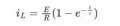
at initial time t=0, exponential part becomes e^0 which is 1.
then we obtain that initial current is iL(0)=(E/R)*(1-1)=(E/R)*0 = 0. and since current is zero, impedance at that point in time is infinite, not R
at some large t value exponential part becomes zero (negative exponent),
and iL(large enough)=(E/R)*(1-0)=(E/R)*1=E/R so at this time, impedance is really just R
tjhe same is also shown by graphs... at t-0, current is zero (infinite impedance).
voltage regulators have some overhead, 1-3V. this is called voltage drop. assuming generous 3V for voltage drop, it means 5V regulator input should never see less than 8V. if you get voltage drop from 12V to 8V under load for ANY amount of time - problem is the PSU. adding capacitor that would prevent brownouts that last for 50 seconds or so for loads that draw some 4A would be impractical and power up time would be ridiculous,
capacitors placed around regulators are used to ensure stability / prevent oscillations of the regulator.
MCUs tend to draw very little current, so this circuit is much easier to back by some capacitor.
look at the current equation:
at initial time t=0, exponential part becomes e^0 which is 1.
then we obtain that initial current is iL(0)=(E/R)*(1-1)=(E/R)*0 = 0. and since current is zero, impedance at that point in time is infinite, not R
at some large t value exponential part becomes zero (negative exponent),
and iL(large enough)=(E/R)*(1-0)=(E/R)*1=E/R so at this time, impedance is really just R
tjhe same is also shown by graphs... at t-0, current is zero (infinite impedance).
i think i read that solenoids draw some 0.6A or so. and there are several of them (5-6?). so we are likely talking about 12VDC source that needs to be capable of some 4A or so of current. also even if people are racing through those doors, i would say 5 seconds is the minimum time you may need to bridge, possibly 10x that.Yes it is correct my solenoids work at 12V, but I also have an MCU that works at 3.3VDC and my doubt is that the solenoids when the switching happens, the input capacitor may discharge and create issues for the MCU.
voltage regulators have some overhead, 1-3V. this is called voltage drop. assuming generous 3V for voltage drop, it means 5V regulator input should never see less than 8V. if you get voltage drop from 12V to 8V under load for ANY amount of time - problem is the PSU. adding capacitor that would prevent brownouts that last for 50 seconds or so for loads that draw some 4A would be impractical and power up time would be ridiculous,
capacitors placed around regulators are used to ensure stability / prevent oscillations of the regulator.
MCUs tend to draw very little current, so this circuit is much easier to back by some capacitor.