Driving a Logic Level FET with 2 Volts

Thread Starter

pyroartist

Joined Oct 9, 2015
131
I have an N-channel logic level FET, IRLZ44, that I need to turn on a DC motor. However the triggering signal is only about 2.3 Volts.
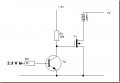
This is not enough to drive the gate directly so I need a circuit to do this. I found this transitor drive circuit (attached). However it
warns you that this will turn the FET off when voltage goes up and ON when voltage goes to zero. How can I invert this action so
that the FET turns on when input voltage goes to 2.3V? Use a PNP transistor? If so how would that circuit look?
The second question: Is it OK if the 12V used for the gate transistor is the same 12V source that will power the motor?
 

Attachments

AlbertHall

Joined Jun 4, 2014
12,626
You could use a P-channel MOSFET and swap the positions of the load and the MOSFET.
You could add an extra NPN transistor duplicating the circuit around T1 on the input so you have a double inversion - two negatives equal a positive.
 

Thread Starter

pyroartist

Joined Oct 9, 2015
131
You could use a P-channel MOSFET and swap the positions of the load and the MOSFET.
You could add an extra NPN transistor duplicating the circuit around T1 on the input so you have a double inversion - two negatives equal a positive.
I don't believe I have any P channel FETS. But I could do two NPN transistors. Does the collector of the first connect to the base of the 2nd?
 

AlbertHall

Joined Jun 4, 2014
12,626
BTW, the resistor on the gate of the MOSFET should not be connected to +12V - the maximum rating of the MOSFET is 10V. Connect that resistor to +5V instead.
 

crutschow

Joined Mar 14, 2008
38,526
If you want to run everything from +12V in GopherT's schematic, change the 1kΩ resistors to 2kΩ, change the 330Ω resistor to 500Ω, and add a 500Ω resistor in series with the collector of the PNP transistor.
 

dl324

Joined Mar 30, 2015
18,336
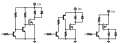
Two NPN inverters, NPN/PNP, NPN/P MOSFET:
upload_2017-3-16_19-31-47.png
EDIT: label 12V supply
EDIT 2: To avoid more superfluous comments pointing out excessive gate voltage, refer to updated schematics below.
 
Last edited:

Thread Starter

pyroartist

Joined Oct 9, 2015
131
Hey, thank you all for the suggested circuits. I will study them tomorrow. Late now. BTW, since the gate of a FET is really just a capacitor does it really matter if you have 10V or 12V on it? I suppose there is a capacitor breakdown voltage limit on the gate but 12V seems low..
 

GopherT

Joined Nov 23, 2012
8,009
Hey, thank you all for the suggested circuits. I will study them tomorrow. Late now. BTW, since the gate of a FET is really just a capacitor does it really matter if you have 10V or 12V on it? I suppose there is a capacitor breakdown voltage limit on the gate but 12V seems low..
Check the DATASHEET of the specific MOSFET you plan to use. There is an Absolute limit listed in most Datasheets.
Most MOSFETS are specified at 10v or 5v gate voltage and list a 15 to 20v absolut max. Some may be lower.

Edit : so you did say which MOSFET. DATASHEET fir irfz44 is a max of 10v.

Per your question, isn't the gate like a cap so does voltage matter? Well, voltage matters for caps so it matters for gates.
 
Last edited:

dl324

Joined Mar 30, 2015
18,336
BTW, since the gate of a FET is really just a capacitor does it really matter if you have 10V or 12V on it? I suppose there is a capacitor breakdown voltage limit on the gate but 12V seems low..
Absolute maximum gate-source voltage on the MOSFET you're using is 10V.

With the circuits I posted, you don't need a logic level MOSFET. If you don't have one, the gate drive will need to be changed to limit maximum gate voltage.
 

dl324

Joined Mar 30, 2015
18,336
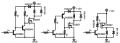
If you have a zener diode in the range of 2.7-5.6V, you can do this:
upload_2017-3-16_22-26-24.png

Resistor values aren't critical. The resistor on the gate will affect switching time.
 

dl324

Joined Mar 30, 2015
18,336
All three of these circuits put 12V across the gate-source of the MOSFET. Its absolute maximum rating is 10V so there is a serious risk of damaging the MOSFET.
That was before I read the datasheet. The circuits were updated in post #13; just before above your post; and hours before...:eek:
 
Last edited:

dl324

Joined Mar 30, 2015
18,336
I will build the circuit using 2 NPNs from dl324 and see if I have a zener somewhere.
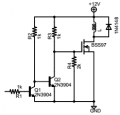
If you don't have an appropriate zener, you could use a voltage divider with a ratio of 1:2; that would give you a maximum Vgs of 8V.
upload_2017-3-21_11-7-42.png
EDIT: Add schematic for clarity.
EDIT 2: Corrected placement and values for R3 and R4.

Notes:
  1. Snubber diode needs to be able to handle the motor current.
  2. Resistor values are not critical.
  3. R1 needs to provide Ib1 >= 0.1 Ic1.
  4. R2 needs to provide Ib2 >= 0.1 Ic2.
 
Last edited:

Thread Starter

pyroartist

Joined Oct 9, 2015
131
I had already built the NPN circuit by dl324 before seeing the one above. I checked the Vgs breakdown for the IRLZ44 and it is not 10 Volts. It is +/-16 Volts so I eliminated the zener and the original schematic did not have an R4 in so that is not in either. Nevertheless...
The circuit works perfectly to drive my 12V motor from a 2.3V signal. Success!
Thanks to all for the suggestions and interesting discussions.
 
Top