Driverless Shuttle Crashes On First Day Of Operation

Thread Starter

MrAl

Joined Jun 17, 2014
13,756
Actually, 70% of all accidents occur within 10 miles of home.

For safety reasons, I never drive within 10 miles of my house. :D
Hi,

More distance *OR* more cars, not just one or the other.

Yeah that's funny. Have your car towed 11 miles away then drive it :)
 

Thread Starter

MrAl

Joined Jun 17, 2014
13,756
I wonder if an autonomous vehicle can detect the absence of a road surface.

In 1980, a freighter collided with a support column of the Sunshine Skyway Bridge over Tampa Bay, causing collapse of the southbound span. The weather was bad, and visibility was nearly non-existent. 8 vehicles, including a Greyhound bus drove off the bridge, killing 35 people.

One driver was lucky enough to figure something was wrong and stopped -- likely saving many more lives.

If all the vehicles were autonomous, would they just keep driving over the edge, one after another? Scary thought.
Hi,

The future is not ours to see, just yet anyway. I am betting we will see all kinds of nutty stuff before this is over.

Should we start the first citizens against driverless vehicles organization or wait for someone else to do it? :)
 

GopherT

Joined Nov 23, 2012
8,009
Hi,

Accidents are not related to time on the road. They are related to the number of cars and the distance traveled. More cars and/or more distance means more accidents, regardless if they are on the road for 1 minute or 1 hour.
Fatalities on the road are also related to the speed limit. The higher the speed limit, the higher the incidence of deaths caused by accidents.

I don't think so. Accidents are proportional to driver skill and attentiveness. I will soon put 100,000 miles on my 10th car and I've never had an accident. Many over-the-road truck drivers can say the same. On the other hand, there is a goofy teenager in our neighborhood who has had two major accidents on his way home from school in the middle of the afternoon.

It is true that greater speed limits lead to a greater percentage of deaths per accident. However, greater speed limits do not necessarily cause more accidents. Only Iowa reported more crashes in their interstate highways when raising the speed limit. California and New York even reported equal or lower accident rate.

Two recent cases helped refute the notion that relaxed speed limits lead to more accidents. After New York raised the cap on its highway traffic to 65 mph in 1995, the state’s total crash rate dropped by 4 percent. And in 2000, the Automobile Club of Southern California determined that higher speed limits in that state did not increase the rate of statewide accidents over a period of five years. A study of Iowa’s 1996 increase of the state speed limit from 55 to 65 mph concluded that this speed hike caused a jump in traffic accidents. In a lengthy literature review of traffic engineering studies, however, it stands alone in its conclusion that higher speed limits cause more crashes.
Watch the movie iRobot with Will Smith. You'll get the idea how the whole concept will work.

It may be interesting that insurance companies no longer lobby against higher speed limits because it saves them money. There are fewer long-term medical claims as speeds increase.
 

GopherT

Joined Nov 23, 2012
8,009
I wonder if an autonomous vehicle can detect the absence of a road surface.

In 1980, a freighter collided with a support column of the Sunshine Skyway Bridge over Tampa Bay, causing collapse of the southbound span. The weather was bad, and visibility was nearly non-existent. 8 vehicles, including a Greyhound bus drove off the bridge, killing 35 people.

One driver was lucky enough to figure something was wrong and stopped -- likely saving many more lives.

If all the vehicles were autonomous, would they just keep driving over the edge, one after another? Scary thought.

In the end, even autonomous cars are a stop-gap solution to the inevitable situation that humans will not need to leave their homes in the future. Amazon will deliver everything (by drone vehicles on ground or in the air) and office work will be done via telecommuting, manufacturing will be done by automation.
 

nsaspook

Joined Aug 27, 2009
16,428
I wonder if an autonomous vehicle can detect the absence of a road surface.

In 1980, a freighter collided with a support column of the Sunshine Skyway Bridge over Tampa Bay, causing collapse of the southbound span. The weather was bad, and visibility was nearly non-existent. 8 vehicles, including a Greyhound bus drove off the bridge, killing 35 people.

One driver was lucky enough to figure something was wrong and stopped -- likely saving many more lives.

If all the vehicles were autonomous, would they just keep driving over the edge, one after another? Scary thought.
Gap in the road, no worries.
 

Thread Starter

MrAl

Joined Jun 17, 2014
13,756
I don't think so. Accidents are proportional to driver skill and attentiveness. I will soon put 100,000 miles on my 10th car and I've never had an accident. Many over-the-road truck drivers can say the same. On the other hand, there is a goofy teenager in our neighborhood who has had two major accidents on his way home from school in the middle of the afternoon.

It is true that greater speed limits lead to a greater percentage of deaths per accident. However, greater speed limits do not necessarily cause more accidents. Only Iowa reported more crashes in their interstate highways when raising the speed limit. California and New York even reported equal or lower accident rate.

Two recent cases helped refute the notion that relaxed speed limits lead to more accidents. After New York raised the cap on its highway traffic to 65 mph in 1995, the state’s total crash rate dropped by 4 percent. And in 2000, the Automobile Club of Southern California determined that higher speed limits in that state did not increase the rate of statewide accidents over a period of five years. A study of Iowa’s 1996 increase of the state speed limit from 55 to 65 mph concluded that this speed hike caused a jump in traffic accidents. In a lengthy literature review of traffic engineering studies, however, it stands alone in its conclusion that higher speed limits cause more crashes.
Watch the movie iRobot with Will Smith. You'll get the idea how the whole concept will work.

It may be interesting that insurance companies no longer lobby against higher speed limits because it saves them money. There are fewer long-term medical claims as speeds increase.
Hi,

There are approximately 2000 more fatalities per year due to the increase from 55 to 65. This was the conclusion after a study done in 41 states. Read the Farmers study then make your decision, but there is no way in h*** that you will ever convince me that faster speed leads to lower injuries. Also, there are various aspects of this that have to be dealt with carefully. For example, if someone dies they dont have much of a medical cost.

When i say it is based on miles traveled and not time on the road, that means that if you travel 60 miles in one hour or 60 miles in 1/2 hour your risk is the same except for the fatality factor which goes up with speed.
The implication you bring up here is that you are somehow safer going 120 miles per hour than 60 miles per hour and that is just not true. In the above example you would be on the road for just 30 minutes vs 60 minutes but that does not cut your chance in half. Also keep in mind that as the speed doubles the energy quadruples making any accident 4 times as worse not just 2 times as worse.

If i give you a jar of 100000 peanuts and color just one of them with food coloring and you pick randomly, what is the chance that you will pick the one that is food colored. You can not look at just one case and make a judgement, you can never do that with statistics, you must look at a huge amount of data from possibly millions of cases, as had been done already in the past and the results are as i report here.
 

nsaspook

Joined Aug 27, 2009
16,428
Hi,

There are approximately 2000 more fatalities per year due to the increase from 55 to 65.
I didn't see much of an actual speed increase when the official limit was increased. Most people drove at the speed they deemed was safe, on most interstates that's at least 65 MPH.

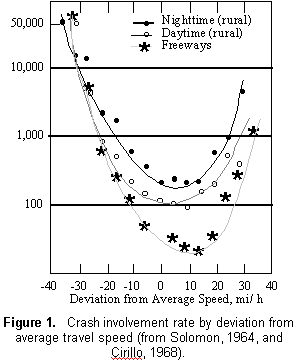
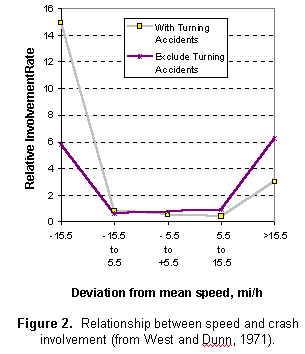
What's really dangerous is speed variation in traffic. Automated vehicle pacing for safe distances with traffic would be a good safety feature that we see already on some cars.


https://www.fhwa.dot.gov/publications/research/safety/98154/speed.cfm
 

Glenn Holland

Joined Dec 26, 2014
703
In the end, even autonomous cars are a stop-gap solution to the inevitable situation that humans will not need to leave their homes in the future. Amazon will deliver everything (by drone vehicles on ground or in the air) and office work will be done via telecommuting, manufacturing will be done by automation.
If self driving technology becomes a practical reality, most of the mundane jobs done by humans will be obsoleted.

Most people are not qualified to do any kind of technical work (anything in STEM) and there will be mass unemployment like we've never seen before..
 

GopherT

Joined Nov 23, 2012
8,009
If self driving technology becomes a practical reality, most of the mundane jobs done by humans will be obsoleted.

Most people are not qualified to do any kind of technical work (anything in STEM) and there will be mass unemployment like we've never seen before..
Yes, that is what I said above.
 

WBahn

Joined Mar 31, 2012
33,063
I also understand there is always going to be a need for manual cars\trucks\busses, but this is like the argument against electric cars.
Yes, there is always going to be cases that electric cars are no good, but for the other 98% of case it is a far better solution. Same for automation.
But look at the contradiction you've set up from mutually-exclusive claims: (1) "But you are right, the system fails now because there are still humans involved today..." and (2) "Yes, there is always going to be cases that electric cars are no good,"

As long as the second is the case, the first will also be the case and, hence, the system will always fail.
 

Glenn Holland

Joined Dec 26, 2014
703
The "Vitality Factor" of self driving cars (the time or miles traveled between hazardous failures) must be much longer than human operated vehicles.

If the vitality factor cannot met, self driving cars will still pose a serious safety risk and a legal liability to both their owner and the vehicle's manufacturer. The economics of eliminating the driver is the main advantage where the cost of labor is concerned. However, if vehicle safety is severely compromised, there will be absolutely no benefit to driverless technology.

Also, what happens if the self driving control malfunctions (and defaults to fail safe) and stops the car right in the middle of a freeway? If manual steering is completely eliminated, how can a disabled vehicle be cleared from the road?

At my transit agency in S.F., the trains are normally operated at a peak speed of 50 MPH without human intervention. However, there is still an operator in the lead car in case the ATC malfunctions and stops the train. Then the operator must switch from auto to manual control in which he/she relies on human perception to adjust the speed with respect to the track conditions (such as distance to the train ahead and the alignment of track switches).

The operating rules also require that a train running in manual in the subway cannot exceed 25 MPH on straight track and 10 MPH on curved sections with blind spots. At peak commute hours, there are about 10 trains running in the subway and statistically about 1 out of 100 of them will experience an ATC failure that stops the train and the operator must take over by manual control. A failure rate of just 1%, (with a reduction in maximum speed) can create a severe back up in service.

Although ATC must meet strict safety and reliability standards, the default to fail safe rate is still about 0.5% to 1% and if you multiply the number of cars on the streets and freeways by just the 0.5% failure rate, you can get a picture of what the nightmare would look like.
 
Last edited:

GopherT

Joined Nov 23, 2012
8,009
The "Vitality Factor" of self driving cars (the time or miles traveled between hazardous failures) must be much longer than human operated vehicles.

If the vitality factor cannot met, self driving cars will still pose a serious safety risk and a legal liability to both their owner and the vehicle's manufacturer. The economics of eliminating the driver is the main advantage where the cost of labor is concerned. However, if vehicle safety is severely compromised, there will be absolutely no benefit to driverless technology.

Also, what happens if the self driving control malfunctions (and defaults to fail safe) and stops the car right in the middle of a freeway? If manual steering is completely eliminated, how can a disabled vehicle be cleared from the road?

At my transit agency in S.F., the trains are normally operated without human intervention. However, there is still an operator in the lead car in case the ATC malfunctions and stops the train. Then the operator must switch from auto to manual control in which he/she relies on human perception to adjust the speed with respect to the track conditions (such as distance to the train ahead and the alignment of track switches).

The operating rules also require that a train running in manual in the subway cannot exceed 25 MPH on straight track and 10 MPH on curved sections with blind spots. At peak commute hours, there are about 10 trains running in the subway and statistically about 1 out of 100 of them will experience an ATC failure that stops the train and the operator must take manual control.

Although ATC must meet strict safety and reliability standards, the failure rate is still about 1% and if you multiply the number of cars on the streets and freeways by 1%, you can get a picture of what the nightmare would look like.

Uber has only been doing this a few years and they are already way below 1% failure rate. Why is your train system so high?
 

Glenn Holland

Joined Dec 26, 2014
703
Uber has only been doing this a few years and they are already way below 1% failure rate. Why is your train system so high?
The electronic equipment on electric trains is more susceptible to electro-magnetic interference (EMI) than diesel powered vehicles. The power for our trains is 615 VDC from an overhead trolley wire and a train running at full load can draw about 1000 amps. With that high current (and strong magnetic fields), the risk for EMI is much higher than a simple gas powered automobile.

Also, the rails are the negative return for the train power and propulsion current. Most ACT systems still use the rails for communication of control data and that creates the opportunity for EMI to corrupt the data stream. Some of the old fashioned ATC systems used a simple speed code using a 100 Hz. carrier that is modulated by solid state relay operating at 75, 120, 180, and 270 On/Off cycles per minute. That simple code is very difficult to corrupt and the reliability of the older ATC systems can be 0.001% or even better. However, the simple code is adequate for speed control only and not versatile enough for all the functions needed for mass transit such as train docking (stopping in the middle of the passenger boarding platform) and door control.

Computerized ATC systems use "telegrams" which may consist of at least 100 data bits which are more susceptible to corruption. The "refresh rate" for the telegrams is about 70 per second which is much greater than the "watch dog time cycle" that will cause the propulsion and braking system to react to an error and stop the train. One corrupted telegram will not cause a malfunction, however there are cases where the length of time in a consecutive string of corrupt telegrams will be enough to allow the watch dog to time out and initiate a shut down.
 
Last edited:

joeyd999

Joined Jun 6, 2011
6,434
https://economictimes.indiatimes.co...y/driverless-crashes/articleshow/56510821.cms

Interesting comments about the selected driverless vehicle mishaps.

Pedestrians pay for Volvo's ride
Last May, while trying to demonstrate Volvo's pedestrian detection and auto-braking feature, the car automatically accelerated towards a group of people knocking them off their feet. Volvo said that accident occurred because of the owner’s neglect to pay for the pedestrian detection functionality that costs extra money.
I want the Deathrace 2000 mod.
 

GopherT

Joined Nov 23, 2012
8,009
I want the Deathrace 2000 mod.
I wonder if the owner's Deathrace points were enough to pay for the repairs?

On the other hand, it is kind of an Extorsion from the manufacturer. "Auto drive for just $5k. Oh, what? You want to avoid pedestrians, too? That will be$2k more. What? Other cars, too? Another $2k. Beer trucks?.."
 

Thread Starter

MrAl

Joined Jun 17, 2014
13,756
I didn't see much of an actual speed increase when the official limit was increased. Most people drove at the speed they deemed was safe, on most interstates that's at least 65 MPH.

What's really dangerous is speed variation in traffic. Automated vehicle pacing for safe distances with traffic would be a good safety feature that we see already on some cars.


https://www.fhwa.dot.gov/publications/research/safety/98154/speed.cfm
Hi,

My experience has been varied. The other day i had to take the highway interstate 287 and going the traffic was moving at 60 to 65 in the slow lane with some doing about 70 in the fast lane, but coming back the slow lane was going 50 to 55, and i think that was because there was a supply truck in the slow lane going slower than usual. I enjoyed the ride home because of that.

I hear other reports from people though of speeds up to 85 on same road. We also know that when the posted speed limit is one thing, people automatically assume that they can get away with an extra 5 to 10 miles per hour speed.
Back when i was going to PA for a visit, cars were going at least 80 on i78 west and it was nuts. I cant see going that fast for any reason. Maybe because i went to driving school years ago and saw first hand what can go wrong vs how much time is actually saved. It amazes me what people will risk to get there 5 minutes sooner. I believe that is because they dont realize the risk is so high. Sure not everyone gets into an accident and dies, but the ones who did are not with us anymore and there is no way to reverse that.
 

nsaspook

Joined Aug 27, 2009
16,428
Hi,
My experience has been varied.
The police give also tickets for going too slow on interstates for a reason, it's unsafe due to speed variation and normal driver behavior with a road hog.

When you have official road speeds that are close to the actual engineered speeds (a speed in which most drivers personally feel both comfortable and safe) of roads the differentials between drivers reduce if good lane discipline is enforced. It's simple calculus that differentials (rates of change) imply speed and movement changes instead of smooth safe driving.
 
Last edited:
Top