Drive a LED with a PWM through a mosfet

Thread Starter

Bigcher08

Joined Jul 2, 2024
2
Hey guys,
I'm trying to simulate what I thought would be an obvious circuit. I want to drive a LED with a PWM. However I want to go across a mosfet before.
My PWM goes to my gate and my LED is connected in series with a resistor to limit the current. However my signal Vout which is the output of that circuit actually never goes back to 0V in the case the mosfet is conducting. I thought it might be the forward voltage of the diode but I get the same result even if I remove it and only keep the resistor.
Would someone have an idea of what I'm missing here?
Thanks a lot!
 

Attachments

LowQCab

Joined Nov 6, 2012
5,101
The FET is basically an open Switch when it is turned-Off.

Your model is acting as it should.

You should read approx. 3.3V minus 0.7V equals ~2.6-Volts, at your supposed "Output",
or ~Zero-Volts when the FET is On.

Why do You have an "Output" connection added on to this Circuit ?

You should be measuring Current through the Diode, not Voltage at the Drain terminal of the FET.
.
.
.
 

Thread Starter

Bigcher08

Joined Jul 2, 2024
2
The FET is basically an open Switch when it is turned-Off.

Your model is acting as it should.

You should read approx. 3.3V minus 0.7V equals ~2.6-Volts, at your supposed "Output",
or ~Zero-Volts when the FET is On.

Why do You have an "Output" connection added on to this Circuit ?

You should be measuring Current through the Diode, not Voltage at the Drain terminal of the FET.
.
.
.
Hi,
thanks a lot for your answer. That's actually the problem when the fet is ON I am reading somewhere around 0.7V instead of 0V as shown in the image. That's the part that got me confused.
Thank you !
 

LowQCab

Joined Nov 6, 2012
5,101
Calculate the amount of Current that should be flowing when the FET has 3.3V on it's Gate-Pin.

To do this, start with the Forward-Voltage across the Diode, which can be loosely assumed to be 0.7-Volts.
Subtract 0.7-Volts from the Supply-Voltage of 3.3-Volts, which equals ~2.6-Volts.
Now to calculate the Current, take 2.6-Volts and divide it by 20-Ohms,
2.6 / 20 = 130 milliAmps, or, 0.130-Amps.

Next, Calculate the Rds/On of the FET when 3.3-Volts is applied to it's Gate.
Also look for a Graph showing the Voltage-Drop across the FET when ~130mA is flowing through it.
Do this by looking-up, and studying, the appropriate Graphs in the Specification-Sheet.

Now that You have estimated how much Current "should be" flowing,
You can calculate how much heat will be dissipated by the Diode.
Look-Up the Forward-Voltage of the Diode when it is subjected to 130mA of Current.
It probably won't be the 0.7-Volts that was estimated earlier,
0.7V X 0.13A = 0.091-Watts, or 91 milliWatts.

You can also estimate the amount of Heat that will be dissipated by the Resistor, and by the FET,
because You now have an estimate of the Current flowing throughout the Circuit.
And the Current will always be exactly the same in every Component of the Circuit.


If the "Diode" in this Circuit was replaced by an ordinary ~10mA-LED,
the LED would probably just make one bright "Flash", and then be instantly smoked.

An LED will generally "act-like" a standard Silicon-Diode,
except for the fact that an LED will almost always have a higher Forward-Voltage-Rating than a Diode.
.
.
.
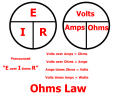
Ohms Law FLAT .png.
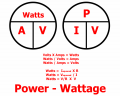
Power-Watage Formulas FLAT  .png.
Ohms-Law-Pie-Chart .png.
 

AHMADee00

Joined Dec 13, 2023
7
Hey guys,
I'm trying to simulate what I thought would be an obvious circuit. I want to drive a LED with a PWM. However I want to go across a mosfet before.
My PWM goes to my gate and my LED is connected in series with a resistor to limit the current. However my signal Vout which is the output of that circuit actually never goes back to 0V in the case the mosfet is conducting. I thought it might be the forward voltage of the diode but I get the same result even if I remove it and only keep the resistor.
Would someone have an idea of what I'm missing here?
Thanks a lot!
The voltage across the mosfet is never goes to zero. In triode mode when Vgs>Vds+Vt the voltage across the mosfet become between 0.2 - 1 depend on mosfet type. same happen also with bjt in saturation region.
 
Top