Drill battery low voltage cutoff

Thread Starter

bigdodge

Joined Jan 25, 2011
19
Here’s what I’m needing to do.
I wanna make a simple usb adapter that goes on my Milwaukee batteries. Has an on off switch and 2 USB’s.
That part is simple enough. I already have a printed housing made.

The hard part I’m having trouble with is a small low voltage cutoff. I’ve seen a few different ones on Amazon. But they are all way too big. There made big with a relay to handle a higher amp load.

Currently the light in the switch and the 2 USB’s consume about 1 amp. So if a circuit was designed to handle 2-5 amps that would be perfect.

Most drill batteries do not have a built in low voltage cutoff. They let the tool handle that.
I had found a YouTube video and an article in here of using a simple 5s bms. Using 3.3 ohm resistors attached like the picture. I even tried 10 ohm resistors like I seen in the post in here. But when I hook the wires to the battery the resistors start smoking.

I’m needing someone that is smarter than me to help me figure this out.
Thanks in advance.
 

Attachments

crutschow

Joined Mar 14, 2008
38,430
So what is this bms circuit you are showing?
Need more detail than just a picture to "figure this out".
 
Last edited:

Thread Starter

bigdodge

Joined Jan 25, 2011
19
So what is this bms circuit you are showing?
Need more detail than just a picture to "figure this out".
The bms is just a simple bms from Amazon. Typically you would hook up your cell monitoring wire where the resistors are. When using a tool battery there is no access to the individual cell taps.
This will not be for charging. Only purpose I’m trying to use the mbs for is to stop the battery pack from draining to low.

I don’t have to use this bms. I’m looking for a small compact way to have a low voltage cutoff for a circuit with 2-5 amps.
 

crutschow

Joined Mar 14, 2008
38,430
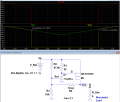
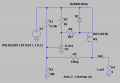
Below is the LTspice sim of a cutoff circuit using the low-cost TL431 programmable reference as a comparator:
It stops conducting, turning the MOSFET off, when the Ref voltage, determined by the voltage divider R2/R3, drops below 2.5V (Vb=16.1V here).

R4 provides a positive feedback hysteresis of about 0.9V to prevent the switch oscillating near the cutoff voltage.

M1 can be just about any P-MOSFET with a 30V or greater voltage rating, and an on-resistance low enough so the I²R power is no greater that about 1/2W at the maximum load current (20mΩ for 5A).

1750618866198.png
 
Last edited:

Thread Starter

bigdodge

Joined Jan 25, 2011
19
Below is the LTspice sim of a cutoff circuit using the low-cost TL431 programmable reference as a comparator:
It stops conducting, turning the MOSFET off, when the Ref voltage, determined by the voltage divider R2/R3, drops below 2.5V (Vb=16.1V here).

R4 provides a positive feedback hysteresis of about 0.9V to prevent the switch oscillating near the cutoff voltage.

M1 can be just about any P-MOSFET with a 30V or greater voltage rating, and an on-resistance low enough so the I²R power is no greater that about 1/2W at the maximum load current (20mΩ for 5A).

View attachment 351601
 

crutschow

Joined Mar 14, 2008
38,430
I’ll have to google how to program the tl431.
The word "programmable", which often refers to programming a computer type device, perhaps implies a more complex procedure than is required here.
The only "programming" for the TL431 is calculating the value for R2 and R3.
The value of those voltage divider resistors determine the output cutoff voltage, which occurs when the divider voltage is 2.5V.

Perhaps "adjustable" would be a better word to describe the TL431.
 
Last edited:

Thread Starter

bigdodge

Joined Jan 25, 2011
19
The word "programmable", which often refers to programming a computer type device, perhaps implies a more complex procedure than is required here.
The only "programming" for the TL431 is calculating the value for R2 and R3.
The value of those voltage divider resistors determine the output cutoff voltage, which occurs when the divider voltage is 2.5V.

Perhaps "adjustable" would be a better word to describe the TL431.
That is kinda what I was understanding. From what little googling I have had a chance to do.
 
I replied to your comment on my thread but didn't see a reply back from you. If you do the resistors like in your picture, but use something like 10k ohm or higher, then they should be OK. I have used a similar set up with 5x 10k ohm resistors, and it has worked extremely well. Somewhere around my house I have actually a battery adapter, going to a 5S BMS, then to switches to control some USB ports for charging on the go, kind of like what you're talking about here.

You could do the TL431 option suggested above, but I'm gonna be honest, that is probably way too advanced for your experience level. I've looked at TL431 for myself, and I understand how they work, but it's a bit more complex than I want to deal with. You'll probably be safer with a solution like the BMS circuit you have, but with 10k or higher value resistors.
 
Its data sheet will tell you everything you need to know.
I really don't want to be rude to anyone, but if he doesn't know why 5x 3.3ohm resistors would start smoking when connected to 20V, I don't think he'll understand this data sheet. I don't understand most of it, and granted I am not an engineer or anything, but I've been an electronics hobbyist for over 20 years, and I've taken computer engineering classes in college, and I'm an electrician professionally.
 

MisterBill2

Joined Jan 23, 2018
27,371
What I see from the start of this thread is that the TS has decided on a solution without even teling us what the actual purpose is, or what it is actually desired to do. We are instead challenged with coming up with a scheme to protect a battery pack but never told what is going on. At least that is what I see.
A simple USB adapter that goes on the 20 volt Milwaukee battery pack?? Is that intended to be a USB power pack??Or what???
 
Yeah there definitely could be more information, but to me there seems to be plenty. Maybe it's because I already have gone through this exact issue myself and created a device extremely similar, so I have that context, but there does seem to be enough information to me. But OP hasn't commented back in a few weeks. I guess we'll see. Or maybe not.
 

crutschow

Joined Mar 14, 2008
38,430
I don't think he'll understand this data sheet. I don't understand most of it
Also not to be rude, but understanding a device's data sheet is fundamental to using the device in a design.
Learning how to read a data sheet is basic to designing an electronic circuit.
I know many attempt a design without understanding a data sheet, but the results are often not pretty.
 
Last edited:

panic mode

Joined Oct 10, 2011
4,949
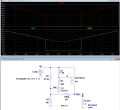
the battery pack reaches 21V when fully charged. while charging it may be even higher. that exceeds maximum allowed Vgs of most mosfets including this one. i would suggest limiting that to something more reasonable, like 6.8-8.2V.
1752442587106.png
 

panic mode

Joined Oct 10, 2011
4,949
well... i was bitten by same thing not that long ago. circuit was only 12V and the 20V limit was stuck is in the back of my brain so when i decided to use different part, I did not think to double check the documentation. then found the hard way that my new mosfets only tolerated +/-10V and first two boards that were already powered, had that mosfet fail. i was scratching solder mask and adding the smd resistor and zener to already assembled PCBs. fortunately it was only a prototype so only 5 boards were affected.
 
Top