Doubt about transistor

Thread Starter

rfpd

Joined Jul 6, 2016
101
I'm confunsing a concept here, imagine a voltage gain or a current gain montage and a gate. Using the gate montage, everytime the transistor (NPN) is on, there is current flowing diretly to ground, from collector to emitter, therefore, being emitter connected to ground, so is the collector. In a current gain montage, it amplifies the current, but at the emitter, there's just base-0.7V. Even at the voltage gain montage, there's not the same voltage in emitter and collector. It would only make sense to have a voltage relation in saturation mode, since it activates the base-collector diode. My question is just that, why is there a relation in voltage in a gate montage, but not in the rest?
 

GopherT

Joined Nov 23, 2012
8,009
I'm confunsing a concept here, imagine a voltage gain or a current gain montage and a gate. Using the gate montage, everytime the transistor (NPN) is on, there is current flowing diretly to ground, from collector to emitter, therefore, being emitter connected to ground, so is the collector. In a current gain montage, it amplifies the current, but at the emitter, there's just base-0.7V. Even at the voltage gain montage, there's not the same voltage in emitter and collector. It would only make sense to have a voltage relation in saturation mode, since it activates the base-collector diode. My question is just that, why is there a relation in voltage in a gate montage, but not in the rest?

Maybe a picture would be better to describe your question. In the mean time, I understand your question to be, why isn’t V(ce) equal or greater than V(be)? Is that correct?
 

Thread Starter

rfpd

Joined Jul 6, 2016
101
Maybe a picture would be better to describe your question. In the mean time, I understand your question to be, why isn’t V(ce) equal or greater than V(be)? Is that correct?


I meant switch not gate.


So, in this scenario there's a transistor switch and a transistor current amplifer. In the first case, when it's off, collector takes the same voltage as emitter. In the second case, the voltage in the emitter is different from the collector, I mean following the switch example, shouldn't we have vcc at the emitter (it makes sense not to be, since it's base -0.7V)?

I do get why Vce is differente from Vbe, since there's not really a linear voltage difference, only a current one. Only in saturation mode there's a linear difference between them, since it activates the diode. I just don't understand why the switch scenario is an exception (or looks like one).
 

MrChips

Joined Oct 2, 2009
34,807
I still don't understand your question.

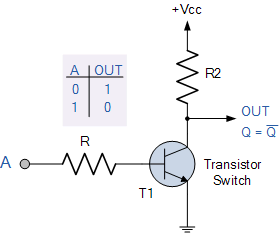
In the upper circuit, the NPN transistor is shown in a common emitter configuration.
When the transistor is off, no current flows from collector to emitter. Collector voltage is Vcc. Emitter voltage is GND.
When the transistor is on, in saturation mode, the transistor conducts and collector voltage is near GND. Emitter voltage is GND.

The second diagram is a common collector configuration.
When the transistor is off, collector voltage is Vcc. Emitter voltage is GND.
When the transistor is on, collector voltage is Vcc. Emitter voltage is Vin - 0.7V.
 

Thread Starter

rfpd

Joined Jul 6, 2016
101
I still don't understand your question.

In the upper circuit, the NPN transistor is shown in a common emitter configuration.
When the transistor is off, no current flows from collector to emitter. Collector voltage is Vcc. Emitter voltage is GND.
When the transistor is on, in saturation mode, the transistor conducts and collector voltage is near GND. Emitter voltage is GND.

The second diagram is a common collector configuration.
When the transistor is off, collector voltage is Vcc. Emitter voltage is GND.
When the transistor is on, collector voltage is Vcc. Emitter voltage is Vin - 0.7V.
Like you said, in common collector configuration emitter voltage is Vin - 0.7, and collector voltage is Vcc. Therefore they have different voltages, but in the common emitter configuration, emitter and collector have the same voltage. Both on. Why, in one case, it's 'dropping down' to ground, and in the other, they have completly differente voltages.

To be in saturation mode don't we need a difference of 0.7V between base and collector?
 

GopherT

Joined Nov 23, 2012
8,009
when it's off, collector takes the same voltage as emitter.
No, when it is off (base voltage at zero), no current flows through R2 so both ends of R2 are at Vcc.
If current flows into the base, then current starts to flow through the transistor. The voltage difference across R2 follows ohms law (current x resistance). The voltage across Vce is Vcc minus the voltage drop across R2.

Note: Check the datasheet of your transistor but, at max allowable current into the base, Vce can be very low (0.1v).

In the second case, the voltage in the emitter is different from the collector, I mean following the switch example, shouldn't we have vcc at the emitter
Yes, As current into the base increases, the voltage of the emitter gets close to the collector voltage.
 

Thread Starter

rfpd

Joined Jul 6, 2016
101
No, when it is off (base voltage at zero), no current flows through R2 so both ends of R2 are at Vcc.
If current flows into the base, then current starts to flow through the transistor. The voltage difference across R2 follows ohms law (current x resistance). The voltage across Vce is Vcc minus the voltage drop across R2.

Note: Check the datasheet of your transistor but, at max allowable current into the base, Vce can be very low (0.1v).


Yes, As current into the base increases, the voltage of the emitter gets close to the collector voltage.
I meant when it's on, my mistake.

So, in the first case there's a lot of current in the collector, since there's no current in the emitter (Ie = Ib + Ic), therefore there's a huge drop in tension, is that it?. So, it has no relation whatsoever to emitter voltage, only that there is no current there.

(About the second example)

Gets close, but only in saturation mode, right? Since in active mode it's a invertion of the base voltage, and emitter's voltage is base's - 0.7.
 

GopherT

Joined Nov 23, 2012
8,009
I meant when it's on, my mistake.

So, in the first case there's a lot of current in the collector, since there's no current in the emitter (Ie = Ib + Ic), therefore there's a huge drop in tension, is that it?. So, it has no relation whatsoever to emitter voltage, only that there is no current there.

No, you need to think of voltage like water pressure and current like water (it flows). You cannot have lots of current flowing at the colllector without lots of current flowing through the emitter.


This Class A amplifier amplifier voltage (and current if properly designed).

(About the second example)

Gets close, but only in saturation mode, right? Since in active mode it's a invertion of the base voltage, and emitter's voltage is base's - 0.7.
No, in the second case, the output line is at the emitter so the output follows the same voltage as the input (does not invert).

This configuration CANNOT be used as a switch because the output voltage (at the emitter) will always be 0.6 v less than the input at the base. This amplifier can amplify current to drive a bigger load without problems (voltage sagging) but it cannot amplify voltage.
 
Last edited:

GopherT

Joined Nov 23, 2012
8,009
The first example can be used as a switch or a class A amplifier.

To use it as a switch, you just need enough current to flow through R2 to make (current x R2) > Vcc. This insures the output is “ clipping” (voltage drop across R2 is limited by the supply voltage).

To make it a switch, you dump larger currrnt into the base vs less current to keep The output in the linear region (that is, not clipping).
 

dl324

Joined Mar 30, 2015
18,326
Like you said, in common collector configuration emitter voltage is Vin - 0.7, and collector voltage is Vcc. Therefore they have different voltages, but in the common emitter configuration, emitter and collector have the same voltage. Both on. Why, in one case, it's 'dropping down' to ground, and in the other, they have completly differente voltages.
In saturation mode, the collector and emitter aren't likely to have the same voltage. It can be close, but rarely the same.
To be in saturation mode don't we need a difference of 0.7V between base and collector?
You don't give voltage polarity, but by saying between base and collector, that implies reverse biasing of the CB junction. That isn't saturation mode. It is describing saturation mode...

The CB junction is forward biased in saturation. The forward biasing of that junction is what makes the collector voltage approach the emitter voltage.
 
Last edited:

dl324

Joined Mar 30, 2015
18,326
I'm confunsing a concept here, imagine a voltage gain or a current gain montage and a gate.
You confused me too. I had to look up montage to see what it meant in this context.

It meant nothing because it was incorrect usage of the word...
 

Thread Starter

rfpd

Joined Jul 6, 2016
101
No, you need to think of voltage like water pressure and current like water (it flows). You cannot have lots of current flowing at the colllector without lots of current flowing through the emitter.


This Class A amplifier amplifier voltage (and current if properly designed).


No, in the second case, the output line is at the emitter so the output follows the same voltage as the input (does not invert).

This configuration CANNOT be used as a switch because the output voltage (at the emitter) will always be 0.6 v less than the input at the base. This amplifier can amplify current to drive a bigger load without problems (voltage sagging) but it cannot amplify voltage.
Yeah sorry, I forgot what the second circuit was, I though it was the voltage amplifier, the one that gets the output at the collector. By confusing myself, I'm confusing my question. I understood what you said, but let me reformulate.

So, first case we have a switch and in the second case a current amplifier. In the second case, when it's on, collector has always Vcc, and emitter has always base - 0.7 (or 0.6 V). So we have two differente voltages in the emitter and collector. Which makes sense.

In the first case, when it's off, it's an open circuit, no current, therefore collector has Vcc. When it's on,there's current flowing from the collector to emitter. So, having 0 V (ground) on the emitter, I would have 0V aswell in the collector, having the same voltage in both points (unlike the other scenario). Why is that happening? Is the collector following emitter's voltage or is it just a 'coincidence', and in fact just a product of ohm's law, having a high current, resulting in a high tension drop.
 
Last edited:

Thread Starter

rfpd

Joined Jul 6, 2016
101
You don't give voltage polarity, but by saying between base and collector, that implies reverse biasing of the CB junction. That isn't saturation mode.

The CB junction is forward biased in saturation. The forward biasing of that junction is what makes the collector voltage approach the emitter voltage.
Base having more 0.7 V than collector, didn't mean it in any particular order (npn of corse).

Montage in my language makes sense,sorry about that, I meant it like an assembly.
 
Last edited:

Thread Starter

rfpd

Joined Jul 6, 2016
101
The first example can be used as a switch or a class A amplifier.

To use it as a switch, you just need enough current to flow through R2 to make (current x R2) > Vcc. This insures the output is “ clipping” (voltage drop across R2 is limited by the supply voltage).

To make it a switch, you dump larger currrnt into the base vs less current to keep The output in the linear region (that is, not clipping).
I've been rereading, and I think I understand now. It's not related to the emitter's voltage (not directly I mean), but we do need to verify we have a resistor high enough, or high enough current, so that we can drop all that voltage.
 

dl324

Joined Mar 30, 2015
18,326
Base having more 0.7 V than collector, didn't mean it in any particular order (npn of corse).
In electronics, order matters.

For an NPN transistor, if I say the CB voltage is 0.7V, that implies that the collector voltage is 0.7V higher than the base voltage; the voltage from the collector to the base is 0.7V. If I say the BC voltage is -0.7V, it means the same condition as the first statement.

We also typically refer to the "diodes" in transistors as PN junctions, or just junctions.
 

GopherT

Joined Nov 23, 2012
8,009
I've been rereading, and I think I understand now. It's not related to the emitter's voltage (not directly I mean), but we do need to verify we have a resistor high enough, or high enough current, so that we can drop all that voltage.

It sounds like you are getting the idea. Now, get a few transistors and a handful of resistors and start experimenting.
 

Thread Starter

rfpd

Joined Jul 6, 2016
101
In electronics, order matters.

For an NPN transistor, if I say the CB voltage is 0.7V, that implies that the collector voltage is 0.7V higher than the base voltage; the voltage from the collector to the base is 0.7V. If I say the BC voltage is -0.7V, it means the same condition as the first statement.

We also typically refer to the "diodes" in transistors as PN junctions, or just junctions.
I said 0.7V between base and collector (base having more 0.7 V than collector), which is right. It's like saying BC voltage is 0.7V, reverse voltage would be CB like you said, and that only happens in a pnp.

Duly noted about the PN junctions!
 
Top