Oh, well then i know what you watch on TV (ha ha).
Yes it is the God of South Park, a really funny version too
I modified it to avoid any issues with copyrights, but then again i am sure the Fair Use Act would cover it anyway and the South Park team gets a little free advertisement out of it.
South Park and The Simpsons are about all I watch on TV. So I'll congratulate you on having excellent taste which is, as always, defined as any taste that at least partially coincides with my own.
Fair use would cover it. Aside from which Matt and Trey have never been known to sue people over intellectual property stuff. Likely even less inclined now that they have, in their words "FU money" following the Viacom deal. Plus, unless you made money off it or somehow lowered the value of their brand, something that seems categorically impossible given what they do with their brand, they'd have no actual damages and the most they could do is hit you with a cease and desist. They wouldn't of course, but most people forget the damages part of copyright litigation.
Thanks again for all I'm learning in this ongoing disagreement.
South Park and The Simpsons are about all I watch on TV. So I'll congratulate you on having excellent taste which is, as always, defined as any taste that at least partially coincides with my own.
Fair use would cover it. Aside from which Matt and Trey have never been known to sue people over intellectual property stuff. Likely even less inclined now that they have, in their words "FU money" following the Viacom deal. Plus, unless you made money off it or somehow lowered the value of their brand, something that seems categorically impossible given what they do with their brand, they'd have no actual damages and the most they could do is hit you with a cease and desist. They wouldn't of course, but most people forget the damages part of copyright litigation.
Thanks again for all I'm learning in this ongoing disagreement.
Oh I am happy you enjoy these discussions.
Yes, South Park has come a long way and has been so successful it's amazing. I even wrote part of my own episode ha ha.
The thing i don't understand though is how sometimes the TV stations list this as for "children". I have trouble thinking that small children would be watching this show with the more or less adult themes. I do know that children are very misunderstood in this country. Everyone seems to think that they are "little angels". Watch this show you'll see the other side of the story.
Well, I think we should get back on topic and open another thread about South Park if you think it would be interesting to discuss.
Stability is an issue that comes up a lot in a lot of fields especially control theory. There have been many ways developed in the past to handle this. My favorite I think is the Root Locus method. It can usually show in detail how a system can become unstable under the variation of some variable in the system. It's not that hard to understand if you know how to find complex roots of complex number equations, although there are procedures where you don't even have to know that.
I'll be glad to open a thread on South Park after I've been here for a while. Right now I'm too green to be comfortable doing that. But yeah, where I grew up I could see it being for kids,. But it really isn't for normal kids growing up in a healthy environment. Just because something is animated doesn't make it child appropriate.
Thanks for telling me about another new idea I didn't know existed. Watched a video on the Root Locus method. Didn't understand it. I think I get the math and what the math is supposed to broadly do, but I don't understand what the variable are. At first I thought they were trying to reduce signal interference because they were talking about dampening, which I associate with fixing signal interference. And then I thought they were talking about stability across different temperatures. And then they said something about springs, which made me wonder if this was actually for physical vibration damping because I've used springs in suspension to cancel out physical oscillations but I've never understood how to tune the spring size and shape to the frequency I wanted to cancel. When I was younger I'd be frustrated by having no clue. Now I'm glad I have more to learn. So long as I'm at least a little ignorant I'm never bored. Thanks for taking the time to talk to me about this stuff.
I'll be glad to open a thread on South Park after I've been here for a while. Right now I'm too green to be comfortable doing that. But yeah, where I grew up I could see it being for kids,. But it really isn't for normal kids growing up in a healthy environment. Just because something is animated doesn't make it child appropriate.
Thanks for telling me about another new idea I didn't know existed. Watched a video on the Root Locus method. Didn't understand it. I think I get the math and what the math is supposed to broadly do, but I don't understand what the variable are. At first I thought they were trying to reduce signal interference because they were talking about dampening, which I associate with fixing signal interference. And then I thought they were talking about stability across different temperatures. And then they said something about springs, which made me wonder if this was actually for physical vibration damping because I've used springs in suspension to cancel out physical oscillations but I've never understood how to tune the spring size and shape to the frequency I wanted to cancel. When I was younger I'd be frustrated by having no clue. Now I'm glad I have more to learn. So long as I'm at least a little ignorant I'm never bored. Thanks for taking the time to talk to me about this stuff.
You are welcome and i am happy to see people interested in this things.
The Root Locus Procedure is a little different than the basic theory behind it. The basic theory is the key to really understanding what it is all about, and that is quite simple as long as you have at least some idea how complex roots come about.
It all starts with the transfer equation. The transfer equation, most generally, is a complex expression that shows how the output of a system varies with the input. All you do is find the roots of this equation and that tells you a lot about the time response, and that tells you if it oscillates or not. The main cause of oscillation is when the real part of the response goes positive, because that means the root moves into the right half plane of the complex plane. That means that the exponential part of the response has a positive exponent, and that means in the time domain the response increases indefinitely. This happens when we vary a given variable, the one we choose to vary so we can find out if the response oscillates if that variable changes to certain values.
This is key to the analysis of a system that may oscillate given certain internal changes.
To see this graphically, check out the "complex plane" also called the "Argand plane".
If you look at the 'jw' axis, when the response root moves across this axis from left to right that means that the response becomes oscillatory. To create an oscillator, the response root will lie directly on the 'jw' axis. If it moves any farther to the right however, the response not only oscillates the amplitude increases indefinitely and that usually means the output gets pinned to one of the power supply rails, which of course is not good.
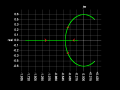
Here is an example of a Root Locus plot of a certain second order system.
The arrows indicate how the response changes as the variable of interest is *decreased*.
It is easy to see that the response crosses the 'jw' axis at some point and that means that the variable can not be allowed to get to that value and often should not come to close to that value either.

 Facebook
 Google
 GitHub
 Linkedin